Peer Reviewer Process
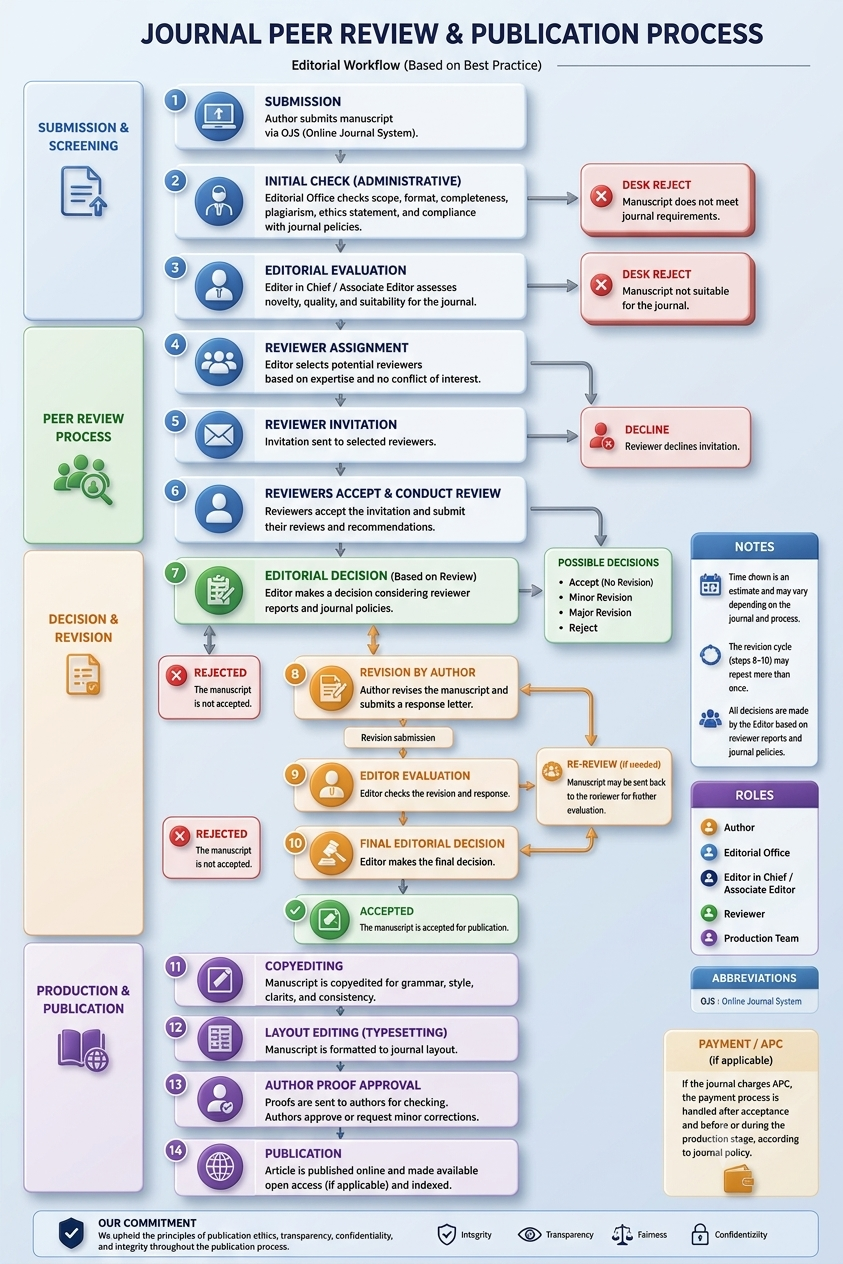
1. Authors must follow the Submission Preparation Checklist and use the Article Template provided by Jurnal Ilmu dan Teknologi Kelautan Tropis (JITKT) when submitting a manuscript. Authors are also required to submit the Declaration of Originality together with the manuscript.
2. All submitted manuscripts will undergo an initial administrative screening and plagiarism check using Turnitin software. Submissions with a similarity index exceeding 20% will be processed in accordance with the journal’s Plagiarism Policy.
3. After submission, the Editor in Chief will assign the manuscript to the appropriate Section Editor (Associate Editor) for editorial handling.
4. Following administrative screening, the Editor-in-Chief and Section Editor will conduct an initial editorial evaluation (prequalification review) to assess the manuscript’s suitability in terms of scope, scientific quality, originality, completeness of data, methodology, and compliance with the journal’s author guidelines.
5. Manuscripts that fall outside the scope of JITKT, do not meet the journal’s quality standards, contain insufficient scientific contribution, or fail to comply with submission requirements may be rejected at the editorial stage without external peer review (desk rejection).
6. Manuscripts that pass the editorial evaluation will proceed to the peer review stage. The Section Editor will assign at least two independent reviewers with relevant expertise. If reviewer recommendations substantially differ, additional reviewers may be invited. All manuscripts are evaluated through a double-blind peer review process to maintain reviewer and author anonymity and ensure an objective assessment.
7. Reviewers are generally given up to eight weeks to complete the review process. For revised manuscripts requiring further evaluation, reviewers are requested to provide their recommendations within one week. Extensions may be granted upon request.
8. Based on reviewer reports and editorial consideration, the manuscript may receive one of the following decisions: Accept, Minor Revision, Major Revision, Re-review, or Reject. Revised manuscripts may undergo additional review cycles where necessary.
9. The final editorial decision is made by the Section Editor and Editor in Chief based on reviewer recommendations, editorial evaluation, and journal policies.
10. Accepted manuscripts will proceed to the production stage, including copyediting, layout editing (typesetting), author proof approval, and final publication. If applicable, information regarding Article Processing Charges (APC) will be communicated through the Open Journal System (OJS) after acceptance and prior to publication.
11. The entire submission, review, revision, and publication process is managed through the Open Journal System (OJS) to ensure transparency, traceability, and efficient communication among authors, reviewers, and editors.