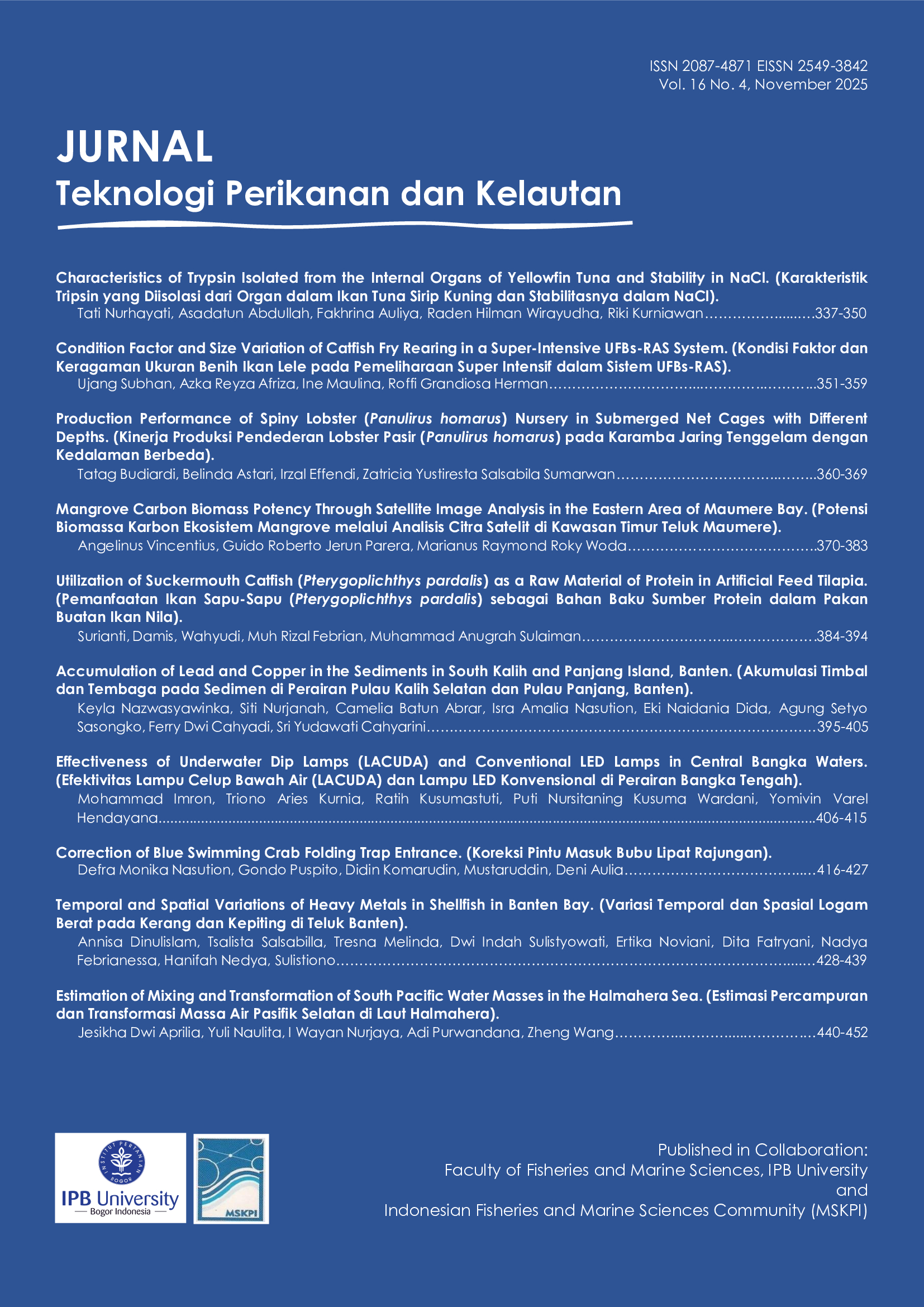
MANGROVE CARBON BIOMASS POTENCY THROUGH SATELLITE IMAGE ANALYSIS IN THE EASTERN AREA OF MAUMERE BAY
POTENSI BIOMASSA KARBON EKOSISTEM MANGROVE MELALUI ANALISIS CITRA SATELIT DI KAWASAN TIMUR TELUK MAUMERE
DOI:
https://doi.org/10.24319/jtpk.16.370-383Keywords:
carbon, mangrove, Maumere Bay, satelliteAbstract
Mangrove ecosystems can store significant amounts of carbon in their standing biomass. The eastern part of Maumere Bay contains mangrove areas that are important because of their economic and ecological value. The amount of carbon stored in the mangroves is unknown due to the lack of inventory data. The objective of this study is to obtain estimated surface carbon biomass stocks in the mangrove forests in the eastern part of Maumere Bay using Sentinel-2A imagery. The study was conducted from June to September 2024. Carbon stock values were obtained using the Normalized Difference Vegetation Index (NDVI) analysis method. Actual carbon stocks in surface biomass were obtained from the allometric equation. A stratified sampling method was applied to determine 18 sample spots, each with a size of 10×10 m2. Data was analyzed using accuracy tests and linear, polynomial, and exponential regression. The results of the regression analysis show that the exponential regression equation has the highest coefficient of determination (R2) value, namely 0.8373, with the highest accuracy. Therefore, the exponential regression equation was accepted as a model for estimating surface carbon stocks. The NDVI vegetation index has a strong correlation with carbon stocks of 83.73% (R2 = 0.8373). The exponential equation is y = 13.637e2.0499x, which reflects natural growth patterns where y is the carbon value and x is the NDVI value. The mangrove area covers 527.93 ha. The total aboveground carbon stock amounts to 29,760.52 tons of carbon, with an average value of 56.34 tons of carbon per hectare.
Downloads
References
Arhatin RE, Wahyuningrum PI. 2013. Algoritma Indeks Vegetasi Mangrove Menggunakan Satelit Landsat ETM+. Buletin PSP. 21(2): 215–228.
Chianucci F, Cutini A. 2012. Digital Hemispherical Photography for Estimating Forest Canopy Properties: Current Controversies and Opportunities. iForest - Biogeosciences and Forestry. 5(6): 290–295. DOI: https://doi.org/10.3832/ifor0775-005.
Decree of the Minister of Environment Number 201 of 2004 concerning Standard Criteria and Guidelines for Determining Mangrove Damage. Jakarta.
Dharmawan IWE, Pramudji. 2017. Panduan Pemantauan Komunitas Mangrove (Edisi 2). Jakarta (ID): COREMAP-CTI, Lembaga Ilmu Pengetahuan Indonesia.
Dharmawan IWS, Siregar CA. 2008. Karbon Tanah dan Pendugaan Karbon Tegakan Avicennia marina (Forsk.) Vierh. di Ciasem, Purwakarta. Jurnal Penelitian Hutan dan Konservasi Alam. 5(4): 317–328.
Gumilang RS, Rahadian A, Priyanto EB, Kuswantoro. 2013. Peran Ekosistem Mangrove sebagai Pelindung Bencana Pesisir di Kawasan Pesisir Teluk Maumere, Kabupaten Sikka. Bogor (ID): Wetlands International Indonesia Programme, Partners for Resilience.
Haryati A, Fikriyya N, Prihatingsih I. 2024. Estimasi Simpanan Karbon Organik pada Ekosistem Mangrove di Desa Mojo, Kecamatan Ulujami, Pemalang. Jurnal Ilmu dan Teknologi Kelautan Tropis. 16(1): 75–88. DOI: https://doi.org/10.29244/jitkt.v16i1.51920.
Hasibuan RR, Kardhinata EH, Riyanto R. 2020. Analisis Kandungan Karbon pada Daun Mangrove Rhizophora apiculata di Kampung Nipah Kecamatan Perbaungan Kabupaten Serdang Bedagai Sumatera Utara. Jurnal Ilmiah Biologi UMA (JIBIOMA). 2(2): 78–82. DOI: https://doi.org/10.31289/jibioma.v2i2.260.
Huete A, Justice C, Van Leeuwen W. 1999. MODIS Vegetation Index (MOD13) Algorithm Theoretical Basis Document, Version 3. Tucson and Charlottesville (US): University of Arizona and University of Virginia.
Kassagi MFA, Ario R, Soenardjo N. 2024. Kajian Persentase Tutupan Kanopi Mangrove Menggunakan Metode Hemispherical Photography di Desa Sambiroto dan Desa Keboromo, Kabupaten Pati, Jawa Tengah. Journal of Marine Research. 13(1): 51–59. DOI: https://doi.org/10.14710/jmr.v13i1.35424.
Khan K, Sadono R, Wilopo W, Hermawan MTT. 2024. Development of Land Cover and Carbon Storage in Plawangan Hill of Gunung Merapi National Park, Yogyakarta, Using Landsat Data Series 2009, 2013, 2017, and 2023. Jurnal Manajemen Hutan Tropika. 30(1): 107–117. DOI: https://doi.org/10.7226/jtfm.30.1.107.
Kusuma AH, Muhaemin M, Yudha IG, Hudaidah S, Adiputra YT. 2023. Simpanan Karbon di Vegetasi Mangrove Desa Sungai Nibung, Kabupaten Tulang Bawang, Provinsi Lampung. Jurnal Teknologi Perikanan dan Kelautan. 14(1): 1–11. DOI: https://doi.org/10.24319/jtpk.14.1-11.
Marzuki, Nurdin N, Yasir I, Mashoreng S, Selamat MB. 2023. Estimasi Stok Karbon Biomassa pada Ekosistem Mangrove Menggunakan Data Satelit di Pulau Nunukan Kabupaten Nunukan Kalimantan Utara. Majalah Ilmiah Globë. 25(1): 63–76.
Mutmainna N, Umar MR, Salim MA. 2024. Estimasi Simpanan Karbon Tegakan Rhizophora spp., dan Sedimen Ekosistem Mangrove di Kecamatan Belopa, Kabupaten Luwu. BIOMA: Jurnal Biologi Makassar. 9(1): 145–159.
National Standardization Agency. 2011. SNI 7724:2011. Measurement and Calculation of Carbon Stocks – Field Measurements for Forest Carbon Stock Estimation (Ground Based Forest Carbon Accounting). Jakarta.
Nellemann C, Corcoran E, Duarte CM, Valdés L, De Young C, Fonseca L, Grimsditch G. 2009. Blue Carbon: The Role of Healthy Oceans in Binding Carbon: A Rapid Response Assessment. Nairobi (KE): United Nations Environment Programme, GRID-Arendal.
Noor YR, Khazali M, Suryadiputra INN. 2006. Pengenalan Mangrove di Indonesia (Cetakan Kedua). Bogor (ID): Ditjen PHKA dan Wetlands International-Indonesia Programme.
Pretzsch H, Biber P, Uhl E, Dahlhausen J, Rötzer T, Caldentey J, Koike T, van Con T, Chavanne A, Seifert T, et al. 2015. Crown Size and Growing Space Requirement of Common Tree Species in Urban Centres, Parks, and Forests. Urban Forestry & Urban Greening. 14(3): 466–479. DOI: https://doi.org/10.1016/j.ufug.2015.04.006.
Rahmattin NAFE, Hidayah Z. 2020. Analisis Ketersediaan Stok Karbon pada Mangrove di Pesisir Surabaya, Jawa Timur. Juvenil: Jurnal Ilmiah Kelautan dan Perikanan. 1(1): 58–65. DOI: https://doi.org/10.21107/juvenil.v1i1.6812.
Rahmawati S, Irawan A, Supriyadi IH, Azkab MH. 2014. Panduan Monitoring Padang Lamun (Edisi Pertama). Jakarta (ID): COREMAP-CTI, Lembaga Ilmu Pengetahuan Indonesia.
Simpson WT. 1996. Method to Estimate Dry-Kiln Schedules and Species Groupings: Tropical and Temperate Hardwoods. Madison (US): Department of Agriculture, Forest Service, Forest Products Laboratory.
Vincentius A, Nessa MN, Jompa J, Saru A, Nurdin N, Rani C. 2018. Influential Factors Analysis Towards Mangrove Cover and Production of Demersal Fish in Maumere Bay, Indonesia. AACL Bioflux. 11(3): 810–822.
Vincentius A, Parera GRJ, Woda MRR. 2024. Estimasi Stok Biomassa Karbon Mangrove Menggunakan Citra Satelit Sentinel-2A di Teluk Maumere Bagian Barat. Acropora: Jurnal Ilmu Kelautan dan Perikanan Papua. 7(2): 30–41. DOI: https://doi.org/10.31957/acr.v7i2.4282.
Waru AT, Rukminasari N, Inaku DF, Yanuarita D, Supriadi. 2022. Estimasi Cadangan Karbon di Atas Permukaan pada Hutan Mangrove Kuri Caddi Menggunakan Citra Sentinel-2A. Jurnal Pengelolaan Perairan. 4(1): 13–24.
Withaningsih S, Malik AD, Parikesit P. 2024. Aboveground Spatiotemporal Carbon Storage Model in the Changing Landscape of Jatigede, West Java, Indonesia. Forests. 15(5): 874. DOI: https://doi.org/10.3390/f15050874.
Xu M, Guo B, Zhang R. 2024a. A Novel Approach to Detecting The Salinization of The Yellow River Delta Using A Kernel Normalized Difference Vegetation Index and A Feature Space Model. Sustainability. 16(6): 1–16. DOI: https://doi.org/10.3390/su16062560.
Xu Y, Zhou T, Zeng J, Luo H, Zhang Y, Liu X, Lin Q, Zhang J. 2024b. Spatial Pattern of Forest Age in China Estimated by the Fusion of Multiscale Information. Forests. 15(8): 1290. DOI: https://doi.org/10.3390/f15081290.
Downloads
Published
Issue
Section
License
Copyright (c) 2025 Jurnal Teknologi Perikanan dan Kelautan

This work is licensed under a Creative Commons Attribution-NonCommercial 4.0 International License.
This journal is published under the terms of the Creative Commons Attribution-NonCommercial 4.0 International License. Authors who publish with this journal agree to the following terms: Authors retain copyright and grant the journal right of first publication with the work simultaneously licensed under a Creative Commons Attribution-NonCommercial 4.0 International License. Attribution — You must give appropriate credit, provide a link to the license, and indicate if changes were made. You may do so in any reasonable manner, but not in any way that suggests the licensor endorses you or your use. NonCommercial — You may not use the material for commercial purposes.
How to Cite