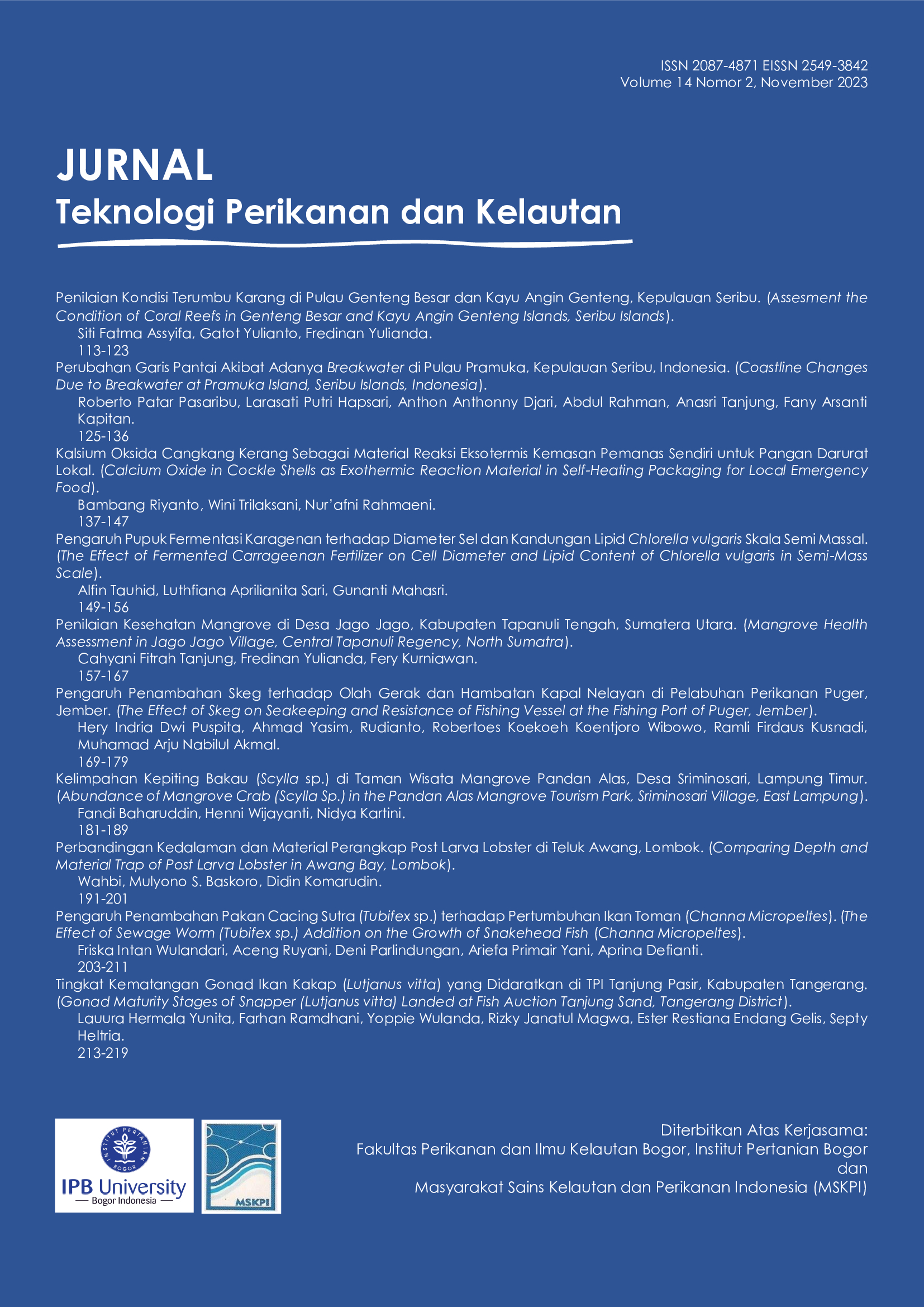
PENGARUH PENAMBAHAN SKEG TERHADAP OLAH GERAK DAN HAMBATAN KAPAL NELAYAN DI PELABUHAN PERIKANAN PUGER, JEMBER
DOI:
https://doi.org/10.24319/jtpk.14.169-179Keywords:
fishing vessel, seakeeping, skeg, resistanceAbstract
A fishing vessel is a type of ship used for fishing activities, fish transportation, and other purposes. Fishing vessels in Puger have their own distinctive characteristic of having a broad and rounded hull shape. This is intended to enhance the vessel’s maneuverability. However, it will impact the amount of resistance the ship experiences, thus necessitating the use of components to resistance the ship’s motion without altering the broad and rounded hull shape. This research aim to estimate the capabilities of the ship in conditions in the high seas, especially in Puger Waters, serve as a foundation for testing hydrodynamic characteristics of fishing vessels in the Puger Waters by incorporating a skeg component to minimize the occurrence of accidents involving ship instability in the future. The research object utilized an operational ship model, which was then re-drawn and modified by adding a skeg component. Subsequently, hydrodynamic analysis of the ship was conducted, including resistance and maneuverability, using numerical methods. As a result, the resistance and maneuverability of the modified fishing vessel hull variations were found to be 86-98% better than those without the skeg. The use of a skeg has a positive impact on the resistance and maneuverability characteristics of the ship, aligning well with the conditions in the Puger Waters.
Downloads
Downloads
Published
Issue
Section
License
This journal is published under the terms of the Creative Commons Attribution-NonCommercial 4.0 International License. Authors who publish with this journal agree to the following terms: Authors retain copyright and grant the journal right of first publication with the work simultaneously licensed under a Creative Commons Attribution-NonCommercial 4.0 International License. Attribution — You must give appropriate credit, provide a link to the license, and indicate if changes were made. You may do so in any reasonable manner, but not in any way that suggests the licensor endorses you or your use. NonCommercial — You may not use the material for commercial purposes.
How to Cite