
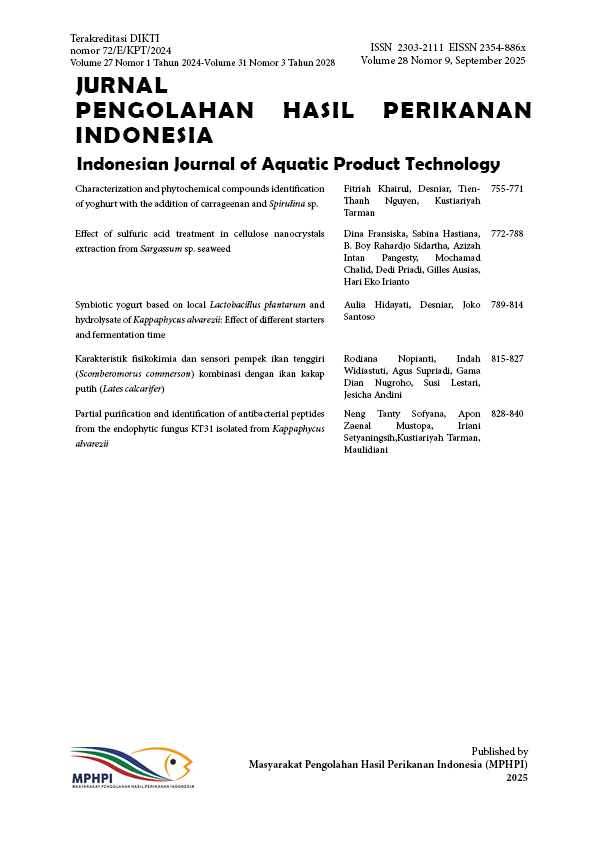
Karakteristik fisikokimia dan sensori pempek ikan tenggiri (Scomberomorus commerson) kombinasi dengan ikan kakap putih (Lates calcarifer) Physicochemical and sensory properties of pempek made from narrow-barred spanish mackerel (<i>Scomberomorus commerson</i>) combined with barramundi (<i>Lates calcarifer</i>)
Article Sidebar
-
aroma, hardness, proximate, taste, whiteness
Abstract
Pempek is a traditional food typical of the Palembang region in South Sumatra. Pempek is made from a mixture of ground fish and tapioca flour. This study aimed to determine the best formula for combining narrow-barred Spanish mackerel (Scomberomorus commerson) and barramundi (Lates calcarifer) based on the physical, chemical, and sensory characteristics of pempek. The experimental design was a randomized block design consisting of five treatment levels, each repeated three times: P1= 4:0, P2= 3:1, P3=2:2, P4= 1:3, and P5= 0:4. The research parameters used were proximate, physical, and sensory analyses. Proximate test results showed that the water content of pempek ranges from 53.65-56.27%, ash content 1.10-1.43%, fat content 0.35%-0.8%, protein content 7.05-8.42%, and carbohydrate levels 34.52-35.7%. The color test results for whiteness ranged from 54.90-59.32, lightness value 56.54-60.30, hue value 107.75-113.39°, and chroma value 8.89-13.17. The results of the pempek hardness test ranged from 22.7–24.87 N. The sensory test results for aroma were 5.08-5.36, and taste were 4.68-6.36. Based on all research parameters, the best combination of pempek was in treatment P4 (1:3).
Full text article
References
Accella, D., Sipahutar, Y, H., & Maulani, A. (2022). Penerapan GMP dan SSOP pengolahan pempek ikan tenggiri (Scomberomorus commerson) di UMKM Kota Tanjung Pinang, Kepulauan Riau. Prosiding Simposium Nasional IX Kelautan dan Perikanan: 59-72.
Agung, G. S., & Rismaya, R. (2024). Pengaruh suhu pemanasan terhadap karakteristik mutu minyak goreng bekas pakai pedagang gorengan. Agritekno: Jurnal Teknologi Pertanian, 13(1), 15-23. https://doi.org/10.30598/jagritekno.2024.13.1.15
Alp-Erbay, E., & Yeşilsu, A. F., (2021). Fish protein and its derivatives: functionality, biotechnology and health effects. Aquatic Food Studies, 1(1), AFS13. https://doi.org/10.4194/AFS13
Ambily, V., & Nandan, B., S. (2018). Nutritional composition of Arius subrostratus (Valenciennes, 1840) from Cochin estuary, India. Indian Journal of Geo Marine Sciences, 47(5), 972–977.
AOAC (Association Official Analitical Chemistry). (2005). The association of official analytical chemist, 18th Ed. AOAC International. Gaithhersburg, MD, USA.
Berliana, A. (2024). Profiling senyawa volatil dan karakteristik kimia ikan kakap putih (Lates calcarifer) dengan analisis metabolomik berdasarkan bobot. [Skripsi]. Universitas Sriwijaya.
Briscione, J., & Parkhurst, B. (2018). The flavor matrix. Houghton Mifflin Harcourt Publishing Company.
[BSN] Badan Standardidasi Nasional. (2019). SNI 7761:2019. Pempek ikan. Jakarta: Badan Standardisasi Nasional.
[BSN] Badan Standardisasi Nasional. (2006). SNI 01-2346:2006. Petunjuk pengujian organoleptik dan atau sensori. Jakarta: Badan Standardisasi Nasional.
Cheng, J. H., Sun, D.W., Han, Z., & Zeng, X. A. (2013). Texture and structure measurements and analyses for evaluation of fish and fillet freshness quality: a review. Comprehensive Reviews in Food Science and Food Safety, 13(1), 52–61. https://doi.org/10.1111/1541-4337.12043
Cooke, S. J., & Philipp, D. P. (2009). Centrarchid Fishes Diversity, Biology, and Conservation. Blackwell Publishing Ltd.
Damongilala, L. J. (2021). Kandungan gizi pangan ikani. Bandung: CV. Patra Media Grafindo.
Daud, A., Suriati, & Nuzulyanti. (2019). Kajian penerapan faktor yang mempengaruhi akurasi penentuan kadar air metode thermogravimetri. Lutjanus, 24(2), 11-16. https://doi.org/10.51978/jlpp.v24i2.79
Djazuli, N., Wahyuni, M., Monintja, G., & Purbayanto, A. (2009). Modifikasi teknologi pengolahan surimi dalam pemanfaatan “by-catch” pukat udang di laut arafuru. Jurnal Pengolahan Hasil Perikanan Indonesia, 12(1), 17-30. https://journal.ipb.ac.id/index.php/jphpi/article/view/885/858
Fadhallah, E. G., Nurainy, F., & Surosa, E. (2021). Karakteristik sensori, kimia, dan fisik pempek dari ikan tenggiri dan kiter pada berbagai formulasi. Jurnal Penelitian Pertanian Terapan, 21(1), 16-23. https://dx.doi.org/10.25181/jppt.v21i1.1972
Fadhlurrohman, I., Seytawardani, T., & Sumarmono, J. (2023). Karakteristik warna (hue, chroma, whiteness index), rendemen, persentase whey keju dengan penambahan teh hitam orthodox (Camellia sinensis var. assamica). Jurnal Teknologi dan Industri Pangan UNISRI, 8(1), 10-19. https://doi.org/10.33061/jitipari.v8i1.8133
Fajri, M., & Dasir. (2017). Studi waktu tenggang penggunaan daging ikan gabus pada pembuatan pempek lenjer. Edible, 6(1), 20-26. https://doi.org/10.32502/jedb.v6i1.628
Hapsari, L. P., Wahyudi, D., Suryana, A., Pattirane, C. P., Aripudin, & Adi, C. P. (2022). Gambaran histopatologi ginjal benih ikan kakap putih (Lates calcarifer) yang mengalami penurunan salinitas berbeda. Jurnal Perikanan dan Kelautan, 12(2), 143-149. https://dx.doi.org/10.33512/jpk.v12i2.15093
Huda, N., Shen., Y. H., Huey. Y. L., Ahmad. R, & Mardiah, A. (2010). Evaluation of physico-chemical properties of Malaysian commercial beef meatballs. American Journal of Food Technology, 5(1), 13-21. https://dx.doi.org/10.3923/ajft.2010.13.21
Hutchings, J. B. (1999). Food color and apperance (2nd ed). Aspen Publishers.
Jaya, B., Agustriani, F., & Isnaini. (2013). Laju pertumbuhan dan tingkat kelangsungan hidup benih kakap putih (Lates calcarifer, Bloch) dengan pemberian pakan yang berbeda. Maspari Journal, 5(1), 56-63. https://www.neliti.com/id/publications/148747/laju-pertumbuhan-dan-tingkat-kelangsungan-hidup-benih-kakap-putih-lates-calcarif
[KKP] Kementerian Kelautan dan Perikanan. (2025). Ikan Kakap Putih Tinggi Peminat, KKP Pastikan Stok Aman hingga Lebaran. Jakarta: Kementerian Kelautan dan Perikanan. https://kkp.go.id/news/news-detail/ikan-kakap-putih-tinggi-peminat-kkp-pastikan-stok-aman-hingga-lebaran-XQnl.html
Lawless, H. T., & Heymann, H. (2013). Sensory evaluation of food: Principle and practices. Springer Science&Bussiness Media, LLC.
Mapari, S. A. S., Meyer, A. S., & Thrane, U. (2006). Colorimetric characterization for comparative analysis fungal pigments and natural food colorants. Journal of Agricultural and Food Chemistry, 54, 7027-7035. https://doi.org/10.1021/jf062094n
Menalla, E., Serna, J. G., Cantero, G., & Cocero, M. J. (2024). Hydrothermal hydrolysis of triglycerides: Tunable and intensified production of diglycerides, monoglycerides, and fatty acids. Chemical Engineering Journal, 493(2024), 152391. https://doi.org/10.1016/j.cej.2024.152391
Mishra, R. (2022). Handbook on fish processing and preservation. CRC Press.
Mudgil, D., & Mudgil, S. B. (2019). Objective food science and technology. Scientific Publisher.
Nafsiyah, I., Nurilmala, M., & Abdullah, A. (2018). Komposisi nutrisi ikan sidat Anguilla bicolor bicolor dan Anguilla marmorata. Jurnal Pengolahan Hasil Perikanan Indonesia, 21(3), 504-512. http://dx.doi.org/10.17844/jphpi.v21i3.24733
Nasir, A., Dasir, D., & Patimah, S. (2021). Nilai protein pempek dari jenis olahan ikan patin (Pangasius pangasius) dan perbandingan tepung tapioka. Jurnal Penelitian Ilmu-Ilmu Teknologi Pangan, 9 (1), 1-12. https://doi.org/10.32502/jedb.v9i1.3451
Nofitasari, N. (2015). Pengaruh penggunaan jenis ikan yang berbeda terhadap kualitas pempek. [Skripsi]. Universitas Negeri Padang.
Nopianti, R., & Herpandi. (2015, November 05). Karakteristik fisikokimia dan sensoris pempek dari berbagai jenis ikan berdasarkan kualitas fisiko-kimia. Prosiding Seminar Nasional Dies Natalis Ke-52 Fakultas Pertanian Universitas Sriwijaya. Fakultas Pertanian. Universitas Sriwijaya. ISBN 978-979-8389-214.
Park, J. W. (2013). Surimi and Surimi Seafood. CRC Press.
Putri, F. A., Pujimulyani, D., & Kanetro, B. (2024). Pengaruh penambahan bubuk kunir (Curcuma mangga Val.) dan variasi lama perebusan terhadap karakteristik fisik, kimia dan tingkat kesukaan pempek ikan kakap. Prosiding Seminar Nasional Mini Riset Mahasiswa, 3(2), 252-263. https://ejurnal.ung.ac.id/index.php/semasetwa/article/view/28948
Ratnawati, L. (2022). Pengaruh waktu penggilingan dan teknik pemasakan terhadap kinetika pengeringan daging giling. Jurnal Pangan, 31(1), 45-54. https://doi.org/10.33964/jp.v31i1.543
Rosa, R., Bandara, N. M., & Nunes, M. L. (2007). Nutritional quality of african catfish Clarias gariepinus (Burchell 1822): a positive criterion for the future development of the European production of Silurodei. International Journal of Food Science and Technology, 42, 342-351. https://doi.org/10.1111/J.1365-2621.2006.01256.X
Saputra, A., Oktariani, H., & Supriadi, A. (2024). Identifikasi asam amino pembentuk tekstur dan viskositas daging ikan belida (Chitala lopis), ikan patin (Pangasius pangasius), dan ikan gabus (Channa striata). Samakia: Jurnal Ilmu Perikanan, 15(1), 121-130. https://doi.org/10.35316/jsapi.v15i1.3395
Saputri, N. E., Hidayah, N., & Muttalib, Y. S. (2021). Komposisi nilai gizi pempek ikan tenggiri (Scomberomorus commersonii) dengan penambahan wortel (Daucus carota). Poltekita: Jurnal Ilmu Kesehatan, 15(2), 143-149. https://doi.org/10.33860/jik.v15i2.488
Septia, N. (2024). Volatilomik berbasis SPME-GC/MS dan karakteristik kimia ikan tenggiri (Scomberomorus commersonii) berdasarkan perbedaan bobot. [Skripsi]. Universitas Sriwijaya.
Shaviklo, G. R. (2006). Quality assessment of fish protein isolates using surimi standard methods. Iranian Fisheries Organisation (SHILAT).
Siswanti., Agnesia, P. Y., & Anandito, R. B. K. (2017). Pemanfaatan daging dan tulang ikan kembung (Rastrelliger kanagurta) dalam pembuatan camilan stik. Jurnal Teknologi Hasil Pertanian, 10(1), 41-49. https://doi.org/10.20961/jthp.v10i1.17492
Steel, R. G. D., & Torrie, J. H. (1993). Prinsip dan prosedur statistik: suatu pendekatan biometrik. Gramedia Pustaka Utama.
Suwandi, R., Nurjanah., & Margaretha, M. (2014). Proporsi bagian tubuh dan kadar proksimat ikan gabus pada berbagai ukuran. Jurnal Pengolahan Hasil Perikanan Indonesia, 17(1), 22-28. https://doi.org/10.17844/jphpi.v17i1.8134
Tabilo-Munizaga, G., & Barbosa-Cánovas, G. V. (2004). Color and textural parametrs of pressurized and heat-treated surimi gels as affected by potato starch and egg white. Food Research International, 37(8), 767-775. https://doi.org/10.1016/j.foodres.2004.04.001
Thamrin, E. S., Endang, W., Bindar, Y., & Kartika, I. A. (2022). Karakterisasi bahan pewarna tinta termokromik leuco dye system pada produk pempek ikan. Jurnal Ilmu dan Teknologi Pangan, 11(4), 635-643. https://doi.org/10.24843/itepa.2022.v11.i04.p05
Yechiel, E. (2005). Interactive vehicles in synergistic cosmeceuticals: Andvances in nanoencapsulation, transportation, transfer, and targeting. In M. R. Rosen (Ed.), Delivery system handbook for personal care and cosmetic products (pp. 303-319). William Andrew, Inc. https://doi.org/10.1016/B978-081551504-3.50019-5
Zhao, Q., Zheng, B., Li, J., Cheong, K. L., Li, R., Chen, J., Liu, X., Jia, X., Song, B., Wang, Z., dan Zhong, S. (2024). Emulsion-filled surimi gel: a promising approach for enhancing gel properties, water holding capacity, and flavor. Trends in Food Science & Technology, 152: 104663. https://doi.org/10.1016/j.tifs.2024.104663
Authors
Copyright (c) 2025 Rodiana Nopianti, Indah Widiastuti, Agus Supriadi, Gama Dian Nugroho, Susi Lestari, Jesicha Andini

This work is licensed under a Creative Commons Attribution 4.0 International License.
Authors who publish with this journal agree to the following terms:
- Authors retain copyright and grant the journal right of first publication with the work simultaneously licensed under a Creative Commons Attribution License that allows others to share the work with an acknowledgement of the work's authorship and initial publication in this journal.
- Authors are able to enter into separate, additional contractual arrangements for the non-exclusive distribution of the journal's published version of the work (e.g., post it to an institutional repository or publish it in a book), with an acknowledgement of its initial publication in this journal.
Article Details



