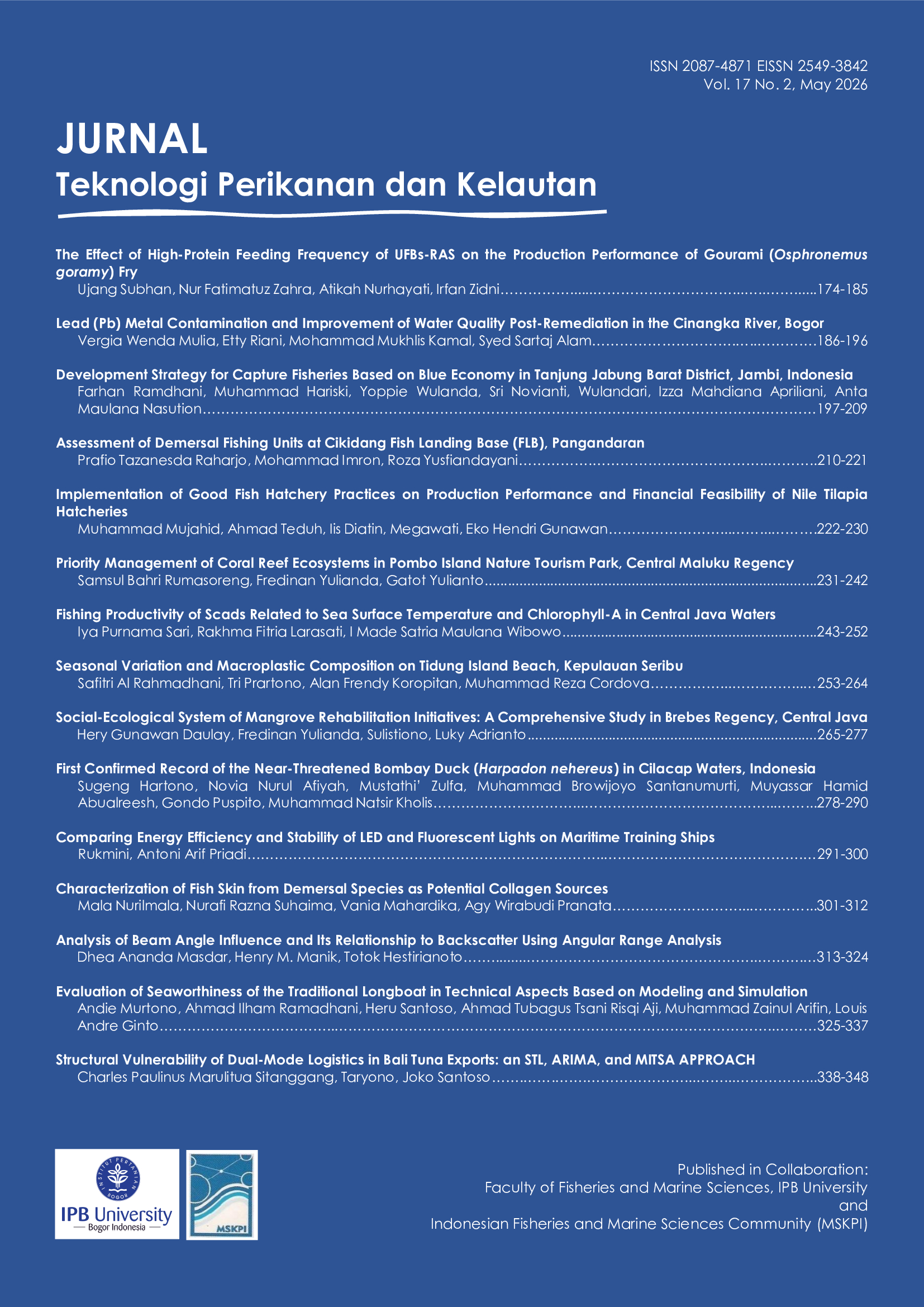
IMPLEMENTATION OF GOOD FISH HATCHERY PRACTICES ON PRODUCTION PERFORMANCE AND FINANCIAL FEASIBILITY OF NILE TILAPIA HATCHERIES
PENERAPAN CARA PEMBENIHAN IKAN YANG BAIK TERHADAP KINERJA PRODUKSI DAN KELAYAKAN FINANSIAL PEMBENIHAN IKAN NILA
DOI:
https://doi.org/10.24319/jtpk.17.222-230Keywords:
net B/C, NPV, profitability, R/C ratio, sensitivity analysisAbstract
Procedures of good fish hatchery practices (GFHP) are regulatory standards to ensure biosecurity, product traceability, and sustainability of hatchery operations in producing high-quality fish fries. The implementation of these practices determines not only the technical aspects of production but also some financial consequences for aquaculture practitioners. This study aims to evaluate the production performance and financial performance of the Nile tilapia (Oreochromis niloticus) implementing GFHP in Kutasirna Village, Cisaat District, Sukabumi Regency, West Java, Indonesia. Non-experimental methodology was applied to compare the business performances before and after the implementation of GFHP. Data were collected from direct observation and information from interviews with a group of 8 fish farmers in the village. Production performance and financial performance were improved after GFHP was implemented by the group. The fry production increased by approximately 110% and the net benefit–cost (net B/C) ratio increased by 73%. The financial parameters indicate reasonable stability to a higher feed price and a lower selling price of the fry. This study shows a strong indication of positive outcomes from the implementation of GFHP, i.e. continuous supplies of good quality fry for tilapia production.
Downloads
References
Ali SE, Jansen MD, Mohan CV, Delamare-Deboutteville J, Charo-Karisa H. 2020. Key Risk Factors, Farming Practices and Economic Losses Associated with Tilapia Mortality in Egypt. Aquaculture. 527: 735438. DOI: https://doi.org/10.1016/j.aquaculture.2020.735438.
Arumugam M, Jayaraman S, Sridhar A, Venkatasamy V, Brown PB, Abdul Kari Z, Tellez-Isaias G, Ramasamy T. 2023. Recent Advances in Tilapia Production for Sustainable Developments in Indian Aquaculture and its Economic Benefits. Fishes. 8(4): 176. DOI: https://doi.org/10.3390/fishes8040176.
[BPS] Badan Pusat Statistik-Statistics Indonesia. 2024. Indonesia Foreign Trade Statistics Exports 2023. Jakarta (ID): BPS-Statistic Indonesia.
Brande MR, Santos DFL, Fialho NS, Proença DC, Ojeda PG, Godói FCM, Roubach R, Bueno GW. 2023. Economic and Financial Risks of Commercial Tilapia Cage Culture in a Neotropical Reservoir. Heliyon. 9(6): e16336. DOI: https://doi.org/10.1016/j.heliyon.2023.e16336.
Burad-Méndez A, Domínguez-May R, Olvera-Novoa MA, Robledo D, Salas S. 2023. Economic Analysis of Nile Tilapia (Oreochromis niloticus) Production Based on Farm Size and Number of Rearing Tanks. Latin American Journal of Aquatic Research. 51(5): 747–759. DOI: https://doi.org/10.3856/vol51-issue5-fulltext-3071.
Castilho-Barros L, Owatari MS, Mouriño JLP, Silva BC, Seiffert WQ. 2020. Economic Feasibility of Tilapia Culture in Southern Brazil: A Small-scale Farm Model. Aquaculture. 515: 734551. DOI: https://doi.org/10.1016/j.aquaculture.2019.734551.
Chaidir AR, Herdiyanto DW, Eska AC, Kalandro GD. 2025. The Effect of Automatic Fish Feeding Technology on the Quality of Tilapia Fish Culture Products. Jurnal Teknologi Perikanan dan Kelautan. 16(1): 44–51. DOI: https://doi.org/10.24319/jtpk.16.44-51.
Diatin I, Nuristy DF, Teduh A, Mujahid M. 2017. Incremental Net Benefits from the Increasing in the Production of Koi Fish Cyprinus carpio var. Koi Culture. Jurnal Akuakultur Indonesia. 16(1): 68–75. DOI: https://doi.org/10.19027/jai.16.1.68-75.
Dickson M, Nasr-Allah A, Kenawy D, Kruijssen F. 2016. Increasing Fish Farm Profitability through Aquaculture Best Management Practice Training in Egypt. Aquaculture. 465: 172–178. DOI: https://doi.org/10.1016/j.aquaculture.2016.09.015.
[DJPB] Direktorat Jenderal Perikanan Budidaya-Directorate Generale of Aquaculture. 2025. Laporan Kinerja Direktorat Jenderal Perikanan Budidaya Tahun 2024. Kementerian Kelautan dan Perikanan Republik Indonesia.
Dorantes-De-La-O JCR, Maeda-Martínez AN. 2023. Bioeconomic Model for the Evaluation of a Backyard Aquaculture System for Tilapia (Oreochromis niloticus). Latin American Journal of Aquatic Research. 51(2): 282–294. DOI: https://doi.org/10.3856/vol51-issue2-fulltext-2999.
El-Sayed AFM, Fitzsimmons K. 2023. From Africa to the World—The Journey of Nile Tilapia. Reviews in Aquaculture. 15(1): 6–21. DOI: https://doi.org/10.1111/raq.12738.
Frimpong EA, Ansah YB, Amisah S, Adjei-Boateng D, Agbo NW, Egna H. 2014. Effects of Two Environmental Best Management Practices on Pond Water and Effluent Quality and Growth of Nile Tilapia, Oreochromis niloticus. Sustainability. 6(2): 652–675. DOI: https://doi.org/10.3390/su6020652.
Hartati H, Jayadi J, Tamsil A. 2019. Evaluasi Penerapan Manajemen Cara Pembenihan Ikan yang Baik (GFHP) pada Unit Pembenihan Udang Dinas Kelautan dan Perikanan Provinsi Sulawesi Selatan di Bojo Kabupaten Barru. Journal of Indonesian Tropical Fisheries. 2(2): 206–215. DOI: https://doi.org/10.33096/joint-fish.v2i2.54.
Henriksson PJG, Dickson M, Nasr Allah A, Al-Kenawy D, Phillips M. 2017. Benchmarking the Environmental Performance of Best Management Practice and Genetic Improvements in Egyptian Aquaculture Using Life Cycle Assessment. Aquaculture. 468(1): 53–59. DOI: https://doi.org/10.1016/j.aquaculture.2016.09.051.
Hutagalung RA, Tindaon LIU, Canti M, Soewono AD, Barus T. 2024. Growth Improving of Catfish (Clarias gariepinus) and Nile Tilapia (Oreochromis niloticus) through Biopellet. Jurnal Teknologi Perikanan dan Kelautan. 15(2): 127–137. DOI: https://doi.org/10.24319/jtpk.15.127-137.
Munguti JM, Nairuti R, Iteba JO, Obiero KO, Kyule D, Opiyo MA, Abwao J, Kirimi JG, Outa N, Muthoka M, et al. 2022. Nile Tilapia (Oreochromis niloticus Linnaeus, 1758) Culture in Kenya: Emerging Production Technologies and Socio-Economic Impacts on Local Livelihoods. Aquaculture, Fish and Fisheries. 2(4): 265–276. DOI: https://doi.org/10.1002/aff2.58.
Nass RAR, Povh JA, Oliveira CAL, Ribeiro RP, Brumatti RC. 2025. Bioeconomic Simulator for Economic-financial Management of Tilapia Reproduction Fish Farms. Revista Observatorio de la Economía Latinoamericana. 22(8): 1–21. DOI: https://doi.org/10.55905/oelv22n8-188.
Portinho JL, Silva MSGM, Queiroz JF, de Barros I, Campos Gomes AC, Losekann ME, Koga-Vicente A, Spinelli-Araujo L, Vicente LE, Rodrigues GS. 2021. Integrated Indicators for Assessment of Best Management Practices in Tilapia Cage Farming. Aquaculture. 545: 737136. DOI: https://doi.org/10.1016/j.aquaculture.2021.737136.
Prabu E, Rajagopalsamy CBT, Ahilan B, Jeevagan IJMA, Renuhadevi M. 2019. Tilapia – An Excellent Candidate Species for World Aquaculture: A Review. Annual Research & Review in Biology. 31(3): 1–14. DOI: https://doi.org/10.9734/arrb/2019/v31i330052.
Rahman MT, Nielsen R, Khan MA, Ankamah-Yeboah I. 2020. Impact of Management Practices and Managerial Ability on the Financial Performance of Aquaculture Farms in Bangladesh. Aquaculture Economics & Management. 24(1): 79–101. DOI: https://doi.org/10.1080/13657305.2019.1647578.
Regulation of the Minister of Marine Affairs and Fisheries Number 22 of 2024 concerning Good Fish Hatchery Practices. Jakarta.
Regulation of the Minister of Marine Affairs and Fisheries Number 35/PERMEN-KP/2016 concerning Good Fish Hatchery Practices. Jakarta.
Regulation of the Minister of Marine Affairs and Fisheries Number KEP.02/MEN/2007 concerning Good Aquaculture Practices. Jakarta.
Roheim CA, Sudhakaran PO, Durham CA. 2012. Certification of Shrimp and Salmon for Best Aquaculture Practices: Assessing Consumer Preferences in Rhode Island. Aquaculture Economics & Management. 16(3): 266–286. DOI: https://doi.org/10.1080/13657305.2012.713075.
Samah R. 2020. Increasing the Fish Production with Good Aquaculture Practices. International Journal of Business and Technology Management. 2(1): 27–33.
Sau F, Sarma M, Trilaksani W. 2017. Penerapan Cara Pembenihan Ikan yang Baik dalam Meningkatkan Kinerja UMKM Pembenihan Udang di Kabupaten Barru, Provinsi Sulawesi Selatan. Jurnal Manajemen Pengembangan Industri Kecil Menengah. 12(1): 15–24. DOI: https://doi.org/10.29244/mikm.12.1.15-24.
Subasinghe R, Alday-Sanz V, Bondad-Reantaso MG, Jie H, Shinn AP, Sorgeloos P. 2023. Biosecurity: Reducing the Burden of Disease. Journal of the World Aquaculture Society. 54(2): 397–426. DOI: https://doi.org/10.1111/jwas.12966.
Surianti, Damis, Wahyudi, Febrian MR, Sulaiman MA. 2025. Utilization of Suckermouth Catfish (Pterygoplichthys pardalis) as a Raw Material of Protein in Artificial Feed Tilapia. Jurnal Teknologi Perikanan dan Kelautan. 16(4): 384–394. DOI: https://doi.org/10.24319/jtpk.16.384-394.
Yosef S. 2009. Rich Food for Poor People: Genetically Improved Tilapia in the Philippines. IFPRI Discussion Paper. International Food Policy Research Institute.
Downloads
Published
Issue
Section
License
Copyright (c) 2026 Muhammad Mujahid, Ahmad Teduh, Iis Diatin, Megawati Megawati, Eko Hendri Gunawan

This work is licensed under a Creative Commons Attribution-NonCommercial 4.0 International License.
This journal is published under the terms of the Creative Commons Attribution-NonCommercial 4.0 International License. Authors who publish with this journal agree to the following terms: Authors retain copyright and grant the journal right of first publication with the work simultaneously licensed under a Creative Commons Attribution-NonCommercial 4.0 International License. Attribution — You must give appropriate credit, provide a link to the license, and indicate if changes were made. You may do so in any reasonable manner, but not in any way that suggests the licensor endorses you or your use. NonCommercial — You may not use the material for commercial purposes.
How to Cite