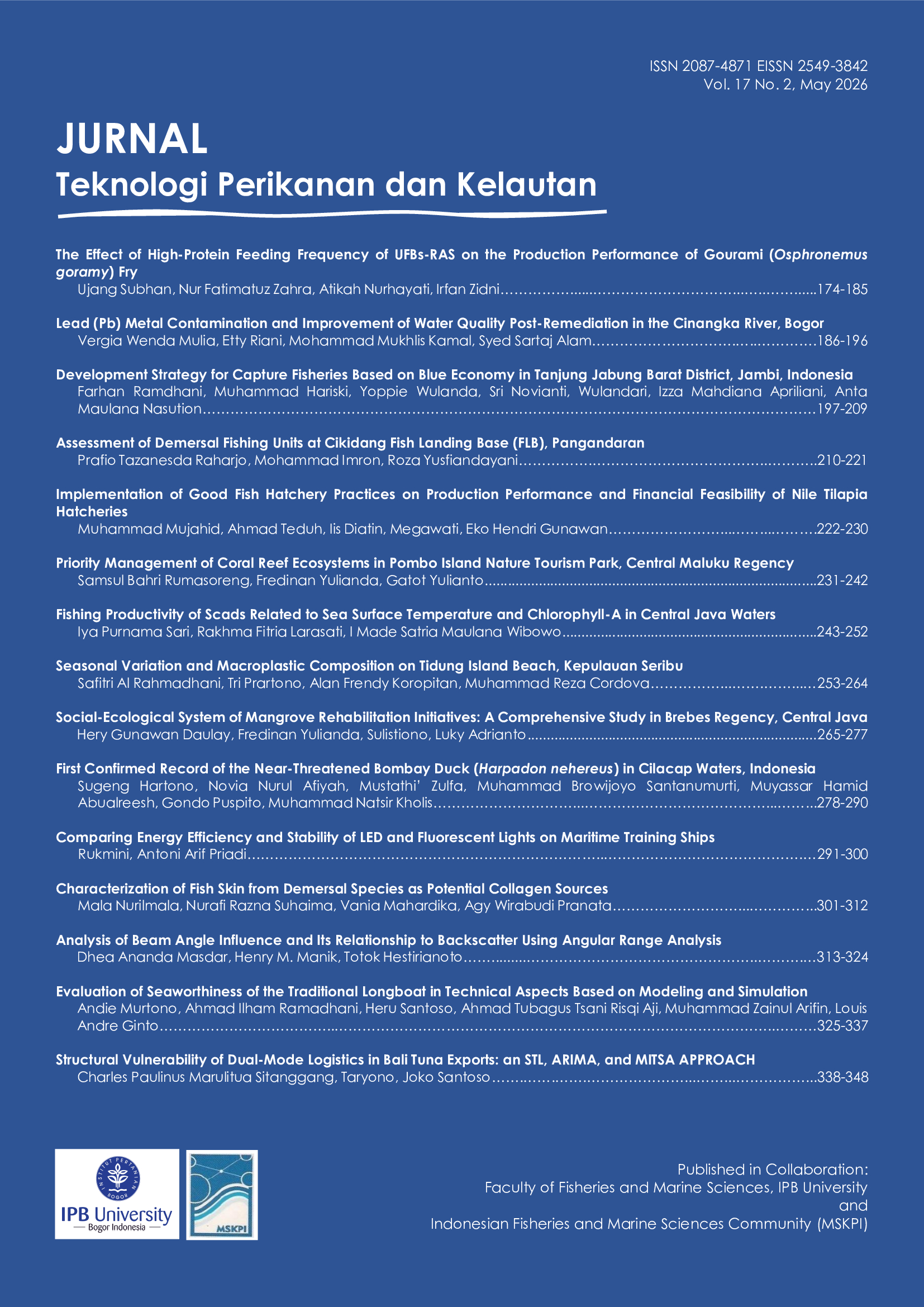
INTEGRATED ASSESSMENT OF CORAL REEFS AND REEF FISH ASSEMBLAGES IN KAIMANA MARINE PROTECTED AREAS, WEST PAPUA
PENILAIAN TERPADU TERUMBU KARANG DAN KOMUNITAS IKAN KARANG DI KAWASAN KONSERVASI PERAIRAN KAIMANA, PAPUA BARAT
DOI:
https://doi.org/10.24319/jtpk.17.243-252Keywords:
adaptive management, coral reefs, long-term monitoring, marine protected areas, reef fish assemblagesAbstract
Coral reefs in the Kaimana Marine Protected Areas (MPAs) in West Papua are among Indonesia’s most biodiverse ecosystems, but human activities and climate change increasingly threaten them. This study aimed to evaluate the condition of coral reefs and reef fish assemblages in the No-Take and Utilization Zones of Kaimana MPA using historical monitoring data. The data were collected from 24 sites across three periods: T0 (2012–2013), T1 (2015–2016), and T2 (2019), and analyzed in 2020. Benthic composition was assessed using the Point Intercept Transect method, while reef fish assemblages were surveyed via Underwater Visual Census. Ecological indicators included live hard coral cover, benthic substrate composition, and biomass of reef fish by trophic groups and families. Temporal and spatial differences among monitoring periods and between the No-Take and Utilization Zones were tested using one-way ANOVA and Kruskal–Wallis tests. Live hard coral cover differed significantly between management zones (p < 0.001), increasing in the No-Take Zone but declining in the Utilization Zone. Several benthic indicators, including crustose coralline algae, rubble, dead coral, and other algae, showed significant temporal variation, reflecting disturbance, eutrophication, and climate-related stress. In contrast, reef fish biomass declined across zones and monitoring periods, indicating that spatial protection alone has been insufficient to counteract persistent fishing pressure and limited enforcement. The contrasting trends in coral cover and reef fish biomass emphasize the need for adaptive MPA management through stronger enforcement, community participation, habitat restoration, and ridge-to-reef water-quality control.
Downloads
References
Ahmadia GN, Wilson JR, Green AL. 2013. Coral Reef Monitoring Protocol for Assessing Marine Protected Areas in the Coral Triangle. Technical Report. Coral Triangle Support Partnership.
Allen GR, Erdmann MV. 2009. Reef Fishes of the Bird’s Head Peninsula, West Papua, Indonesia. Checklist. 5(3): 587–628. DOI: https://doi.org/10.15560/5.3.587.
Bawole R, Yulianda F, Bengen DG, Fahrudin A, Mudjirahayu. 2019. Governability of Marine Protected Areas: The Effect of Trade-offs, Hybrid Patterns, and Policy Implications in Cenderawasih Bay National Park, Indonesia. The 3rd EMBRIO International Workshop on Marine Biodiversity: Understanding, Utilization, Conservation 9–10 October 2018, Bogor, Indonesia. IOP Conference Series: Earth and Environmental Science. DOI: https://doi.org/10.1088/1755-1315/278/1/012011.
Boli P, Yulianda F, Soedharma D, Damar A, Kinseng R. 2014. Integration of Marine Resources Management Based on Customary into Modern Conservation Management in Raja Ampat, Indonesia. International Journal of Sciences: Basic and Applied Research. 13(2): 280–291.
Cammen KM, Rasher DB, Steneck RS. 2019. Predator Recovery, Shifting Baselines, and the Adaptive Management Challenges They Create. Ecosphere. 10(2): e02579. DOI: https://doi.org/10.1002/ecs2.2579.
Campbell SJ, Kartawijaya T, Yulianto I, Prasetia R, Clifton J. 2013. Co-management Approaches and Incentives Improve Management Effectiveness in the Karimunjawa National Park, Indonesia. Marine Policy. 41: 72–79.
Decree of the Governor of West Papua Number 523/60/3/2018 concerning the Designation of Kaimana Marine Conservation Area. Manokwari.
Decree of the Minister of Marine Affairs and Fisheries of the Republic of Indonesia Number 25/KEPMEN-KP/2021 concerning Marine Conservation Area of Buruway, Arguni, Kaimana, Etna Bay, and Surrounding Waters in West Papua Province. Jakarta.
Fox HE, Pet JS, Dahuri R, Caldwell RL. 2003. Recovery in Rubble Fields: Long-term Impacts of Blast Fishing. Marine Pollution Bulletin. 46(8): 1024–1031. DOI: https://doi.org/10.1016/S0025-326X(03)00246-7.
Giyanto, Abrar M, Siringoringo R, Suharti S, Wibowo K, Edrus IN, Arbi U, Cappenberg HA, Sihaloho HF, Tuti Y. 2014. Panduan Monitoring Kesehatan Terumbu Karang. Jakarta (ID): COREMAP-CTI LIPI.
Golbuu Y, Wolanski E, Idechong JW, Victor S, Isechal AL, Oldiais NW, Idip D, Richmond RH, van Woesik R. 2012. Predicting Coral Recruitment in Palau’s Complex Reef Archipelago. PLoS ONE. 7(11): e50998. DOI: https://doi.org/10.1371/journal.pone.0050998.
Green AL, Fernandes L, Almany G, Abesamis R, McLeod E, Aliño PM, White AT, Salm R, Tanzer J, Pressey RL. 2014. Designing Marine Reserves for Fisheries Management, Biodiversity Conservation, and Climate Change Adaptation. Coastal Management. 42(2): 143–159. DOI: https://doi.org/10.1080/08920753.2014.877763.
Grorud-Colvert K, Sullivan-Stack J, Roberts C, Constant V, Horta EC, Pike EP, Kingston N, Laffoley D, Sala E, Claudet J, et al. 2021. The MPA Guide: A Framework to Achieve Global Goals for the Ocean. Science. 373(6560): eabf0861. DOI: https://doi.org/10.1126/science.abf0861.
[IPCC] Intergovernmental Panel on Climate Change. 2023. Food, Fibre, and Other Ecosystem Products. In: Climate Change 2022 – Impacts, Adaptation and Vulnerability: Working Group II Contribution to the Sixth Assessment Report of the Intergovernmental Panel on Climate Change. Cambridge (GB): Cambridge University Press.
Johnson MD, Bravo LMR, O’Connor SE, Varley NF, Altieri AH. 2019. pH Variability Exacerbates Effects of Ocean Acidification on a Caribbean Crustose Coralline Alga. Frontiers in Marine Science. 6: 150. DOI: https://doi.org/10.3389/fmars.2019.00150.
Kennedy EV, Vercelloni J, Neal BP, Ambariyanto, Bryant DEP, Ganase A, Gartrell P, Brown K, Kim CJS, Hudatwi M, et al. 2020. Coral Reef Community Changes in Karimunjawa National Park, Indonesia: Assessing the Efficacy of Management in the Face of Local and Global Stressors. Journal of Marine Science and Engineering. 8(10): 760. DOI: https://doi.org/10.3390/jmse8100760.
Kulbicki M, Guillemot N, Amand M. 2005. A General Approach to Length-weight Relationships for New Caledonian Lagoon Fishes. Cybium. 29(3): 235–252.
Lennox RJ, Brownscombe JW, Darimont C, Horodysky A, Levi T, Raby GD, Cooke SJ. 2022. The Roles of Humans and Apex Predators in Sustaining Ecosystem Structure and Function: Contrast, Complementarity and Coexistence. People and Nature. 4(5): 1071–1082. DOI: https://doi.org/10.1002/pan3.10385.
Maucieri DG, Baum JK. 2021. Impacts of Heat Stress on Soft Corals, an Overlooked and Highly Vulnerable Component of Coral Reef Ecosystems, at a Central Equatorial Pacific Atoll. Biological Conservation. 262: 109328. DOI: https://doi.org/10.1016/j.biocon.2021.109328.
McClanahan TR, Maina JM, Darling ES, Guillaume MMM, Muthiga NA, D’Agata S, Leblond J, Arthur R, Jupiter SD, Wilson SK, et al. 2020. Large Geographic Variability in the Resistance of Corals to Thermal Stress. Global Ecology and Biogeography. 29(12): 2229–2247. DOI: https://doi.org/10.1111/geb.13191.
Nash KL, Abesamis RA, Graham NAJ, McClure EC, Moland E. 2016. Drivers of Herbivory on Coral Reefs: Species, Habitat, and Management Effects. Marine Ecology Progress Series. 554: 129–142. DOI: https://doi.org/10.3354/meps11795.
Purwanto, Andradi-Brown DA, Matualage D, Rumengan I, Awaludinnoer, Pada D, Hidayat NI, Amkieltiela, Fox HE, Fox M, et al. 2021. The Bird’s Head Seascape Marine Protected Area Network: Preventing Biodiversity and Ecosystem Service Loss Amidst Rapid Change in Papua, Indonesia. Conservation Science and Practice. 3(6): e393. DOI: https://doi.org/10.1111/csp2.393.
Regional Regulation of Kaimana Regency Number 11 of 2014 concerning Regional Marine Conservation Area. Kaimana.
Reimer JD, Peixoto RS, Davies SW, Traylor-Knowles N, Short ML, Cabral-Tena RA, Burt JA, Pessoa I, Banaszak AT, Winters RS, et al. 2024. The Fourth Global Coral Bleaching Event: Where Do We Go from Here?. Coral Reefs. 43(4): 1121–1125. DOI: https://doi.org/10.1007/s00338-024-02504-w.
Rozirwan, Bengen DG, Zamani NP, Effendi H, Chaidir. 2014. The Differences of Soft Corals Spatial Distributions between Sheltered and Exposed Sites at Pongok Island in South of Bangka and Tegal Island in Lampung Bay, Indonesia. International Journal of Marine Science. 4(65): 1–7.
Sala R, Simbolon D, Wisudo SH, Haluan J, Yusfiandayani R. 2017. Multidimensional Analysis of Fisheries Sustainability in Traditional Use Zone of Misool, Raja Ampat, Indonesia. International Journal of Development Research. 7(3): 11822–11829.
Sotka EE, Hay ME. 2009. Effects of Herbivores, Nutrient Enrichment, and Their Interactions on Macroalgal Proliferation and Coral Growth. Coral Reefs. 28(3): 555–568. DOI: https://doi.org/10.1007/s00338-009-0529-1.
Stuart-Smith RD, Edgar GJ, Clausius E, Oh ES, Barrett NS, Emslie MJ, Bates AE, Bax N, Brock D, Cooper A, et al. 2022. Tracking Widespread Climate-driven Change on Temperate and Tropical Reefs. Current Biology. 32(19): 4128–4138. DOI: https://doi.org/10.1016/j.cub.2022.07.067.
Williams ID, Baum JK, Heenan A, Hanson KM, Nadon MO, Brainard RE. 2015. Human, Oceanographic and Habitat Drivers of Central and Western Pacific Coral Reef Fish Assemblages. PLoS ONE. 10(5): e0120516. DOI: https://doi.org/10.1371/journal.pone.0120516.
Zar JH. 2010. Biostatistical Analysis (5th ed). Upper Saddle River (US): Prentice Hall.
Downloads
Published
Issue
Section
License
Copyright (c) 2025 Roni Bawole, Ridwan Sala, Rully N. Wurarah, Selvi Tebaiy, Ismail Sirfefa, Duaitd Kolibongso, Mudjirahayu Mudjirahayu, Sefrianto Timang Saleda, Christover Alfarani Bawole, Marthin Matulessy, Sulistiono Sulistiono, Habema F. Monim, Irman Rumengan, Dariani Matualage, Nugraha Maulana

This work is licensed under a Creative Commons Attribution-NonCommercial 4.0 International License.
This journal is published under the terms of the Creative Commons Attribution-NonCommercial 4.0 International License. Authors who publish with this journal agree to the following terms: Authors retain copyright and grant the journal right of first publication with the work simultaneously licensed under a Creative Commons Attribution-NonCommercial 4.0 International License. Attribution — You must give appropriate credit, provide a link to the license, and indicate if changes were made. You may do so in any reasonable manner, but not in any way that suggests the licensor endorses you or your use. NonCommercial — You may not use the material for commercial purposes.
How to Cite