Dynamics of intraerythrocytic parasite infections in the Java common palm civet (Paradoxurus hermaphroditus)

Downloads
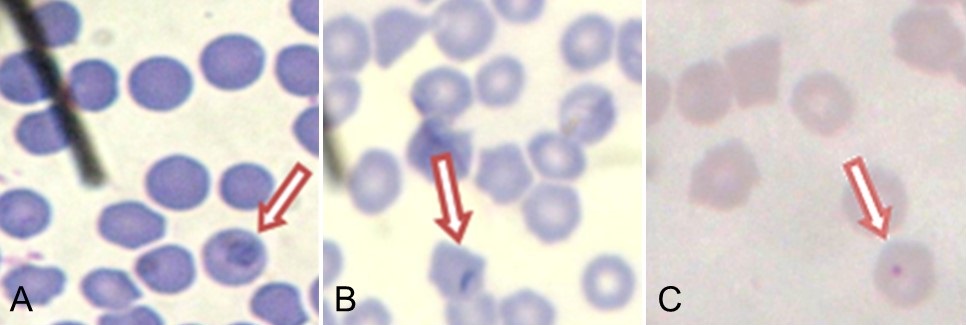
Over seven weeks, this study investigated intraerythrocytic parasitic infections in the Java common palm civet (Paradoxurus hermaphroditus). Blood samples were collected immediately after the civet had been brought from its natural habitat. Following the 30-day adaptation period, additional samples were collected weekly. Our findings revealed infections with Babesia sp., Theileria sp., and Anaplasma sp., with infection rates being the highest for Anaplasma sp. (0.35 ± 0.05)%, followed by Theileria sp. (0.12 ± 0.05)%, and Babesia sp. (0.03 ± 0.02)%. Throughout the study period, the infection rates of Babesia sp. and Anaplasma sp. decreased, whereas Theileria sp. showed an increasing trend until the conclusion of the study.
Aroon S, Artchawakom T, Hill JG, Kupittayanant S, Thanee N. 2009. Ectoparasites of the common palm civet (Paradoxurus hermaphroditus) at Sakaerat Environmental Research Station, Thailand. Suranaree Journal of Science and Technology. 16(4):277-281.
Ashadi G, Handayani SU. 1992. Protozoologi Veteriner I. Bogor: IPB.
Cahill C. 2020. [Un] becoming a resource: Translating the nature of civets in Indonesia. Ethnos. 85(1):100-117. https://doi.org/10.1080/00141844.2018.1536072 DOI: https://doi.org/10.1080/00141844.2018.1536072
Dyachenko V, Pantchev N, Balzer HJ, Meyersen A, Straubinger RK. 2012. First case of Anaplasma platys infection in a dog from Croatia. Parasites & Vectors. 5(49):1-7. https://doi.org/10.1186/1756-3305-5-49 | PMid:22401583 PMCid:PMC3315729 DOI: https://doi.org/10.1186/1756-3305-5-49
Hornok S, Földvári G, Elek V, Naranjo V, Farkas R, de la Fuente J. 2008. Molecular identification of Anaplasma marginale and rickettsial endosymbionts in blood-sucking flies (Diptera: Tabanidae, Muscidae) and hard ticks (Acari: Ixodidae). Veterinary Parasitology. 154(3-4):354-359. https://doi.org/10.1016/j.vetpar.2008.03.019 | PMid:18495345 DOI: https://doi.org/10.1016/j.vetpar.2008.03.019
Lehtinen LE, Birkenheuer AJ, Droleskey RE, Holman PJ. 2008. In vitro cultivation of a newly recognized Babesia sp. in dogs in North Carolina. Veterinary Parasitology. 151(2-4):150-157. https://doi.org/10.1016/j.vetpar.2007.10.022 | PMid:18083310 DOI: https://doi.org/10.1016/j.vetpar.2007.10.022
Lewis-Whelan B, Ardiansyah A, Roberts PD, Nijman V, Damianou E, Morcatty TQ, Birot H, Imron MA, Nekaris KA. 2024. Welfare and Management of Civets in Civet Coffee Tourism Plantations. Journal of Applied Animal Welfare Science. 27(3):561-574. https://doi.org/10.1080/10888705.2023.2270414 | PMid:37853780 DOI: https://doi.org/10.1080/10888705.2023.2270414
Mudappa D, Kumar A, Chellam R. 2010. Diet and fruit choice of the brown palm civet Paradoxurus jerdoni, a viverrid endemic to the Western Ghats rainforest, India. Tropical Conservation Science. 3(3):282-300. https://doi.org/10.1177/194008291000300304 DOI: https://doi.org/10.1177/194008291000300304
Nijman V, Abdullah A, Adinda E, Ardiansyah A, Campera M, Chavez J, Dewi T, Hedger K, Imron MA, Shepherd CR, Sukmadewi DK. 2024. Indonesia's sustainable development goals in relation to curbing and monitoring the illegal wildlife trade. Sustainable Development. 32:5393-5403. https://doi.org/10.1002/sd.2975 DOI: https://doi.org/10.1002/sd.2975
Orkun Ö, Karaer Z. 2017. Molecular characterization of Babesia species in wild animals and their ticks in Turkey. Infection, Genetics and Evolution. 55:8-13. https://doi.org/10.1016/j.meegid.2017.08.026 | PMid:28851619 DOI: https://doi.org/10.1016/j.meegid.2017.08.026
Penzhorn BL. 2006. Babesiosis of wild carnivores and ungulates. Veterinary Parasitology. 138(1-2):11-21. https://doi.org/10.1016/j.vetpar.2006.01.036 | PMid:16500026 DOI: https://doi.org/10.1016/j.vetpar.2006.01.036
Riffel M, Van Rompaey H, Schreiber A, Wirth R. 1989. Weasels, civets, mongooses, and their relatives: an action plan for the conservation of mustelids and viverrids. IUCN: International Union for Conservation of Nature. Association of Zoos and Aquariums, US, Inter-national Fur Trade Federation, IUCN Species Survival Commission (SSC), Mustelid and Viverrid Specialist Group, WWF, Zoologische Gesellschaft, DE. Retrieved from https://coilink.org/20.500.12592/bkjq2d on 27 Dec 2024.
Taye T. 2009. The African Civet Cat (Viverra civetta) and its life supporting role in the livelihood of smallholder farmers in Ethiopia. Conference on international research on food security, natural resource management and rural development, University of Hamburg. p 1-4
All articles published in this journal are licensed under a Creative Commons Attribution-ShareAlike 4.0 International License (CC BY-SA 4.0).
This license permits use, distribution, reproduction, and adaptation in any medium, including for commercial purposes, provided the original work is properly cited, a link to the license is given, and any changes made are indicated. Any derivative work must be distributed under the same license or a compatible license.
How to Cite