Heat tolerance of several beef cattle breeds in Astomulyo Village, Lampung Tengah District

Downloads
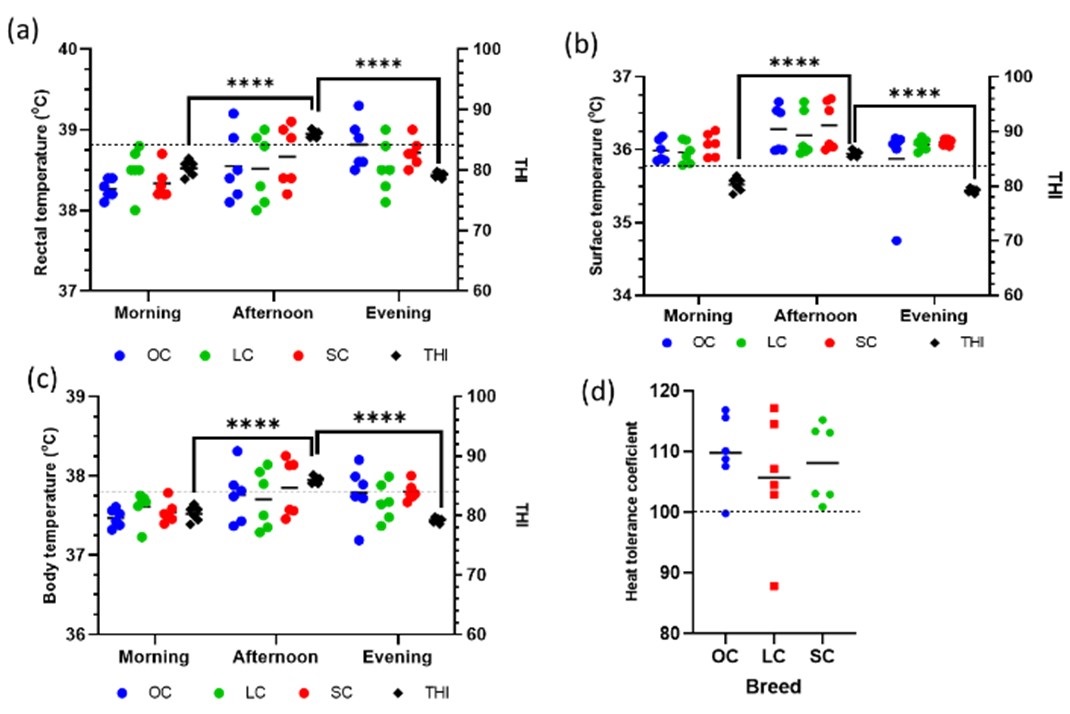
Animals' productivity and health status in tropical regions are significantly influenced by their ability to adapt to hot and humid tropical environments. This study aimed to compare the heat tolerance of the Ongole-cross (OC), Simmental-cross (SC), and Limousin-cross (LC) breeds raised in Astomulyo Village, Lampung Tengah District. This location had a high environmental stress index in the afternoon and moderate environmental stress in the morning and evening. Most cattle have a Heat Tolerance Coefficient (HTC) above 100, and there are no significant differences in HTC values among cattle breeds. The OC, SC, and LC cattle breeds exhibit good heat tolerance and can adapt to hot and humid environments in Lampung Tengah District.
Badan Pusat Statistik Lampung Tengah. 2023. Rata-Rata Suhu Udara dan Kelembaban Relatif Setiap Bulan di Lampung Tengah.
Badan Pusat Statistik Provinsi Lampung. 2023. Populasi Ternak Sapi di Provinsi Lampung Tahun 2019-2021.
Belhadj Slimen I, Najar T, Ghram A, Abdrrabba MJOAP. 2016. Heat stress effects on livestock: molecular, cellular and metabolic aspects, a review. Journal of Animal Physiology and An-imal Nutrition. 100(3):401-412. https://doi.org/10.1111/jpn.12379 | PMid:26250521 DOI: https://doi.org/10.1111/jpn.12379
Bulitta FS, Aradom S, Gebresenbet G. 2015. Effect of transport time of up to 12 hours on welfare of cows and bulls. Journal of Service Science and Management. 8(02):161-182. https://doi.org/10.4236/jssm.2015.82019 DOI: https://doi.org/10.4236/jssm.2015.82019
Kasarapu P, Porto-Neto LR, Fortes MRS, Lehnert SA, Mudadu MA, Coutinho L, Regitano L, George A, Reverter A. 2017. The Bos taurus-Bos indicus balance in fertility and milk related genes. PLoS One. 12(8):e0181930. https://doi.org/10.1371/journal.pone.0181930 | PMid:28763475 PMCid:PMC5538644 DOI: https://doi.org/10.1371/journal.pone.0181930
Mader TL, Davis MS, Brown-Brandl T. 2006. Environmental factors influencing heat stress in feedlot cattle. Journal of Ani-mal Science. 84(3):712-719. https://doi.org/10.2527/2006.843712x | PMid:16478964 DOI: https://doi.org/10.2527/2006.843712x
Nawaan S. 2006. Daya Tahan Panas Pada Sapi Peranakan Sim-mental, Peranakan Ongole Dan Sapi Pesisir. Jurnal Peternakan Indonesia (Indonesian Journal of Animal Science). 11(2):158-166. https://doi.org/10.25077/jpi.11.2.158-166.2006 DOI: https://doi.org/10.25077/jpi.11.2.158-166.2006
Putra RR. 2016. Identifikasi daya tahan panas sapi Pasundan di BPPT Cijeungjing Kecamatan Cijeungjing Kabupaten Ciamis. Students e-Journal. 5(4).
Suretno ND, Purwanto BP, Priyanto R, Supriyatna I. 2017. Evaluasi kesesuaian lingkungan berdasarkan penampilan produksi empat bangsa sapi pada ketinggian berbeda di Provinsi Lampung. Jurnal Veteriner. 18(3):478-486. https://doi.org/10.19087/jveteriner.2017.18.3.478 DOI: https://doi.org/10.19087/jveteriner.2017.18.3.478
Widyas N, Widi TSM, Prastowo S, Sumantri I, Hayes BJ, Burrow HM. 2022. Promoting sustainable utilization and genetic improvement of Indonesian local beef cattle breeds: A review. Agriculture. 12(10):1566. https://doi.org/10.3390/agriculture12101566 DOI: https://doi.org/10.3390/agriculture12101566
All articles published in this journal are licensed under a Creative Commons Attribution-ShareAlike 4.0 International License (CC BY-SA 4.0).
This license permits use, distribution, reproduction, and adaptation in any medium, including for commercial purposes, provided the original work is properly cited, a link to the license is given, and any changes made are indicated. Any derivative work must be distributed under the same license or a compatible license.
How to Cite