Prevalence of diseases by canine blood parasites in Companion Veterinary Clinic, Melaka, Malaysia

Downloads
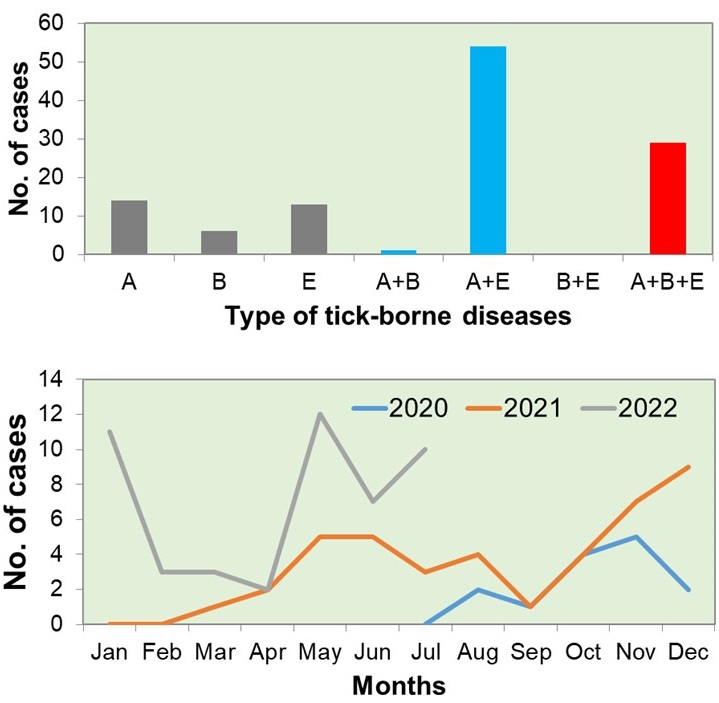
A disease caused by canine blood parasites (tick-borne diseases) is a condition in which dogs are bitten by tick-carrying pathogens. This study assessed the prevalence of diseases caused by canine blood parasites (Anaplasmosis, Babesiosis, and Ehrlichliosis) at the Companion Veterinary Clinic, Melaka, Malaysia, from August 2020 to July 2022. Secondary data of 103 infected dogs were obtained from medical records. Dogs at the puppy stage were more commonly diagnosed (26.21 %). Both males and females showed almost the same prevalence of 52.43% and 47.57%, respectively. Mongrel had a relatively higher prevalence compared to pedigree dogs but there was no breed predisposition. Multiple infections were more common than single infections. Canine tick-borne diseases show a higher prevalence during the intermonsoon season in Malaysia. Anorexia, inactivity, and bleeding diatheses are the most common clinical signs observed in dogs. To support the diagnosis, anaemia and thrombocytopenia were observed in the patient’s complete blood count results. The test kit was positive when antibodies or antigens were detected and parasites could also be observed under a microscope using a blood smear. The prevalence of tick-borne diseases is influenced by intrinsic (age and sex) and extrinsic factors (weather).
Baneth G. 2014. Tick-borne infections of animals and humans: A common ground. International Journal for Parasitology. 44(9):591-596. https://doi.org/10.1016/j.ijpara.2014.03.011 | PMid:24846527 DOI: https://doi.org/10.1016/j.ijpara.2014.03.011
Carrade DD, Foley JE, Borjesson DL. 2009. Canine granulocytic anaplasmosis: A review. Journal of Veterinary Internal Medicine. 23(6):1129-1141. https://doi.org/10.1111/j.1939-1676.2009.0384.x | PMid:19761477 DOI: https://doi.org/10.1111/j.1939-1676.2009.0384.x
Gal A, Harrus S, Arcoh I, Lavy E, Aizenberg I, Mekuzas-Yisaschar Y, Baneth G. 2007. Coinfection with multiple tick-borne and intestinal parasites in a 6-week-old dog. The Canadian Veterinary Journal. 48(6):619-622.
Louly CCB, Fonseca IN, Oliveira VF, Borges LMF. 2006. Ocorrência de Rhipicephalus sanguineus em trabalhadores de clínicas veterinárias e canis, no município de Goiânia, GO. Ciência Animal Brasileira 7(1):103-106.
Pereira M, Valério-Bolas A, Saraiva-Marques C, Alexandre-Pires G, Pereira da Fonseca I, Santos-Gomes G. 2019. Development of dog immune system: from in uterus to elderly. Veterinary sciences. 6(4):83. https://doi.org/10.3390/vetsci6040083 | PMid:31640234 PMCid:PMC6958461 DOI: https://doi.org/10.3390/vetsci6040083
Stich RW, Schaefer JJ, Bremer WG. 2008. Host surveys, ixodid tick biology and transmission scenarios as related to the tick-borne pathogen, Ehrlichia canis. Veterinary Parasitology. 158(4):256-273. https://doi.org/10.1016/j.vetpar.2008.09.013 | PMid:18963493 PMCid:PMC3053144 DOI: https://doi.org/10.1016/j.vetpar.2008.09.013
Sykes JE. 2023. Tick-Borne diseases. Veterinary Clinics: Small Animal Practice. 53(1):141-154. https://doi.org/10.1016/j.cvsm.2022.07.011 | PMid:36400471 DOI: https://doi.org/10.1016/j.cvsm.2022.07.011
Wang C, Ahlowalia SK, Li Y. 2010. Frequency and therapy monitoring of canine Babesia spp. infection by high-resolution melting curve quantitative FRET-PCR. Veterinary Parasitology.168(1-2):11-18. https://doi.org/10.1016/j.vetpar.2009.10.015 | PMid:19931290 DOI: https://doi.org/10.1016/j.vetpar.2009.10.015
Wikel SK. 2022. Changing geographic ranges of human biting ticks and implications for tick-borne zoonoses in North America. Zoonotic Diseases. 2(3):126-146. https://doi.org/10.3390/zoonoticdis2030013 DOI: https://doi.org/10.3390/zoonoticdis2030013
All articles published in this journal are licensed under a Creative Commons Attribution-ShareAlike 4.0 International License (CC BY-SA 4.0).
This license permits use, distribution, reproduction, and adaptation in any medium, including for commercial purposes, provided the original work is properly cited, a link to the license is given, and any changes made are indicated. Any derivative work must be distributed under the same license or a compatible license.
How to Cite