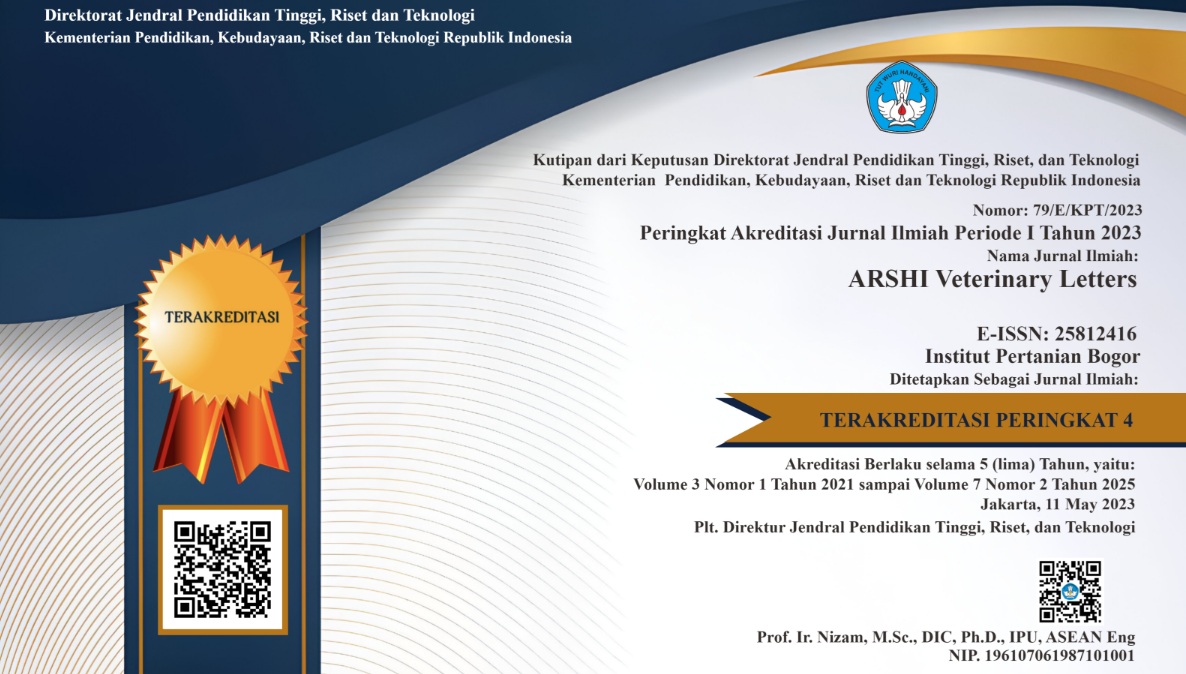
About the Journal
ARSHI Veterinary Letters (ARSHI Vet Lett) is an open-access, peer-reviewed journal in veterinary medicine and animal biomedical sciences.
The journal publishes concise, clinically relevant, and practitioner-oriented articles that support the advancement of veterinary science, clinical decision-making, and animal health practice.
Journal Information
Publisher
ARSHI Veterinary Letters is published by the School of Veterinary Medicine and Biomedical Sciences, IPB University, formerly the Faculty of Veterinary Medicine based on Rector Letter No. 328.
The journal is published in collaboration with the Indonesian Veterinary Hospital Association (Asosiasi Rumah Sakit Hewan Indonesia / ARSHI).
Focus and Aim
ARSHI Veterinary Letters is dedicated to publishing concise, clinically relevant, and practitioner-oriented articles in the field of veterinary medicine and animal biomedical sciences.
The journal aims to disseminate veterinary knowledge that is scientifically sound and practically applicable, particularly through publications that strengthen the linkage between academic research, diagnostic advancement, and everyday veterinary practice.
The journal emphasizes clinical case-driven, case-based, and practice-oriented contributions, including case reports, case series, short clinical communications, and other applied studies that support evidence-based decision-making in animal health, disease diagnosis, treatment, prevention, and management.
Article Coverage
In addition to clinically focused reports, the journal welcomes studies that contribute to the development of veterinary diagnostics, therapeutic approaches, biomedical applications, and animal health services.
ARSHI Veterinary Letters publishes manuscripts involving companion animals, livestock, poultry, wildlife, exotic animals, laboratory animals, and other animal species of veterinary importance.
Scope of the Journal
The scope of the journal includes, but is not limited to:
Readership and Publication Priority
Priority is given to submissions that offer clear clinical relevance, practical value, diagnostic insight, therapeutic novelty, or educational benefit.
The journal serves veterinarians, clinicians, researchers, academics, and veterinary students who are interested in applied veterinary medicine, animal health services, and biomedical science.
Open Access and Indexing
All articles published in ARSHI Veterinary Letters are openly accessible to readers worldwide.
The journal has been indexed in:
The journal is also under evaluation for inclusion in additional indexing and abstracting services.
Creative Commons Licence
All published works in ARSHI Veterinary Letters are licensed under the Creative Commons Attribution-ShareAlike 4.0 International License (CC BY-SA 4.0) .
ARSHI Veterinary Letters is committed to supporting concise, accessible, and practice-oriented scientific communication for the advancement of veterinary medicine and animal biomedical sciences.