Guide for Authors
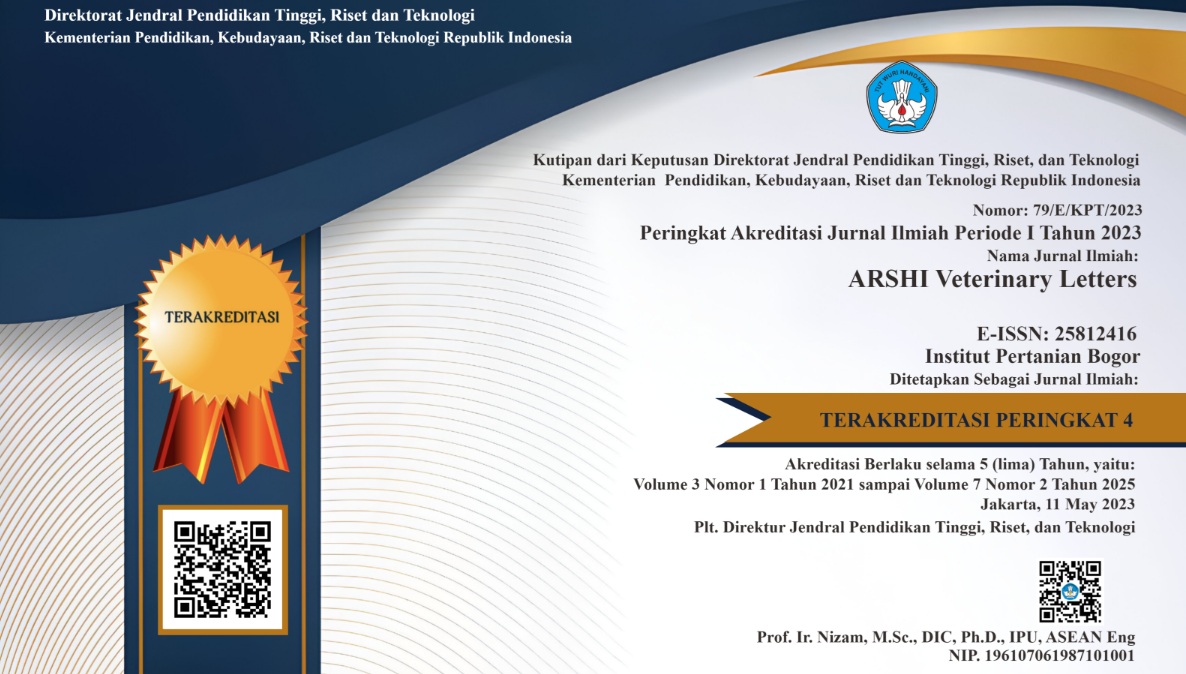
ARSHI Veterinary Letters (ARSHI Vet Lett) is an open-access, peer-reviewed scientific journal published by the Asosiasi Rumah Sakit Hewan Indonesia (ARSHI).
The journal serves as a platform for scholarly communication in veterinary medicine, particularly for articles with clinical, diagnostic, therapeutic, technical, and academic relevance.
ARSHI Vet Lett welcomes submissions in the form of clinical case reports, case series, short communications, technical notes, original research articles, and mini reviews that contribute to the advancement of veterinary science and practice.
Why Publish with ARSHI Vet Lett?
ARSHI Vet Lett is committed to providing a professional, transparent, and accessible publication process. Key benefits of publishing with the journal include:
- A streamlined manuscript submission process through an easy-to-use Open Journal Systems (OJS) platform;
- A dedicated editorial team actively engaged in veterinary clinical, academic, and scholarly publishing communities;
- A rigorous and independent peer review process to ensure high scientific and ethical standards;
- A transparent editorial workflow with online manuscript tracking;
- Global visibility through open-access publication, enhancing the discoverability and impact of published articles;
- Publication under the Creative Commons Attribution-ShareAlike (CC BY-SA) license; and
- An affordable Article Processing Charge (APC) designed to support accessibility for authors.
1. Manuscript Submission
All manuscripts must be submitted through the journal’s Online Journal System (OJS) at:
Authors are required to create an account and ensure that all manuscript metadata are entered completely and accurately, including:
- article title;
- full names of all authors;
- institutional affiliations;
- email addresses of all authors; and
- the designated corresponding author.
Manuscripts must be submitted in Microsoft Word format (.doc or .docx). Figures and tables should preferably be embedded in the manuscript at the appropriate positions and may also be uploaded as supplementary files if necessary.
At the time of submission, authors must also upload:
- a completed and signed Statement of Originality and Copyright Release Form (Form A);
- relevant ethical approval documents, where applicable; and
- any additional supporting files required by the journal.
All submitted manuscripts will undergo an initial administrative and editorial screening before being considered for peer review.
2. General Conditions of Submission
By submitting a manuscript to ARSHI Veterinary Letters, authors confirm that the manuscript:
- is original;
- has not been published previously in any form, except where permitted as a conference abstract or preprint in accordance with the journal’s policy;
- is not under consideration for publication elsewhere;
- does not involve duplicate publication, redundant publication, or “salami slicing”;
- has obtained all necessary institutional and ethical approvals, where applicable;
- has been approved by all listed authors prior to submission; and
- contains data, images, and materials that have been obtained and presented responsibly and lawfully.
All accepted manuscripts may undergo editorial and language editing to improve clarity, consistency, and readability without altering the scientific substance of the work.
3. Types of Manuscripts Accepted
ARSHI Vet Lett accepts the following categories of manuscripts:
A scientific report describing one to three clinical cases with educational, diagnostic, therapeutic, or scientific value in veterinary medicine.
A report describing four or more clinical cases that share a common clinical presentation, disease context, or management approach.
A concise report presenting preliminary findings, noteworthy observations, or clinically relevant information that does not require a full-length article format.
A manuscript describing a specific technique, procedure, method, tool, modification, or practical innovation relevant to veterinary practice or research.
A full-length research article presenting new and unpublished findings that make a clear contribution to the advancement of veterinary science.
A concise and critical review summarizing recent developments in a specific topic relevant to veterinary medicine.
4. Scope of the Journal
ARSHI Vet Lett welcomes manuscripts relevant to veterinary medicine, including but not limited to:
- clinical veterinary medicine;
- internal medicine;
- veterinary surgery;
- veterinary reproduction and obstetrics;
- diagnostic imaging and laboratory diagnostics;
- clinical pathology and anatomical pathology;
- infectious diseases and parasitology;
- veterinary pharmacology and therapeutics;
- companion animals, large animals, exotic animals, and wildlife medicine;
- veterinary hospital case management; and
- other technical or clinical innovations in veterinary science.
5. Reporting Standards
Authors are strongly encouraged to follow appropriate reporting guidelines according to the type of manuscript submitted, including but not limited to:
- the CARE Checklist for clinical case reports;
- the Joanna Briggs Institute (JBI) Checklist for case series; and
- other relevant reporting standards appropriate to the study design.
Reference: https://jbi.global/critical-appraisal-tools
Adherence to reporting guidelines is encouraged to improve the transparency, completeness, and scientific quality of submitted manuscripts.
6. Manuscript Structure and Preparation
Manuscripts should be prepared in clear, concise, and academically appropriate scientific language. Authors are strongly encouraged to ensure that the manuscript is written in high-quality English suitable for an international readership.
Manuscript Length and Supplementary Information
ARSHI Veterinary Letters is designed as a concise letter-format journal. Therefore, all submitted manuscripts, regardless of article type, must fit within a maximum of two published journal pages.
To maintain clarity, consistency, and readability, authors are strongly encouraged to prepare manuscripts in a brief, focused, and clinically meaningful format, emphasizing only the most essential scientific or clinical message.
- Main text: approximately 800–1,200 words;
- Abstract: up to 150 words;
- Keywords: up to 5;
- References: up to 10–15; and
- Tables/Figures: maximum 2 items total.
These limits apply to all manuscript categories, including Clinical Case Report, Case Series, Short Communication, Technical Note, Original Research Article, and Mini Review.
Supplementary Information
Authors may submit Supplementary Information when additional materials are necessary to support the manuscript but cannot be accommodated within the journal’s two-page main article format.
Supplementary files should not contain essential results that are necessary to understand the core conclusions of the article. Key findings must remain in the main manuscript.
Supplementary Information may include, but is not limited to:
- additional figures;
- extended tables;
- detailed laboratory or diagnostic data;
- imaging series;
- raw or supporting datasets;
- methodological details;
- video or multimedia files; and
- additional references directly related to supplementary content.
Authors should ensure that the main manuscript remains fully understandable on its own, while Supplementary Information serves to provide supporting depth, transparency, and completeness.
All supplementary files must be:
- clearly labeled;
- cited appropriately in the main text, for example Supplementary Figure 1 or Supplementary Table 1; and
- submitted in a format suitable for editorial and peer review.
The editorial office reserves the right to determine whether submitted supplementary materials are appropriate, necessary, and suitable for publication.
6.1 General Order of the Manuscript
Manuscripts should be arranged in the following order:
- Title Page
- Abstract
- Keywords
- Main Text
- Acknowledgments, if applicable
- Funding Statement
- Conflict of Interest Statement
- Data Availability Statement
- References
- Tables and Figures, if not embedded within the main text
7. Title Page
The title page must include:
- a clear, concise, and informative article title;
- full names of all authors;
- institutional affiliations for each author;
- email addresses of all authors; and
- the name and email address of the corresponding author.
The title should accurately reflect the scientific focus of the manuscript and avoid unnecessary abbreviations.
8. Abstract and Keywords
8.1 Abstract
Each manuscript must include an abstract written as a single paragraph with a maximum length of 300 words.
The abstract should briefly summarize:
- the background or context;
- the objective of the study or report;
- the main findings;
- the principal interpretation; and
- the clinical or scientific significance.
References should not be included in the abstract.
8.2 Keywords
Please provide up to five keywords relevant to the manuscript. Keywords should complement, rather than simply repeat, the words used in the title.
9. Recommended Structure by Article Type
Recommended structure:
- Introduction
- Case Presentation
- Discussion
- Conclusion
The case presentation should include animal identification, history, physical examination, diagnostics, diagnosis, treatment, clinical progression, and outcome.
Recommended structure:
- Introduction
- Case Series Presentation
- Discussion
- Conclusion
Each case should be presented consistently and systematically to facilitate comparison across cases.
Recommended structure:
- Introduction
- Main Findings / Observation
- Discussion
- Conclusion
Recommended structure:
- Introduction
- Technical Description / Procedure
- Practical Relevance / Discussion
- Conclusion
Authors are encouraged to use the IMRAD format:
- Introduction
- Materials and Methods
- Results
- Discussion
- Conclusion
Recommended structure:
- Introduction
- Main Review Sections/Subsections
- Conclusion / Future Perspective
10. General Formatting Requirements
Authors should observe the following technical and stylistic requirements:
- Use formal and consistent scientific language;
- Use SI Units for all measurements;
- Avoid uncommon abbreviations; if used, define them at first mention;
- Scientific names of species must be written in italics at first mention;
- Use accurate veterinary and biomedical terminology; and
- Avoid ambiguous, overly narrative, or non-scientific language.
11. Figures, Tables, and Visual Materials
11.1 Figures
- Figures must be of good quality with a minimum resolution of 300 dpi;
- Clinical photographs, radiographs, ultrasonographic images, micrographs, and illustrations should be clear and legible; and
- If figures contain identifiable owner, client, or patient information, authors must ensure that appropriate publication permission has been obtained.
11.2 Tables
- Tables must include clear and descriptive titles;
- Appropriate units must be indicated where applicable;
- Vertical lines should be avoided; and
- Tables should be presented as simply as possible and should not unnecessarily duplicate information already described in the text.
11.3 Citation in Text
All figures and tables must be cited consecutively in the main text, for example: Figure 1 and Table 1.
12. References
ARSHI Vet Lett uses the Vancouver referencing style.
General requirements include:
- References must be listed in the order in which they first appear in the text;
- Authors are responsible for the accuracy and completeness of all references;
- References should be drawn from relevant, credible, and up-to-date scientific sources; and
- Whenever possible, authors are encouraged to prioritize primary research articles over weak or secondary sources.
The use of reference management software such as Mendeley, Zotero, or EndNote is strongly recommended to ensure citation consistency.
13. Ethical Standards in Research and Publication
13.1 Animal Research Ethics
Research involving animals must be conducted in accordance with recognized principles of animal welfare and scientific ethics. Manuscripts reporting experimental studies must include:
- the name of the approving ethical committee or institution;
- the ethical approval number, if available; and
- a statement confirming that the study was approved by an Institutional Animal Care and Use Committee (IACUC) or an equivalent body.
13.2 Owner Consent
For clinical case reports, authors must obtain owner consent for the publication of clinical information and any relevant images. Written consent must be retained securely by the authors and made available to the editorial office upon request.
13.3 Publication Ethics
ARSHI Vet Lett adheres to the principles of the Committee on Publication Ethics (COPE) and does not tolerate:
- plagiarism;
- data fabrication;
- data falsification;
- image manipulation;
- duplicate publication;
- simultaneous submission;
- unethical authorship practices; or
- any other form of publication misconduct.
All manuscripts may be screened using plagiarism detection software such as Turnitin or iThenticate.
14–17. Authorship, Conflict of Interest, Funding, and Data Availability
14. Authorship
All individuals listed as authors must have made a substantial scholarly contribution to the manuscript, such as involvement in:
- the conception or design of the study;
- data collection or analysis;
- interpretation of findings;
- drafting of the manuscript; or
- critical revision of the intellectual content.
All authors must approve the final version of the manuscript before submission. Individuals who do not meet the criteria for authorship should be acknowledged in the Acknowledgments section rather than listed as authors.
15. Conflict of Interest
Authors must disclose all potential conflicts of interest that could influence the interpretation or presentation of the work.
16. Funding Statement
All sources of financial support, grants, sponsorship, or institutional assistance must be clearly disclosed.
17. Data Availability Statement
Authors must include a statement describing the availability of the data supporting the findings of the manuscript. Examples include:
“All relevant data are included within the article.”
18. Peer Review Process
ARSHI Vet Lett applies a single-anonymized peer review process, in which reviewer identities are concealed from the authors, while reviewers are aware of the authors’ identities.
Each manuscript that passes the initial editorial screening will be evaluated by at least two and up to three independent reviewers with relevant expertise in the subject area.
Reviewers assess manuscripts based on criteria including:
- originality;
- scientific relevance;
- methodological quality;
- validity of interpretation;
- quality of writing;
- ethical compliance; and
- contribution to the field of veterinary medicine.
Editorial decisions may include:
- Accept
- Minor Revision
- Major Revision
- Reject
The final decision rests with the Editor-in-Chief.
Manuscripts submitted by editors or editorial board members are handled through a fully independent editorial process to avoid conflicts of interest.
19. Manuscript Revision
If revision is requested, authors must submit:
- a revised version of the manuscript; and
- a point-by-point response to reviewers.
Responses to reviewers should be written clearly, respectfully, and systematically, indicating how each comment has been addressed in the revised manuscript.
Revised manuscripts may be:
- assessed directly by the editor; or
- returned to the original reviewers for further evaluation.
Failure to submit revisions within the requested timeframe, without adequate communication, may result in administrative withdrawal of the manuscript.
20. Copyright and Licensing
All articles published in ARSHI Veterinary Letters are distributed under the Creative Commons Attribution-ShareAlike (CC BY-SA) license.
Under this license:
- authors retain copyright of their work;
- the journal is granted the right to publish and disseminate the article;
- others may share, adapt, and reuse the work, provided that appropriate credit is given to the authors and the journal; and
- any derivative works are distributed under the same license.
21–24. Proofs, APC, Appeals, and Editorial Contact
21. Proofs and Publication
Once a manuscript has been accepted, page proofs will be sent to the corresponding author for review. Authors are required to return corrected proofs within three (3) working days.
At the proof stage, only typographical corrections, minor factual corrections, or essential technical clarifications should be made. Substantial scientific changes are generally not permitted at this stage.
The journal aims to publish accepted articles online promptly after completion of the final editorial process.
22. Article Processing Charge (APC)
Information regarding the Article Processing Charge (APC) is available on the journal’s publication fee page.
23. Appeals and Complaints
Authors may submit an appeal if they believe that a rejection decision resulted from a misunderstanding, factual error, or scientific judgment that warrants reconsideration.
Appeals must be submitted by the corresponding author via email to the editorial office and should include:
- the manuscript number;
- the manuscript title; and
- a clear and detailed scientific justification.
The editorial team may review the original decision, seek additional independent editorial or reviewer input, or uphold the original decision. The final decision on appeals rests with the journal and is considered final.
24. Editorial Contact
For inquiries regarding manuscript submission, journal policy, or the editorial process, please contact the editorial office through the official contact page of ARSHI Veterinary Letters.
Submission Checklist
Before submitting your manuscript, please ensure that:
- The manuscript fits the journal’s scope;
- The manuscript has not been published previously and is not under consideration elsewhere;
- All authors have approved the submission;
- The manuscript file is prepared according to the journal’s format;
- The abstract and keywords have been included;
- References are formatted in Vancouver style;
- All tables and figures are numbered and cited in the text;
- A conflict of interest statement is included;
- A funding statement is included;
- A data availability statement is included;
- Ethical approval and/or owner consent has been addressed where required; and
- Form A has been completed and uploaded.
Final Statement. By submitting a manuscript to ARSHI Veterinary Letters, authors are deemed to have read, understood, and agreed to comply with all applicable editorial policies, publication ethics standards, and technical requirements of the journal.