
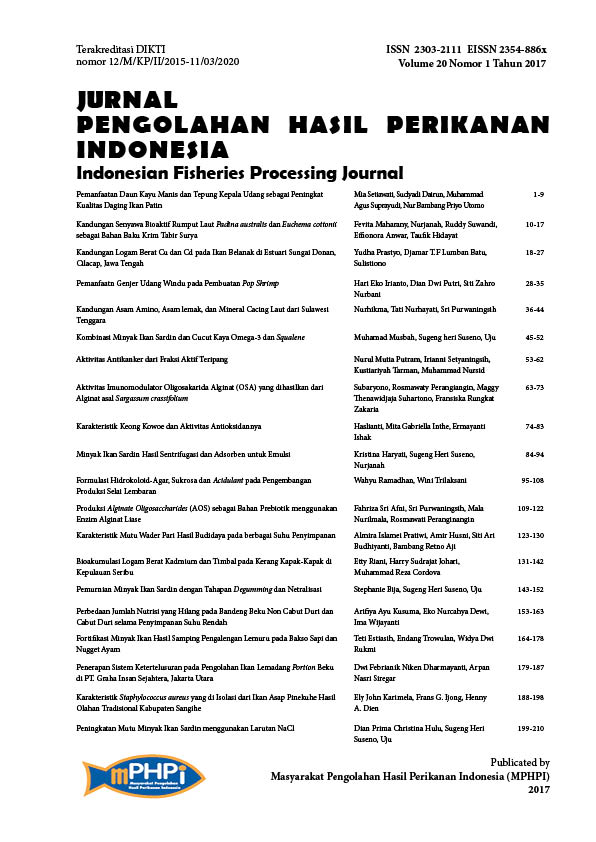
Sardine Fish Oil By Sentrifugation and Adsorbent for Emulsion
Article Sidebar
Submitted
May 12, 2017
Published
April 25, 2017
Keywords:
-
carboxymethyl cellulose (CMC), juice, lecithin.
Abstract
Sardine fish meal by-product contain eicosapentaenoic acid (EPA) and docosahexaenoic (DHA) and it can be made as emulsion. The purpose of this study were to determine the best fish oil emulsion by mixing
the oil phase (lecithin 3% and oil) and water phase (carboxymethyl cellulose/CMC 2% and fruit juice) and then stored until creaming, and the emulsion is analyzed their viscosity, pH, percent of stability and long
separation. Sardine oil is separated from the emulsion and tested oxidation parameters. The best emulsion was fish oil emulsion after refined without citric acid (RTS) with viscosity (2470.31 cP), pH (5.64), percent of stability (56.14%) and long separation (14 days). Primary and secondary oxidation parameters of RTS were FFA (14.87%), PV (14.43 meq/kg), AV (32.57 meq KOH/g), AnV (17.3 meq/kg), and Totox (46.16 meq/kg).
the oil phase (lecithin 3% and oil) and water phase (carboxymethyl cellulose/CMC 2% and fruit juice) and then stored until creaming, and the emulsion is analyzed their viscosity, pH, percent of stability and long
separation. Sardine oil is separated from the emulsion and tested oxidation parameters. The best emulsion was fish oil emulsion after refined without citric acid (RTS) with viscosity (2470.31 cP), pH (5.64), percent of stability (56.14%) and long separation (14 days). Primary and secondary oxidation parameters of RTS were FFA (14.87%), PV (14.43 meq/kg), AV (32.57 meq KOH/g), AnV (17.3 meq/kg), and Totox (46.16 meq/kg).
Full text article
Generated from XML file
Authors
Haryati, K., Suseno, S. H., & Nurjanah, N. (2017). Sardine Fish Oil By Sentrifugation and Adsorbent for Emulsion. Jurnal Pengolahan Hasil Perikanan Indonesia, 20(1), 84-94. https://doi.org/10.17844/jphpi.v20i1.16437
Authors who publish with this journal agree to the following terms:
- Authors retain copyright and grant the journal right of first publication with the work simultaneously licensed under a Creative Commons Attribution License that allows others to share the work with an acknowledgement of the work's authorship and initial publication in this journal.
- Authors are able to enter into separate, additional contractual arrangements for the non-exclusive distribution of the journal's published version of the work (e.g., post it to an institutional repository or publish it in a book), with an acknowledgement of its initial publication in this journal.
Article Details
How to Cite
Haryati, K., Suseno, S. H., & Nurjanah, N. (2017). Sardine Fish Oil By Sentrifugation and Adsorbent for Emulsion. Jurnal Pengolahan Hasil Perikanan Indonesia, 20(1), 84-94. https://doi.org/10.17844/jphpi.v20i1.16437



