Bioavailability properties of intravaginal implants made from chitosan-PEG-PCL in simulated vaginal fluid and vagina of cattle

Downloads
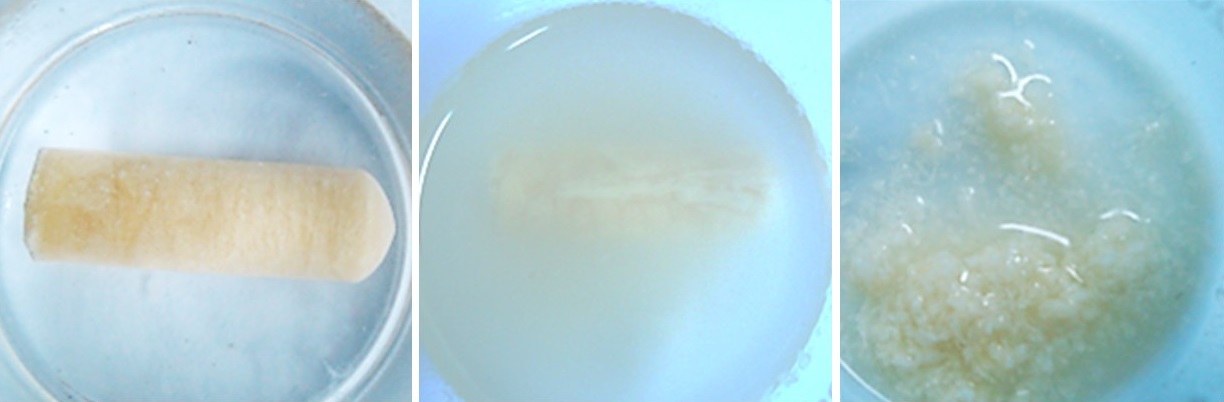
This study aimed to design and evaluate the bioavailability of intravaginal implants made from the biodegradable polymer chitosan-polyethylene glycol (PEG)-polycaprolactone (PCL) in simulated vaginal fluid (SVF) and the cow vagina. Implants were prepared using melt-ing and molding techniques with 26 different formulations. Next, the implants were immersed in 40 mL of SVF at a temperature of 37.8 ℃ and changes in implant morphology were observed every day until day 5. Implants that survived until day five were tested for further availability in the cow's vagina and observed daily for 2 weeks. The immersion test on SVF results showed that implants with a PEG content of 75-85% melt more quickly than implants with a PEG content of 20-72%. Implants containing 1-10% PCL eroded more rapidly in the SVF than those containing 22-80% PCL. Implants containing chitosan can remain stable in the SVF for longer than implants without chitosan. The bioavailability test in the cow's vagina showed that implants 21-23 persisted until the 10th day, while implants 24-26 were expelled from the cow's vagina during the test. Implant 21-23 is a promising formulation for the development of biodegradable intravaginal implants. By adjusting the composition of chitosan (between 14-18 wt%), PEG (maximum 72 wt%), and PCL (minimum 20 wt%), intravaginal implants were able to extend the bioavailability of both simulated vaginal fluid and the vagina of cattle.
Adithya SP, Sidharthan DS, Abhinandan R, Balagangadharan K, Selvamurugan N. 2020. Nanosheets-incorporated bio-composites containing natural and synthetic polymers / ceram-ics for bone tissue engineering. International Journal of Biolog-ical Macromolecules. 164:1960-1972. https://doi.org/10.1016/j.ijbiomac.2020.08.053 | PMid:32800960 DOI: https://doi.org/10.1016/j.ijbiomac.2020.08.053
de Graaff W, Grimard B. 2018. Progesterone-releasing devices for cattle estrus induction and synchronization: Device optimi-zation to anticipate shorter treatment durations and new device developments. Theriogenology. 112:34-43. https://doi.org/10.1016/j.theriogenology.2017.09.025 | PMid:29033104 DOI: https://doi.org/10.1016/j.theriogenology.2017.09.025
Helbling IM, Karp F, Cappadoro A, Luna JA. 2020. Design and evaluation of a recyclable intravaginal device made of ethylene vinyl acetate copolymer for bovine estrus synchronization. Drug Delivery and Translational Research. 10:1255-1266. https://doi.org/10.1007/s13346-020-00717-4 | PMid:31974730 DOI: https://doi.org/10.1007/s13346-020-00717-4
Rajan SS, Cavera VL, Zhang X, Singh Y, Chikindas ML, Sinko PJ. 2014. Polyethylene glycol-based hydrogels for controlled release of the antimicrobial subtilosin for prophylaxis of bacterial vaginosis. Antimicrobial Agents and Chemotherapy. 58(5):2747-2753. https://doi.org/10.1128/AAC.02446-14 | PMid:24566190 PMCid:PMC3993243 DOI: https://doi.org/10.1128/AAC.02446-14
Rathbone MJ, Bunt CR, Ogle CR, Burggraaf S, Macmillan KL, Pickering K. 2002. Development of an injection molded poly(ε-caprolactone) intravaginal insert for the delivery of progesterone to cattle. Journal of Controlled Release. 85:61-71. https://doi.org/10.1016/S0168-3659(02)00272-9 | PMid:12480312 DOI: https://doi.org/10.1016/S0168-3659(02)00272-9
Szymanska E, Winnicka K, Amelian A, Cwalina U. 2014. Vaginal chitosan tablets with clotrimazole-design and evaluation of mucoadhesive properties using porcine vaginal mucosa, mucin and gelatine. Chemical and Pharmaceutical Bulletin. 62(2):160-167. https://doi.org/10.1248/cpb.c13-00689 | PMid:24492586 DOI: https://doi.org/10.1248/cpb.c13-00689
Yessa EY, Tumbelaka LI, Wientarsih I, Ulum MF, Purwantara B. 2023. In vitro, in compost, and in vivo assessment of chitosan-polyethylene glycol as an intravaginal insert for progesterone delivery in sheep. Tropical Animal Science Journal. 46(3):295-305. https://doi.org/10.5398/tasj.2023.46.3.295 DOI: https://doi.org/10.5398/tasj.2023.46.3.295
Xiao XF, Jiang XQ, Zhou LJ. 2013. Surface modification of poly ethylene glycol to resist nonspecific adsorption of proteins. Chinese Journal of Analytical Chemistry. 41(3):445-453. https://doi.org/10.1016/S1872-2040(13)60638-6 DOI: https://doi.org/10.1016/S1872-2040(13)60638-6
All articles published in this journal are licensed under a Creative Commons Attribution-ShareAlike 4.0 International License (CC BY-SA 4.0).
This license permits use, distribution, reproduction, and adaptation in any medium, including for commercial purposes, provided the original work is properly cited, a link to the license is given, and any changes made are indicated. Any derivative work must be distributed under the same license or a compatible license.
How to Cite