Molecular detection of Haemonchus contortus on spotted deer (Axis axis)

Downloads
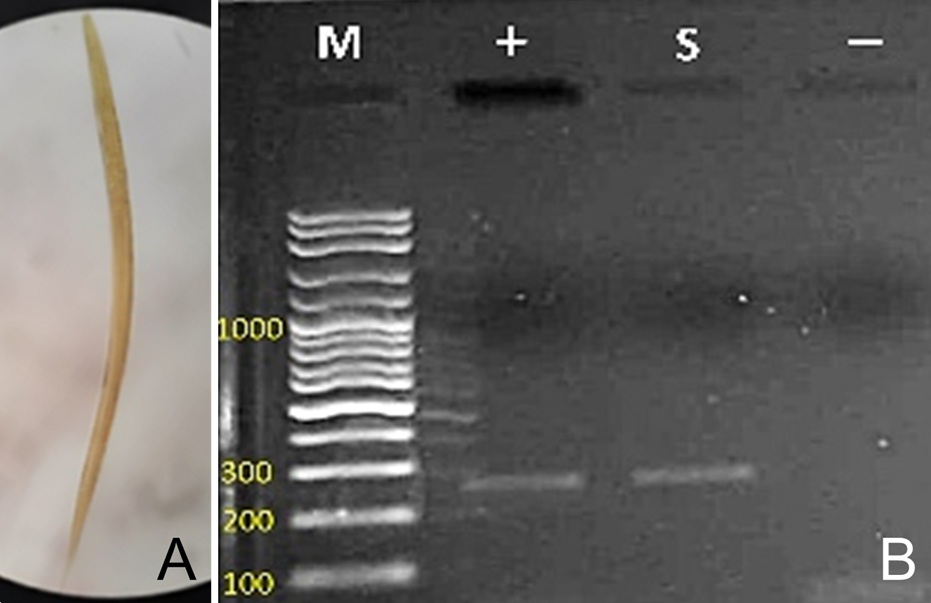
Spotted deer (Axis axis) as a protected endemic animal has the potential to be developed to provide economic value. However, in general, deer are often infected by endoparasitic diseases caused by various factors such as direct contact with infected areas to transmission through feed. As a result of endoparasitic infections, infected animals can experience malnutrition, physiological disorders, and even death. This study aims to identify nematode worm species using molecular diagnosis in spotted deer. Molecular identification of nematode species in deer feces was carried out by fecal sample collection and cultivation, larvae isolation, DNA extraction, PCR process, and electrophoresis. Molecular analysis using specific primer targeting the ITS gene. The PCR results showed the single band at 260 bp. Based on the result, the nematode species that has infected the spotted deer was Haemonchus contortus. These findings provide the first molecular-level confirmation of endoparasite infection in spotted deer in Indonesia, expanding the existing diagnostic information for wildlife health monitoring.
Amarante MRV, Santos MC, Bassetto CC, Amarante AFT. 2017. PCR primers for straightforward differentiation of Haemonchus contortus, Haemonchus placei and their hybrids. Journal of Helminthology. 91(6):757-761. https://doi.org/10.1017/S0022149X16000882 | PMid:28069083
Anggraini, S. 2010. Derajat Infestasi Strongylus spp pada Kuda Bendi di Kota Payakumbuh Sumatera Barat [Thesis]. Aceh: Universitas Syiah Kuala.
Besier RB, Kahn LP, Sargison ND, Van Wyk JA. 2016. The patho-physiology ecology and epidemiology of Haemonchus contortus infection in small ruminants. Advances in Parasitology. 93:95-143. https://doi.org/10.1016/bs.apar.2016.02.022 | PMid:27238004
Hambal M, Mukhtar RS, Hanafiah M, Fahrimal Y, Winaruddin, Manad ZH. 2016. Perkembangan dan gambaran anatomis larva infektif (L3) Haemonchus contortus yang dibiakkan dengan vermicullite. Jurnal Medika Veterinaria. 10(1):63-66. https://doi.org/10.21157/j.med.vet..v10i1.4043
Hartono, Suprihati E, Safitri E, L Retno ND, Mufasirin, Kusnoto. 2019. Identifikasi jenis-jenis endoparasit yang terdapat pada saluran pencernaan rusa bawean (Axis kuhli) dan rusa totol (Axis axis) di Taman Flora Bratang-Surabaya. Journal of Parasite Science. 3(2):53-58. https://doi.org/10.20473/jops.v3i2.16518
Laing R, Kikuchi T, Martinelli A, Tsai IJ, Beech RN, Redman E, Holroyd N, Bartley DJ, Beasley H, Britton C, Curran D. 2013. The genome and transcriptome of Haemonchus contortus, a key model parasite for drug and vaccine discovery. Genome Biology. 14(8):R88. https://doi.org/10.1186/gb-2013-14-8-r88 | PMid:23985316 PMCid:PMC4054779
Shaikenov BS, Rysmukhambetova AT, Massenov B, Deplazes P, Mathis A, Torgerson PR. 2004. The use of a polymerase chain reaction to detect Echinococcus granulosus (G1 Strain) egg in soil sample. American Journal of Tropical Medicine and Hygiene. 71(4):441-443. https://doi.org/10.4269/ajtmh.2004.71.441 | PMid:15516640
Tapia-Escárate D, Lopez-Villalobos N, Scott I, Wilson PR, Bisset SA, Sanhueza JM, Pomroy WE. 2020. A survey of gastrointestinal nematode species in red deer (Cervus elaphus) farms in New Zealand using PCR. Veterinary Parasitology: Regional Studies and Reports. 21:100419. https://doi.org/10.1016/j.vprsr.2020.100419 | PMid:32862895
Wirawan IGKO, Jaya IK, Randu MDS. 2019. Keragaman dan inten-sitas infeksi endoparasit gastrointestinal pada sapi bali dengan sistem ekstensif di Kabupaten Kupang. Jurnal Sain Veteriner. 37(2):151-159. https://doi.org/10.22146/jsv.43185
Yuswandi, Yuniar R. 2015. Studi biologi larva dan cacing dewasa Haemonchus contortus pada kambing. Jurnal Sain Veteriner. 33(1):42-45.
Copyright (c) 2025 CC-BY-SA

This work is licensed under a Creative Commons Attribution-ShareAlike 4.0 International License.
All articles published in this journal are licensed under a Creative Commons Attribution-ShareAlike 4.0 International License (CC BY-SA 4.0).
This license permits use, distribution, reproduction, and adaptation in any medium, including for commercial purposes, provided the original work is properly cited, a link to the license is given, and any changes made are indicated. Any derivative work must be distributed under the same license or a compatible license.
How to Cite