Effect of subacute administration of orange juice (Citrus sinensis) on duodenal structure in paediatric Sprague-Dawley rats (Rattus novergicus)

Unduhan
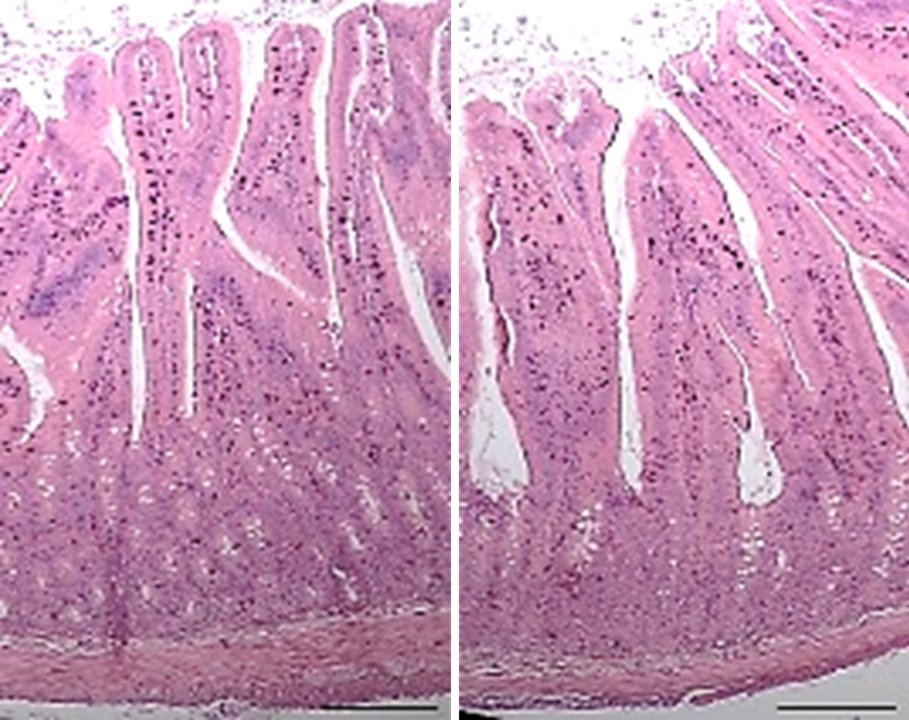
This research investigates the impact of orange juice consumption on the histological structure of the duodenum, a critical site for nutrient absorption and digestion. Focusing on pediatric animals, orange juice (with a pH of 3) was administered to post-weaning rats aged 4 weeks to 6 weeks at dosages ranging from 0g/kg BW to 20g/kg BW over two weeks. Duodenal histopathology was assessed, focusing on parameters such as the quantity of crypts of Lieberkuhn, as well as the length, height, width, and depth of villi (measured in μm). Anatomical pathology examination included measurements of the length and width of the duodenum (also in μm), as well as the color mean (OD). The research findings indicate no significant changes in histo-pathology or anatomy pathology of the duodenum. This suggests that young individuals can adapt to acidic challenges without compromising gastrointestinal health. These findings offer reassurance regarding the short-term consumption of acidic orange juice (with a pH of 3) with minimal risks to intestinal integrity, both during growth and development.
[BPOM] Badan Pengawas Obat dan Makanan. 2022. Peraturan Kepala Badan Pengawas Obat dan Makanan Nomor 7 Tahun 2022 tentang Pedoman Uji Toksisitas Nonklinik secara In Vivo. Jakarta: BPOM.
Azzini E, Venneria E, Ciarapica D, Foddai MS, Intorre F, Zaccaria M, Maiani F, Palomba L, Barnaba L, Tubili C, Maiani G. 2017. Effect of red orange juice consumption on body composition and nutritional status in overweight/obese female: a pilot study. Oxidative Medicine and Cellular Longevity. 2017(1):1672567. https://doi.org/10.1155/2017/1672567 DOI: https://doi.org/10.1155/2017/1672567
Beasley DE, Koltz AM, Lambert JE, Fierer N, Dunn RR. 2015. The evolution of stomach acidity and its relevance to the human microbiome. PloS one. 10(7):e0134116. https://doi.org/10.1371/journal.pone.0134116 DOI: https://doi.org/10.1371/journal.pone.0134116
Celi P, Cowieson AJ, Fru-Nji F, Steinert RE, Kluenter AM, Verlhac V. 2017. Gastrointestinal functionality in animal nutrition and health: new opportunities for sustainable animal production. Animal Feed Science and Technology. 234:88-100. https://doi.org/10.1016/j.anifeedsci.2017.09.012 DOI: https://doi.org/10.1016/j.anifeedsci.2017.09.012
Farrell RJ, Kelly CP. 2002. Celiac sprue. New England Journal of Medicine. 346(3):180-188. https://doi.org/10.1056/NEJMra010852 DOI: https://doi.org/10.1056/NEJMra010852
Gebishu M, Fikadu B, Bekele B, Tesfaye Jule L, N N, Ramaswamy K. 2022. Fluorescence and UV/visible spectroscopic investigation of orange and mango fruit juice quality in case of Adama Town. Scientific Reports. 12(1):7345. https://doi.org/10.1038/s41598-022-11471-7 DOI: https://doi.org/10.1038/s41598-022-11471-7
Gelberg H. 2018. Pathophysiological mechanisms of gastrointestinal toxicity. Comprehensive Toxicology. 2018:139. https://doi.org/10.1016/B978-0-12-801238-3.10923-7 DOI: https://doi.org/10.1016/B978-0-12-801238-3.10923-7
Kim JE, Lee MR, Park JJ, Choi JY, Song BR, Son HJ, Choi YW, Kim KM, Hong JT, Hwang DY. 2018. Quercetin promotes gastrointestinal motility and mucin secretion in loperamide-induced constipation of SD rats through regulation of the mAChRs downstream signal. Pharmaceutical biology. 56(1):309-317. https://doi.org/10.1080/13880209.2018.1474932 DOI: https://doi.org/10.1080/13880209.2018.1474932
Momoh AO, Loyibo E. 2021. The evaluation of the effects of orange juice on the microflora, haematology and selected organs of albino rats. Journal of Probiotics & Health. 9(1):230.
Porter EM, Bevins CL, Ghosh D, Ganz T. 2002. The multifaceted Paneth cell. Cell and Molecular Life Sciences. 59:156-170. https://doi.org/10.1007/s00018-002-8412-z DOI: https://doi.org/10.1007/s00018-002-8412-z
Shaker A, Rubin DC. 2010. Intestinal stem cells and epithelial-mesenchymal interactions in the crypt and stem cell niche. Transla-tional Research. 156(3):180-187. https://doi.org/10.1016/j.trsl.2010.06.003 DOI: https://doi.org/10.1016/j.trsl.2010.06.003
Simon Á, Gulyás G, Mészár Z, Bhide M, Oláh J, Bai P, Csősz É, Jávor A, Komlósi I, Remenyik J, Czeglédi L. 2019. Proteomics alterations in chicken jejunum caused by 24 h fasting. PeerJ. 7:e6588. https://doi.org/10.7717/peerj.6588 DOI: https://doi.org/10.7717/peerj.6588
Karya ini dilisensikan di bawah Creative Commons Attribution-ShareAlike 4.0 International License (CC BY-SA 4.0).
Lisensi ini mengizinkan siapa pun untuk menyalin, membagikan, menggunakan kembali, mengadaptasi, mengubah, dan mengembangkan karya ini dalam media atau format apa pun, termasuk untuk tujuan komersial, dengan syarat mencantumkan atribusi yang sesuai kepada penulis/pencipta asli, menyertakan tautan ke lisensi, dan menjelaskan jika ada perubahan yang dilakukan.
Apabila karya ini diadaptasi atau dimodifikasi, hasil adaptasinya harus didistribusikan dengan lisensi yang sama atau lisensi yang kompatibel.
Cara Mengutip