Treatment of otitis externa caused by Malassezia spp. in a local dog: a non-systemic antifungal approach

Downloads
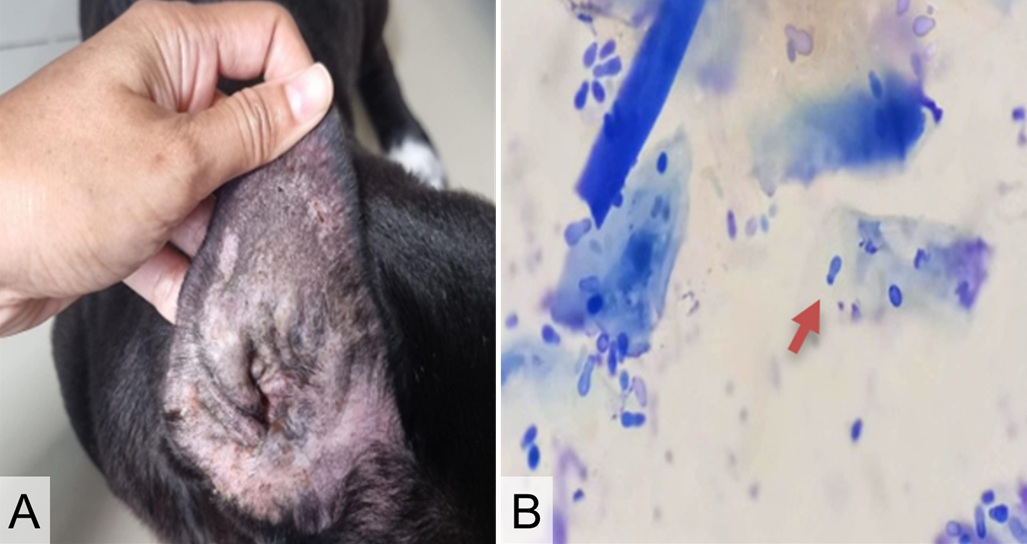
Malassezia spp. are part of the commensal microbiota on the skin and ears of dogs; however, under certain conditions, they can overgrow, triggering otitis externa. Systemic therapy is effective; however, its use is limited by its potential for resistance and hepatotoxic effects. This article reports a case of dextra otitis externa caused by Malassezia spp. in a 1.5-year-old male dog. On initial examination, the dog showed swelling of the right ear flap, scratching wounds, yellowish exudate, narrowing of the ear canal, as well as alopecia, erythema, and nodules on the ear flap and neck. The diagnosis was confirmed by clinical examination and cytology, which revealed the presence of Malassezia spp. The treatment consisted of ear cleaning with a 3% chlorhexidine solution (topical, q12h for 14 days), bathing with a 2% miconazole nitrate-medicated shampoo, and additional therapy with antibiotics, prednisone, chlorpheniramine maleate, and supplements. Evaluation at the 7-day post-treatment follow-up showed a marked clinical improvement. At the 25-day post-treatment follow-up, the patient recovered without recurrence. This case report confirms that topical antifungal therapy with supportive therapy is effective for the treatment of Malassezia spp. in dogs.
Bajwa J. 2023. Malassezia species and its significance in canine skin disease. The Canadian Veterinary Journal. 64(1):87-90.
Chiavassa E, Tizzani P, Peano A. 2014. In vitro antifungal susceptibility of Malassezia pachydermatis strains isolated from dogs with chronic and acute otitis externa. Mycopathologia. 178(3):315-319. https://doi.org/10.1007/s11046-014-9782-0 | PMid:25031085
Hoes NP, van den Broek J, Vroom MW. 2022. The efficacy of a novel topical spray composed of sodium benzoate, alcohol and botanical oils for the treatment of Malassezia dermatitis in dogs-a split body, randomised, blinded study. Veterinary Dermatology. 33(5):398-401. https://doi.org/10.1111/vde.13100 | PMid:35811489
Maynard L, Rème CA, Viaud S. 2011. Comparison of two shampoos for the treatment of canine Malassezia dermatitis: a randomised controlled trial. Journal of small animal practice. 52(11):566-572. https://doi.org/10.1111/j.1748-5827.2011.01124.x | PMid:21985533
Negre A, Bensignor E, Guillot J. 2009. Evidence‐based veterinary dermatology: a systematic review of interventions for Malassezia dermatitis in dogs. Veterinary dermatology. 20(1):1-12. https://doi.org/10.1111/j.1365-3164.2008.00721.x | PMid:19152584
Puig L, Castellá G, Cabañes FJ. 2019. Quantification of Malassezia pachydermatis by real-time PCR in swabs from the external ear canal of dogs. Journal of Veterinary Diagnostic Investigation. 31(3):440-447. https://doi.org/10.1177/1040638719840686 | PMid:30943876 PMCid:PMC6838723
Rodrigues TCN, Vandenabeele S. 2021. Pilot study of dogs with suppurative and non-suppurative Malassezia otitis: A case series. BMC Veterinary Research. 17(1):353. https://doi.org/10.1186/s12917-021-03066-7 | PMid:34794441 PMCid:PMC8603560
Sihelská Z, Čonková E, Váczi P, Harčárová M. 2019. Antifungal susceptibility of Malassezia pachydermatis isolates from dogs. Folia Veterinaria. 63(2):15-20. https://doi.org/10.2478/fv-2019-0013
Thangavelu A, Kaspar SS, Kathirvelu RP, Srinivasan B, Srinivasan S, Sundram R. 2020. Chlorhexidine: an elixir for periodontics. Journal of Pharmacy and Bioallied Sciences. 12(Suppl 1):S57-S59. https://doi.org/10.4103/jpbs.JPBS_162_20 | PMid:33149431 PMCid:PMC7595540
Copyright (c) 2025 CC-BY-SA

This work is licensed under a Creative Commons Attribution-ShareAlike 4.0 International License.
All articles published in this journal are licensed under a Creative Commons Attribution-ShareAlike 4.0 International License (CC BY-SA 4.0).
This license permits use, distribution, reproduction, and adaptation in any medium, including for commercial purposes, provided the original work is properly cited, a link to the license is given, and any changes made are indicated. Any derivative work must be distributed under the same license or a compatible license.
How to Cite