Detection of antibiotic residues in leg quarter of chickens slaughtered in accredited poultry dressing plants in Nueva Ecija, Philippines

Downloads
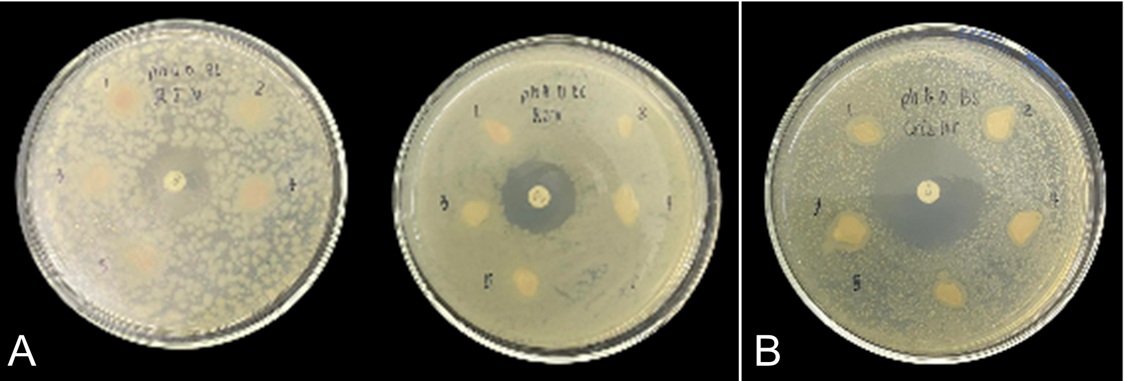
Antibiotic residues in consumable products pose health risks by contributing to antibiotic-resistant bacteria (ARBs), antibiotic-resistant genes (ARGs), and teratogenic and carcinogenic effects. Regular screening of livestock products allows monitoring of these residues in humans. This study aimed to determine the presence of six antibiotic class residues (beta-lactams, aminoglycosides, quinolones, sulfonamides, macrolides, and tetracycline) and multidrug residues in chicken leg quarters (CLQs) from an accredited Poultry Dressing Plant (PDP) in Nueva Ecija, Philippines. Thirty CLQs were collected from six PDPs in Nueva Ecija. Six muscle tissue specimens from each sample were screened for antibiotic residues through microbial inhibition tests at the National Meat Inspection Service (NMIS) Reserve Officers' Training Corps (RTOC) Regional III Laboratory Division, San Fernando, Pampanga. An inhibition zone ≥2 mm indicated a positive result. Screening showed no samples tested positive for any residue, and multi-drug residues were absent. No CLQs contained residues that exceeded the Maximum Residue Limit. CLQs from accredited PDPs in Nueva Ecija contained no antibiotic residues. These results may be due to strict antibiotic regulations, good veterinary supervision on source farms, and proper withdrawal periods.
[NMIS] National Meat Inspection Service. 2024. List of Licensed Poultry Dressing Plant as of February 8, 2024. https://www.nmis.gov.ph/images/pdf/accredited_list/2024/pdp20240208.pdf
[USDA-FAS] United States Department of Agriculture-Foreign Agricultural Service. 2022. Livestock and Poultry Update. https://www.fas.usda.gov/data/philippines-livestock-and-poultry-update-3
Arsène MMJ, Davares AKL, Viktorovna PI, Andreevna SL, Sarra S, Khelifi I, Sergueïevna DM. 2022. The public health issue of antibiotic residues in food and feed: Causes, consequences, and potential solutions. Veterinary World. 15(3):662-671. https://doi.org/10.14202/vetworld.2022.662-671 | PMid:35497952 PMCid:PMC9047141 DOI: https://doi.org/10.14202/vetworld.2022.662-671
Baldrias LR, Gatchalian-Yee M, Raymundo AK. 2008. Detection of antibiotic residues in dressed chicken from commercial and backyard producers using Four Plate Test. Philippine Journal of Veterinary Medicine. 45(1):39-48.
Calagui RT. 2016. Occurrence of Antibiotic Residue in Edible Tissues of Broiler Chicken Sold in Tuguegarao City, Philippines. IASPER Interdisciplinary Research Journal. 1(1):17-30.
Chen J, Ying GG, Deng WJ. 2019. Antibiotic residues in Food: Extraction, Analysis, and Human Health Concerns. Journal of Agricultural and Food Chemistry. 67(27):7569-7568. https://doi.org/10.1021/acs.jafc.9b01334 | PMid:31198037 DOI: https://doi.org/10.1021/acs.jafc.9b01334
Gray P, Jenner R, Norris J, Page S, Browning G. 2021. Antimicrobial prescribing guidelines for poultry. Australian Veterinary Journal, 99(6):181-235. https://doi.org/10.1111/avj.13034 | PMid:33782952 PMCid:PMC8251962 DOI: https://doi.org/10.1111/avj.13034
Menkem ZE, Ngangom BL, Tamunjoh SSA, Boyom FF. 2019. Antibiotic residues in food animals: Public health concern. Acta Ecologica Sinica. 39(5):411-415. https://doi.org/10.1016/j.chnaes.2018.10.004 DOI: https://doi.org/10.1016/j.chnaes.2018.10.004
Muaz K, Riaz M, Akhtar S, Park S, Ismail A. 2018. Antibiotic Residues in Chicken Meat: Global Prevalence, Threats, and Decontamination Strategies: A Review. Journal of food protection. 81(4):619-627. https://doi.org/10.4315/0362-028X.JFP-17-086 | PMid:29537307 DOI: https://doi.org/10.4315/0362-028X.JFP-17-086
Mulchandani R, Wang Y, Gilbert M, Van Boeckel TP. 2023. Global trends in antimicrobial use in food-producing animals: 2020 to 2030. PLOS Global Public Health. 3(2): e0001305. https://doi.org/10.1371/journal.pgph.0001305 | PMid:36963007 PMCid:PMC10021213 DOI: https://doi.org/10.1371/journal.pgph.0001305
Okocha RC, Olatoye IO, Adedeji OB. 2018. Food safety impacts of antimicrobial use and their residues in aquaculture. Public Health Reviews. 39(21):1-22. https://doi.org/10.1186/s40985-018-0099-2 | PMid:30094087 PMCid:PMC6081861 DOI: https://doi.org/10.1186/s40985-018-0099-2
All articles published in this journal are licensed under a Creative Commons Attribution-ShareAlike 4.0 International License (CC BY-SA 4.0).
This license permits use, distribution, reproduction, and adaptation in any medium, including for commercial purposes, provided the original work is properly cited, a link to the license is given, and any changes made are indicated. Any derivative work must be distributed under the same license or a compatible license.
How to Cite