Multiorgan dysfunction in a geriatric dog with congestive heart failure complicated by chronic kidney disease and uremic enteritis

Downloads
Congestive heart failure (CHF) in geriatric dogs may progress to multi-organ dysfunction, particularly affecting the renal and gastrointestinal systems. A 12-year-old male Golden Retriever presented with progressive dyspnea, nocturnal cough, vomiting, diarrhea, and weakness. Clinical examination revealed severe dyspnea with mild cyanosis. Hematology revealed mild anemia, leukocytosis, and thrombocytosis, whereas biochemistry revealed severe azotemia (urea 238.9 mg/dL; creatinine 14.85 mg/dL), indicating advanced chronic kidney disease. Thoracic radiography showed cardiomegaly with pulmonary edema, and abdominal radiography revealed intestinal gas distension, suggesting uremic enteritis. The patient received supportive care, including IV fluids, oxygen, antibiotics, and gastroprotective agents. Despite respiratory improvement, gastrointestinal bleeding persisted. The diagnosis was left-sided congestive heart failure with advanced chronic kidney disease and uremic enteritis. The prognosis was infausta. The patient was treated with four days of supportive therapy consisting of low-rate intravenous Ringer’s lactate, antibiotics, gastroprotectants, vitamin B-complex supplementation, and oxygen therapy.
■ INTRODUCTION
Congestive heart failure (CHF) is a common cardiovascular disorder in geriatric dogs, causing significant morbidity and mortality (Bozkurt et al., 2021). In dogs, CHF primarily results from degenerative mitral valve disease or dilated cardiomyopathy, which impairs cardiac function and circulation (Keene et al., 2019).
Chronic kidney disease (CKD) may develop as a complication of CHF due to renal hypoperfusion and neurohormonal pathway activation, reflecting the interaction between the cardiovascular and renal systems (Savira et al., 2020). In advanced CKD, uremic toxins can disrupt gastrointestinal integrity, causing vomiting, diarrhea, uremic enteritis, and gastrointestinal bleeding (Summers & Quimby, 2024).
Despite the recognized cardiorenal interaction in dogs, reports of concurrent CHF and CKD with uremic enteritis remain scarce in the veterinary literature. This case report describes the diagnostic evaluation and management of a geriatric Golden Retriever with multi-organ dysfunction, emphasizing the importance of an integrated approach in the management of complex diseases.
■ CASE
Anamnesis and Clinical Signs: A 12-year-old male Golden Retriever weighing 32 kg was presented to the Veterinary Teaching Hospital of Padang State University with progressive dyspnea, nocturnal cough, vomiting, diarrhea, and generalized weakness. The dog had a one-month history of dermatological disease treated with topical and oral medications. Previous cardiovascular and renal histories were unknown, as this was the first hospital visit.
Clinical Examination: Severe dyspnea with mild cyanosis, pale-cyanotic mucous membranes, and capillary refill time (CRT) >2 s, respiratory rate was 48-60/min and pulse rate were 140-160/min with weak quality.
Laboratory Findings: Mild anemia, leukocytosis, and thrombocytosis. Serum biochemistry showed severe azotemia with markedly elevated urea (238.9 mg/dL) and creatinine (14.85 mg/dL) levels.
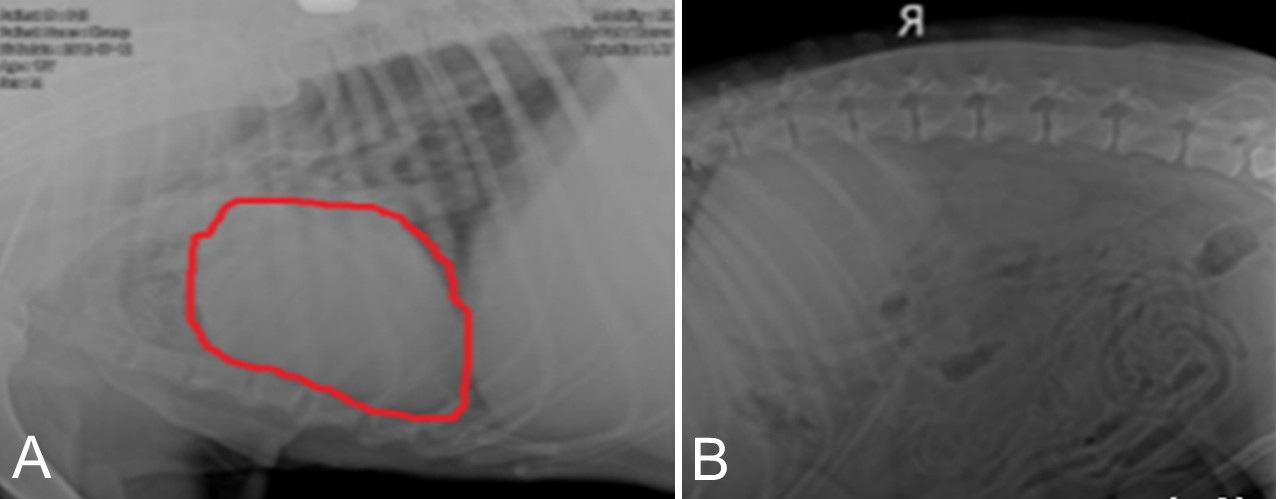
Diagnostic Imaging: Cardiomegaly with diffuse interstitial-alveolar opacities consistent with pulmonary edema secondary to left-sided heart failure (Figure 1). Intestinal gas distension, suggestive of uremic enteritis.
Diagnosis: Left-sided congestive heart failure complicated by advanced chronic kidney disease and uremic enteritis.
Prognosis: Infausta.
Management: The patient received four days of supportive therapy (Table 1), including low-rate intravenous Ringer’s Lactate (±1.5 mL/kg/h), injectable amoxicillin followed by oral cotrimoxazole, gastroprotectants (omeprazole and molagite), vitamin B-complex supplementation, and oxygen therapy.
Figure 1.Radiographic images of a 12-year-old Golden Retriever. (a) Right lateral thoracic radiograph showing cardiomegaly and pulmonary edema. (b) Ventrodorsal abdominal radiograph demonstrating marked intestinal gas distension consistent with uremic enteritis.
| Time (day) | Clinical findings | Main treatment | Notes |
|---|---|---|---|
| 1 | Dyspnea, cyanosis, systolic murmur, and bloody diarrhea | Oxygen therapy, intravenous fluids, antibiotics, and gastroprotective agents | Condition stable, but gastrointestinal bleeding persisted |
| 2 | Dyspnea im-proved; patient remained weak with intermittent vomiting | Supportive therapy continued | Respiratory signs improved; appetite remained low |
| 3 | Slight improvement in activity; bloody diarrhea persisted | Vitamin supplementation added | Signs of enteritis remained evident |
■ RESULTS AND DISCUSSION
CHF in geriatric dogs is commonly associated with degenerative mitral valve disease or dilated cardiomyopathy (McCauley et al., 2020). Decreased cardiac output can lead to renal hypoperfusion, causing cardiorenal syndrome and elevated urea and creatinine levels. Uremic toxins can irritate the gastrointestinal mucosa, causing impaired motility and increased permeability, leading to uremic enteritis (Wang et al., 2019). Histopathological changes include lamina propria edema and gastric gland atrophy (Puccinelli et al., 2025), while vomiting, diarrhea, and gastrointestinal bleeding are common in dogs with CKD (Pradnyani et al., 2021).
The differential diagnosis included gastroenteric ulceration, infiltrative enteritis, and gastrointestinal neoplasia (Bedel et al., 2025); however, abdominal ultrasonography and endoscopy were not performed because of the patient's instability. Supportive therapy included intravenous fluids, antibiotics, gastroprotective agents, vitamin B-complex, and oxygen therapy. Diuretics were not administered owing to severe azotemia and the risk of worsening renal perfusion (Pouchelon et al., 2015).
This case demonstrates complex interactions between the heart, kidneys, and gastrointestinal tract in elderly dogs. Aging reduces cardiovascular function, renal filtration, and gastrointestinal mucosal integrity (Rahbar et al. 2025). CHF and CKD limit therapeutic options, as interventions for one organ can worsen the other (Lombardo et al., 2025), contributing to poor prognosis in geriatric patients (Martinelli et al., 2016).
■ CONCLUSION
This case highlights that congestive heart failure in geriatric dogs may be accompanied by chronic kidney disease and uremic enteritis, resulting in multi-organ dysfunction. The coexistence of these conditions complicates diagnosis and clinical management and is associated with a poor prognosis. Careful monitoring and an integrated clinical approach are essential for managing such complex cases.
References
- Bedel F., Betting A., Girod M., Chavalle T., Prata D., A P.Lecoindre Lecoindre. Clinicopathological and endoscopic features of diffuse alimentary lymphoma in 18 dogs. Veterinary Sciences. 2025; 12(8)
- Bozkurt B., Coats A.J., Tsutsui H., Abdelhamid C.M., Adamopoulos S., Albert N., Anker S.D., Atherton J., Böhm M., Butler J., Drazner M.H.. Universal definition and classification of heart failure: a report of the Heart Failure Society of America, Heart Failure Association of the European Society of Cardiology, Japanese Heart Failure Society and writing committee of the universal definition of heart failure. Journal of Cardiac Failure. 2021; 27(4)
- Keene B.W., Atkins C.E., Bonagura J.D., Fox P.R., Häggström J., Fuentes V.L., Oyama M.A., Rush J.E., Stepien R., Uechi M.. ACVIM consensus guidelines for the diagnosis and treatment of myxomatous mitral valve disease in dogs. Journal of Veterinary Internal Medicine. 2019; 33(3)
- Lombardo S.F., Ferasin H., Ferasin L.. Subcutaneous furosemide therapy for chronic management of refractory congestive heart failure in dogs and cats. Animals. 2025; 15(3)
- Martinelli E., Locatelli C., Bassis S., Crosara S., Paltrinieri S., Scarpa P., Spalla I., Zanaboni A.M., Quintavalla C., Brambilla P.. Preliminary investigation of cardiovascular-renal disorders in dogs with chronic mitral valve disease. Journal of Veterinary Internal Medicine. 2016; 30(5)
- McCauley S.R., Clark S.D., Quest B.W., Streeter R.M., Oxford E.M.. Review of canine dilated cardiomyopathy in the wake of diet-associated concerns. Journal of Animal Science. 2020; 98
- Pouchelon J.L., Atkins C.E., Bussadori C., Oyama M.A., Vaden S.L., Bonagura J.D., Chetboul V., Cowgill L.D., Elliot J., Francey T., Grauer G.F.. Cardiovascular-renal axis disorders in the domestic dog and cat: a veterinary consensus statement. Journal of Small Animal Practice. 2015; 56(9)
- Pradnyani G., Widiastuti S.K., Erawan I.. Laporan kasus: menangani penyakit ginjal kronis pada anjing peranakan pomeranian. Indonesian Medicus Veterinus. 2021; 10(3)
- Puccinelli C., Pelligra T., Bracco A., Lippi I., Perondi F., Mannucci T., Citi S.. Ultrasonographic features of gastropathy in dogs with acute kidney injury and acute-on-chronic kidney injury. Animals. 2025; 15(18)
- Rahbar S.Y., Barzegari A., Saadatian Z., Montazersaheb S., Zununi V.S.. Gut microbiota and kidney aging: insights into current research. Nutrition and Metabolism. 2025; 22(1)
- Savira F., Magaye R., Liew D., Reid C., Kelly D.J., Kompa A.R., Sangaralingham S.J., Burnett J.C., Kaye D., Wang B.H.. Cardiorenal syndrome: multi-organ dysfunction involving the heart, kidney and vasculature. British Journal of Pharmacology. 2020; 177
- Summers S., Quimby J.. Insights into the gut-kidney axis and implications for chronic kidney disease management in cats and dogs. The Veterinary Journal. 2024; 306
- Wang M., Guo Y., Zhao W.. Gastrointestinal disorders in chronic kidney disease. Longhua Chinese Medicine. 2019; 2
Copyright & License
© Copyright © 2026 The Author(s).
This is an Open Access article under the terms of the Creative Commons Attribution-ShareAlike 4.0 International License (CC BY-SA 4.0), which permits unrestricted use, distribution and reproduction in any medium, provided the original work is properly cited.

Bedel F, Betting A, Girod M, Chavalle T, Prata D, Lecoindre P, Lecoindre A. 2025. Clinicopathological and endoscopic features of diffuse alimentary lymphoma in 18 dogs. Veterinary Sciences. 12(8):751. https://doi.org/10.3390/vetsci12080751 | PMid:40872702 PMCid:PMC12390282
Bozkurt B, Coats AJ, Tsutsui H, Abdelhamid CM, Adamopoulos S, Albert N, Anker SD, Atherton J, Böhm M, Butler J, Drazner MH. 2021. Universal definition and classification of heart failure: a report of the Heart Failure Society of America, Heart Failure Association of the European Society of Cardiology, Japanese Heart Failure Society and writing committee of the universal definition of heart failure. Journal of Cardiac Failure. 27(4):387-413. https://doi.org/10.1016/j.cardfail.2021.01.022 | PMid:33663906 PMCid:PMC12587276
Keene BW, Atkins CE, Bonagura JD, Fox PR, Häggström J, Fuentes VL, Oyama MA, Rush JE, Stepien R, Uechi M. 2019. ACVIM consensus guidelines for the diagnosis and treatment of myxomatous mitral valve disease in dogs. Journal of Veterinary Internal Medicine. 33(3):1127-1140. https://doi.org/10.1111/jvim.15488 | PMid:30974015 PMCid:PMC6524084
Lombardo SF, Ferasin H, Ferasin L. 2025. Subcutaneous furosemide therapy for chronic management of refractory congestive heart failure in dogs and cats. Animals. 15(3):358. https://doi.org/10.3390/ani15030358 | PMid:39943128 PMCid:PMC11815753
Martinelli E, Locatelli C, Bassis S, Crosara S, Paltrinieri S, Scarpa P, Spalla I, Zanaboni AM, Quintavalla C, Brambilla P. 2016. Preliminary investigation of cardiovascular-renal disorders in dogs with chronic mitral valve disease. Journal of Veterinary Internal Medicine. 30(5):1612-1618. https://doi.org/10.1111/jvim.14524 | PMid:27717188 PMCid:PMC5032878
McCauley SR, Clark SD, Quest BW, Streeter RM, Oxford EM. 2020. Review of canine dilated cardiomyopathy in the wake of diet-associated concerns. Journal of Animal Science. 98:1-10. https://doi.org/10.1093/jas/skaa155 | PMid:32542359 PMCid:PMC7447921
Pouchelon JL, Atkins CE, Bussadori C, Oyama MA, Vaden SL, Bonagura JD, Chetboul V, Cowgill LD, Elliot J, Francey T, Grauer GF. 2015. Cardiovascular-renal axis disorders in the domestic dog and cat: a veterinary consensus statement. Journal of Small Animal Practice. 56(9):537-552. https://doi.org/10.1111/jsap.12387 | PMid:26331869 PMCid:PMC4584495
Pradnyani GAPI, Widiastuti SK, Erawan IGMK. 2021. Laporan kasus: menangani penyakit ginjal kronis pada anjing peranakan pomeranian. Indonesian Medicus Veterinus. 10(3):517-531. https://doi.org/10.19087/imv.2021.10.3.517
Puccinelli C, Pelligra T, Bracco A, Lippi I, Perondi F, Mannucci T, Citi S. 2025. Ultrasonographic features of gastropathy in dogs with acute kidney injury and acute-on-chronic kidney injury. Animals. 15(18):2666. https://doi.org/10.3390/ani15182666 | PMid:41007911 PMCid:PMC12466630
Rahbar Saadat Y, Barzegari A, Saadatian Z, Montazersaheb S, Zununi Vahed S. 2025. Gut microbiota and kidney aging: insights into current research. Nutrition and Metabolism. 22(1):133. https://doi.org/10.1186/s12986-025-01032-w | PMid:41199352 PMCid:PMC12593916
Savira F, Magaye R, Liew D, Reid C, Kelly DJ, Kompa AR, Sangaralingham SJ, Burnett Jr JC, Kaye D, Wang BH. 2020. Cardiorenal syndrome: multi-organ dysfunction involving the heart, kidney and vasculature. British Journal of Pharmacology. 177:2906-2922. https://doi.org/10.1111/bph.15065 | PMid:32250449 PMCid:PMC7280015
Summers S, Quimby J. 2024. Insights into the gut-kidney axis and implications for chronic kidney disease management in cats and dogs. The Veterinary Journal. 306:106181. https://doi.org/10.1016/j.tvjl.2024.106181 | PMid:38897377
Wang M, Guo Y, Zhao W. 2019. Gastrointestinal disorders in chronic kidney disease. Longhua Chinese Medicine. 2:11. https://doi.org/10.21037/lcm.2019.07.01
Copyright (c) 2026 CC-BY-SA

This work is licensed under a Creative Commons Attribution-ShareAlike 4.0 International License.
All articles published in this journal are licensed under a Creative Commons Attribution-ShareAlike 4.0 International License (CC BY-SA 4.0).
This license permits use, distribution, reproduction, and adaptation in any medium, including for commercial purposes, provided the original work is properly cited, a link to the license is given, and any changes made are indicated. Any derivative work must be distributed under the same license or a compatible license.
How to Cite