Systemic fowl typhoid caused by Salmonella gallinarum in broiler chickens: Pathological and microbiological evidence

Downloads
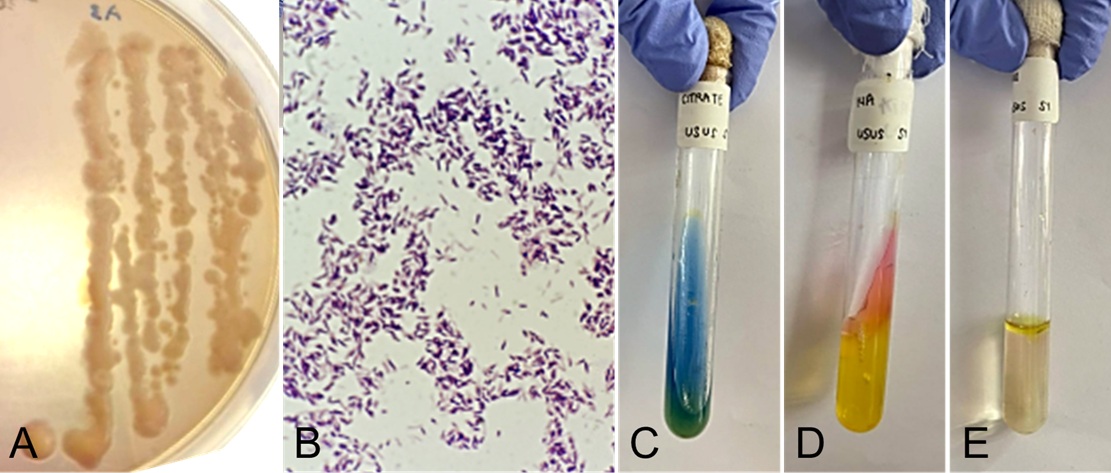
Salmonella gallinarum, the causative agent of fowl typhoid, is a highly pathogenic bacterial disease associated with substantial mortality in poultry, predominantly affecting adult chickens and turkeys. This study aimed to describe the pathological lesions and microbiological characteristics of S. gallinarum infection in chickens with fowl typhoid. S. gallinarum is a gram-negative, rod-shaped, facultative anaerobic bacterium with an optimal growth temperature of 37 °C and the ability to survive across a broad pH range (4.0–9.0). Necropsy findings in affected chickens revealed interstitial pneumonia of the lungs, intestinal hyperemia with petechial hemorrhages, hepatomegaly, splenomegaly, and fatty degeneration of the cardiac tissue. Bacterial culture of intestinal swab samples on MacConkey agar demonstrated the growth of pale-yellow colonies consistent with S. gallinarum. Microscopic examination confirmed Gram-negative bacilli, while biochemical testing showed an alkaline/acid reaction, absence of gas and H₂S production, non-motility, and negative indole and urease reactions
Devi DAS, Suarjana IGK, Kardena IM, Suratma NA, Suardana IBK. 2025. Salmonellosis case in broiler chickens at a closed-house farm in Darmasaba Village, Abiansemal, Badung, Bali. Buletin Veteriner Udayana. 17(3):902-915. https://doi.org/10.24843/bulvet.2025.v17.i03.p36
McVey DS, Kennedy M,Chengappa MM. 4th Eds. 2022. Veterinary microbiology. US: John Wiley & Sons. https://doi.org/10.1002/9781119650836
Nirmala TV, Reddy AD, Karuna Sree E, Venkata Subbaiah K, Shali Raju G, Reddy RVSK. 2018. Salmonellosis in poultry: a case report. International Journal of Current Microbiology and Applied Sciences. 7(2):2347-2349. https://doi.org/10.20546/ijcmas.2018.702.285
Shaji S, Selvaraj RK, Shanmugasundaram R. 2023. Salmonella infection in poultry: a review on the pathogen and control strategies. Microorganisms. 11(11):2814. https://doi.org/10.3390/microorganisms11112814 | PMid:38004824 PMCid:PMC10672927
Swayne DE. 2020. Diseases of poultry. 14th Ed. NJ: Wiley-Blackwell.
Copyright (c) 2025 CC-BY-SA

This work is licensed under a Creative Commons Attribution-ShareAlike 4.0 International License.
All articles published in this journal are licensed under a Creative Commons Attribution-ShareAlike 4.0 International License (CC BY-SA 4.0).
This license permits use, distribution, reproduction, and adaptation in any medium, including for commercial purposes, provided the original work is properly cited, a link to the license is given, and any changes made are indicated. Any derivative work must be distributed under the same license or a compatible license.
How to Cite