Fatal thoracic compression due to abdominal lipoma and gastric distension in a cat

Downloads
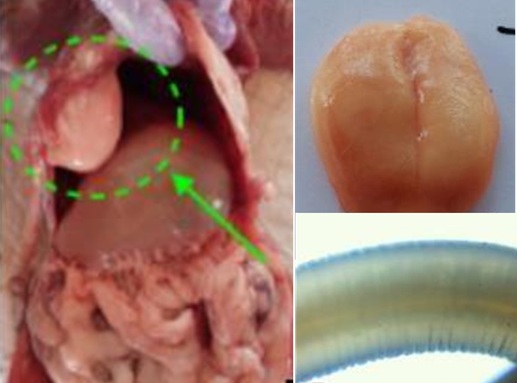
Respiratory distress due to abdominal pathology presents a diagnostic challenge in small animal practice and may be fatal if not promptly recognized. This case study describes the pathological findings in a domestic cat with thoracic cavity narrowing secondary to severe gastric distension and an abdominal lipoma. Necropsy was performed on a cat with dyspnea, abdominal pain, gait incoordination, and influenza-like symptoms. Postmortem examination revealed multiple pathological lesions, including marked gastric distension due to gas accumulation, a solitary lipoma within the abdominal cavity, gastritis, enteritis, Ascaris spp. infection (ascariasis), pulmonary hemorrhage, and tracheal hyperemia. The concurrent presence of abdominal lipoma and gastric distension likely exerts mechanical pressure on the diaphragm and thoracic cavity, restricting lung expansion and impairing gas exchange. This pressure-induced respiratory compromise is considered the primary factor for animal death. This report emphasizes the need for thorough clinical evaluation in cases with respiratory and abdominal signs, highlighting how abdominal masses can trigger life-threatening complications.
Caruso KJ, Cowell RL, Upton ML, Dorsey KE, Meinkoth JH, Campbell GA. 2008. Intrathoracic mass in a cat. Veterinary Clinical Pathology. 31(4):193. https://doi.org/10.1111/j.1939-165X.2002.tb00302.x | PMid:12447782 PMCid:PMC7164224
Charifa A, Azmat CE, Badri T. 2022. Lipoma pathology. Study Guide from StatPearls Publishing, Treasure Island (FL). https://www.ncbi.nlm.nih.gov/books/NBK482343/.
Copeland-Halperin LR, Pimpinella V, Copeland M. 2015. Combined liposuction and excision of lipomas: Long‐term evaluation of a large sample of patients. Plastic Surgery International. 2015(1):625396. https://doi.org/10.1155/2015/625396 | PMid:25694827 PMCid:PMC4324944
Epstein SE. 2014. Exudative pleural diseases in small animals. Veterinary Clinics: Small Animal Practice. 44(1):161-80. https://doi.org/10.1016/j.cvsm.2013.08.005 | PMid:24268340
Goldschmidt MH, Shofer FS. 1992. Skin tumors of the dog and cat. Oxford, UK: Pergamon Press., p2-3, p192-203.
Homandberg GA, Peanasky RJ. 1976. Characterization of proteins from Ascaris lumbricoides which bind specifically to carboxypeptidase. Journal of Biological Chemistry. 251(8):2226-33. https://doi.org/10.1016/S0021-9258(17)33576-7 | PMid:1262322
Kolb L, Yarrarapu SN, Ameer MA, Rosario-Collazo JA. 2023. Lipoma. Study Guide from StatPearls Publishing, Treasure Island (FL). https://www.ncbi.nlm.nih.gov/books/NBK507906/.
Mayhew PD, Brockman DJ. 2002. Body cavity lipomas in six dogs. Journal of Small Animal Practice. 43(4):177-81. https://doi.org/10.1111/j.1748-5827.2002.tb00053.x | PMid:11996395
Piummer SB, Bunch SE, Khoo LA, Spaulding KA. 1993. Tethered spinal cord and an intradural lipoma associated with a meningocele in a Manx-type cat. Journal of American Veterinary Medical Association. 203:1159. https://doi.org/10.2460/javma.1993.203.08.1159 | PMid:8244864
Silverstein D, Hopper K. 2014. Small Animal Critical Care Medicine-E-Book: Small Animal Critical Care Medicine-E-Book. Elsevier Health Sciences.
Skidgel A. 2004. Carboxypeptidase-mediated enhancement of nitric oxide. American Journal of Physiology-Lung Cellular and Molecular Physiology. 287:L35-45. https://doi.org/10.1152/ajplung.00346.2003 | PMid:14977629
Underwood WJ, Blauwiekel R, Delano ML, Gillesby R, Mischler SA, Schoell A. 2015. Biology and diseases of ruminants (sheep, goats, and cattle). In Laboratory Animal Medicine. Academic Press. pp. 623-694. https://doi.org/10.1016/B978-0-12-409527-4.00015-8 | PMCid:PMC7149867
Yildirim D, Tamam C, Ekci B. 2012. From the pseudolipoma to lipoma: staging of the typical radiological appearances. Pictorial essay. Medical Ultrasonography. 14(1):49-52.
Zachary JF, McGavin MD. 2011. Pathologic Basis of Veterinary Disease-E-Book. Elsevier Health Sciences.
Copyright (c) 2025 CC-BY-SA

This work is licensed under a Creative Commons Attribution-ShareAlike 4.0 International License.
All articles published in this journal are licensed under a Creative Commons Attribution-ShareAlike 4.0 International License (CC BY-SA 4.0).
This license permits use, distribution, reproduction, and adaptation in any medium, including for commercial purposes, provided the original work is properly cited, a link to the license is given, and any changes made are indicated. Any derivative work must be distributed under the same license or a compatible license.
How to Cite