Antidiarrheal evaluation of guava leaf infusion in pediatric rats using an intestinal transit model

Downloads
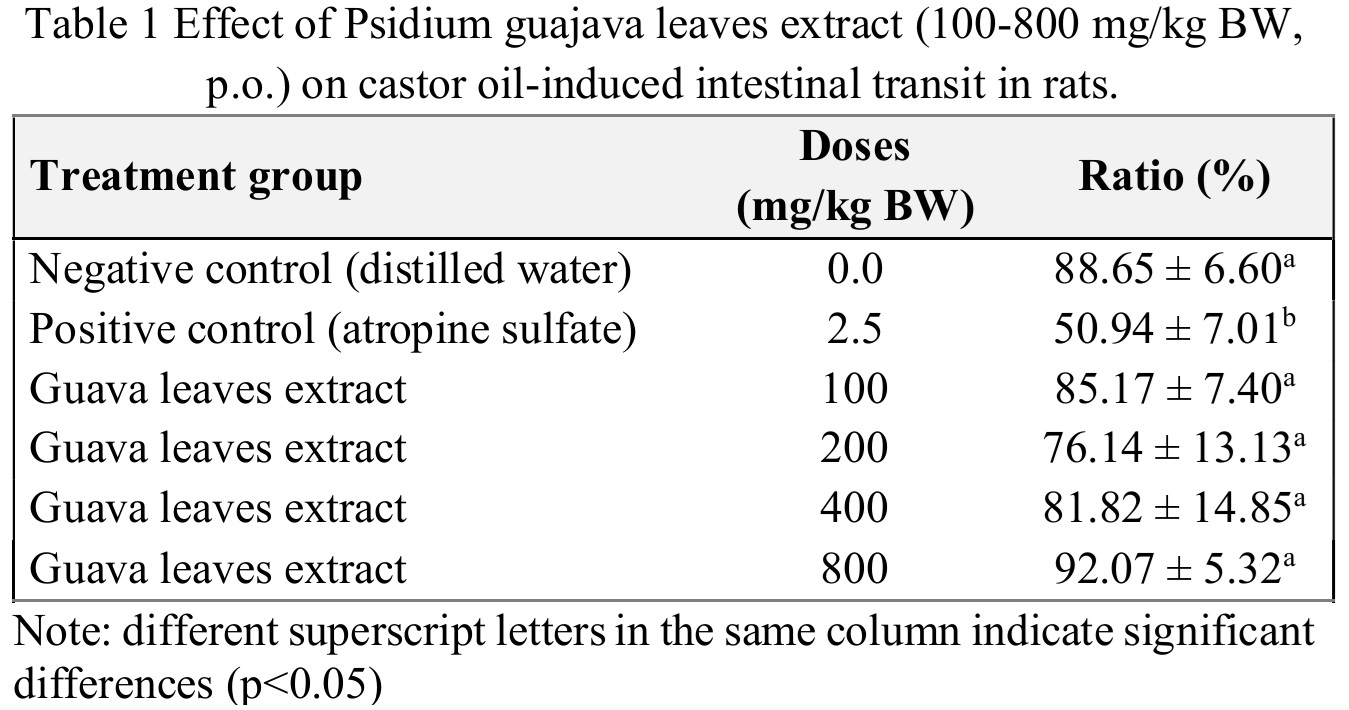
Diarrhoea is a major gastrointestinal disorder in children and remains a significant cause of mortality, particularly in toddlers. Guava leaves (Psidium guajava L.) have long been used in traditional medicine as an anti-diarrhoeal remedy. This study aimed to determine the effective dose of guava leaf infusion in weaned rats using the intestinal transit method. Thirty healthy rats were randomly assigned to six groups: a negative control (distilled water), a positive control (atropine sulfate 2.5 mg/kg BW), and four treatment groups receiving guava leaf infusion at doses of 100, 200, 400, and 800 mg/kg BW. Among the treatment groups, the 200 mg/kg BW dose resulted in the greatest reduction in intestinal transit. However, no statistically significant differences were observed between any treatment group and negative control. These results suggest that within the examined dosage range, guava leaf infusion does not demonstrate a significant antidiarrheal effect in paediatric rat models.
Bahekar SE, Kale RS. 2015. Antidiarrheal activity of ethanolic extract of Manihot esculenta Crantz leaves in Wistar rats. Journal of Ayurveda and Integrative Medicine. 6(1):35-40. https://doi.org/10.4103/0975-9476.146542 | PMid:25878462 PMCid:PMC4395926
Florez ID, Niño-Serna LF, Beltrán-Arroyave CP. 2020. Acute infectious diarrhea and gastroenteritis in children. Current Infectious Disease Reports. 22(2):4. https://doi.org/10.1007/s11908-020-0713-6 | PMid:31993758
Khare S, Nikam D, Singh A, Pandey L. 2024. Evaluation of efficacy and safety of diphenoxylate hydrochloride and atropine sulphate in patient with acute radiation or chemotherapy induced diarrhea. International Journal of Research Medical Science. 12(8):2907-2913. https://doi.org/10.18203/2320-6012.ijrms20242219
Kumar M, Tomar M, Amarowicz R, Saurabh V, Nair MS, Maheshwari C, Sasi M, Prajapati U, Hasan M, Singh S, et al. 2021. Guava (Psidium guajava L.) leaves: Nutritional composition, phytochemical profile, and health-promoting bioactivities. Foods. 10(4):752. https://doi.org/10.3390/foods10040752 | PMid:33916183 PMCid:PMC8066327
Mao Y, Yang Q, Liu J, Fu Y, Zhou S, Liu J, Ying L, Li Y. 2024. Quercetin increases growth performance and decreases incidence of diarrhea and mechanism of action in weaned piglets. Oxidative Medi-cine and Cellular Longevity. 2024(1):5632260. https://doi.org/10.1155/2024/5632260 | PMid:39139212 PMCid:PMC11321896
Ministry of Health of Indonesia. 2022. Profil Kesehatan Indonesia. Jakarta: Ministry of Health of Indonesia.
Ojewole JAO, Awe EO, Chiwororo WDH. 2008. Antidiarrhoeal activity of Psidium guajava Linn. (Myrtaceae) leaves aqueous extract in rodents. Journal of Smooth Muscle Research. 44(6):195-207. https://doi.org/10.1540/jsmr.44.195 | PMid:19234374
de Vries P, Soret R, Suply E, Heloury Y, Neunlist M. 2010. Postnatal development of myenteric neurochemical phenotype and impact on neuromuscular transmission in the rat colon. American Journal Psychology. Gastrointestinal and Liver Physiology. 299(2):G539-G547. https://doi.org/10.1152/ajpgi.00092.2010 | PMid:20522637
Xu H, Collins JF, Ghishan FK. 2012. Molecular Physiology of Gastro-intestinal Function during Development. in: Johnson LR, Ghishan FK, Kaunitz JD, Merchant JL, Said HM, Wood JD, editor. Physiology of the Gastrointestinal Tract. 5th ed. London: Elsevier. https://doi.org/10.1016/B978-0-12-382026-6.00014-2
Zulfiana Y, Fatmawati N. 2023. Use of guava as a prevention of acute diarrhea in toddlers. Journal for Quality in Public Health. 6(2):374-379. https://doi.org/10.30994/jqph.v6i2.461
Copyright (c) 2025 CC-BY-SA

This work is licensed under a Creative Commons Attribution-ShareAlike 4.0 International License.
All articles published in this journal are licensed under a Creative Commons Attribution-ShareAlike 4.0 International License (CC BY-SA 4.0).
This license permits use, distribution, reproduction, and adaptation in any medium, including for commercial purposes, provided the original work is properly cited, a link to the license is given, and any changes made are indicated. Any derivative work must be distributed under the same license or a compatible license.
How to Cite