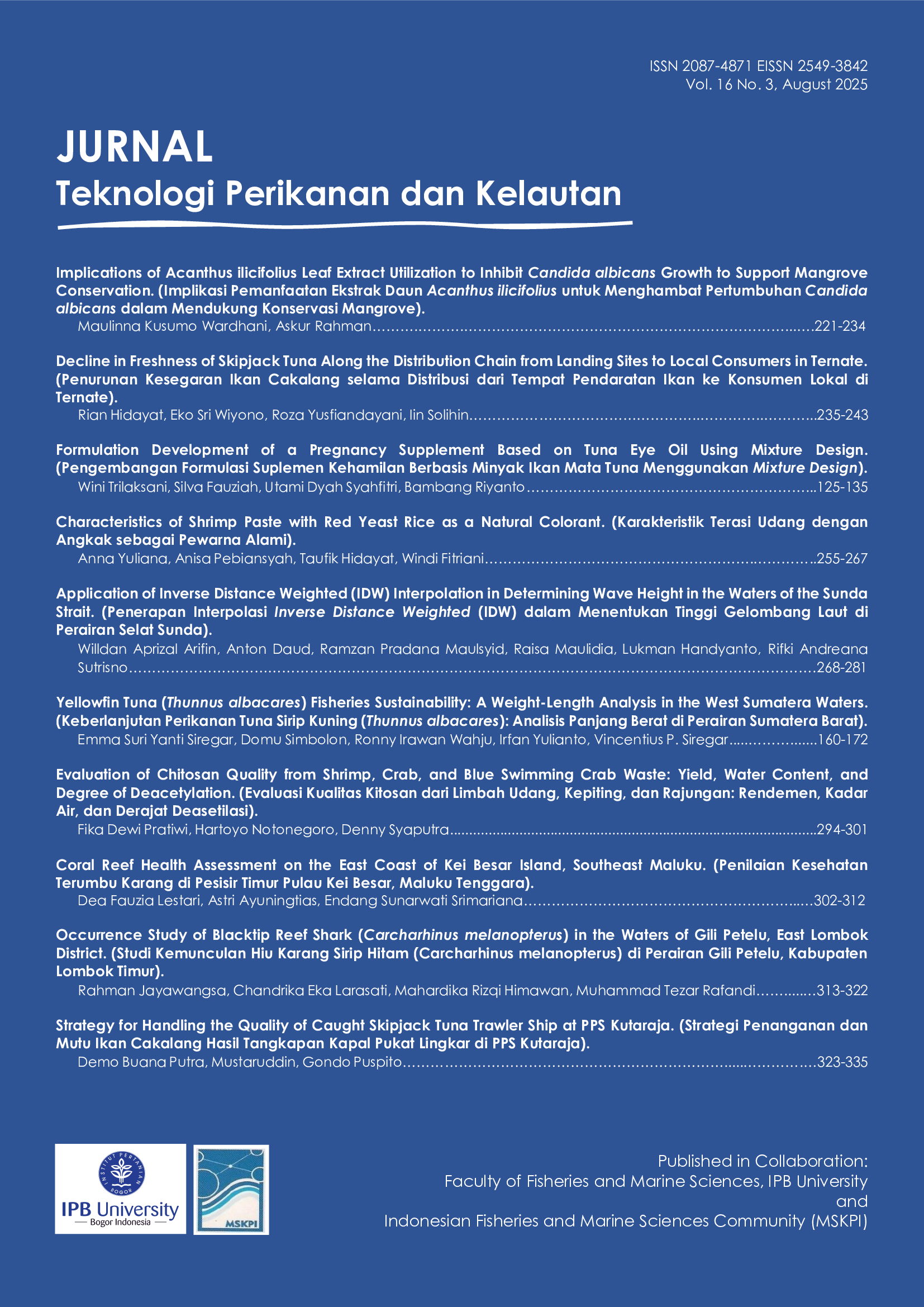
EVALUATION OF CHITOSAN QUALITY FROM SHRIMP, CRAB, AND BLUE SWIMMING CRAB WASTE: YIELD, WATER CONTENT, AND DEGREE OF DEACETYLATION
EVALUASI KUALITAS KITOSAN DARI LIMBAH UDANG, KEPITING, DAN RAJUNGAN: RENDEMEN, KADAR AIR, DAN DERAJAT DEASETILASI
DOI:
https://doi.org/10.24319/jtpk.16.294-301Keywords:
chitosan, crustacean, shell waste, valorizationAbstract
Mud crab, blue swimming crab, and vannamei shrimp carapace are crustacean wastes that have not been optimally utilized in Bangka Island and have the potential to pollute the environment. Converting the biomass from this waste into chitosan supports the principles of a circular economy. This study evaluates the quality of chitosan produced from crustacean waste based on yield, moisture content, and degree of deacetylation (DD), and compares two FTIR-based methods for estimating DD using the spectral band ratios A1320/A1420 and A1655/A3450. Carapace waste (100 g) was processed through demineralization (1.5 M HCl), deproteinization (3.5% NaOH), and deacetylation (60% NaOH) with two replications per species. The chitosan yields were 4.0% ± 0.5 (mud crab), 8.7% ± 0.5 (blue swimming crab), and 12.4% ± 0.9 (shrimp), respectively. The water content was still within the limits of SNI 7949:2013 (<12%), namely 6.4% ± 2.0, 10.7% ± 2.7, and 6.3% ± 0.6. Based on the A1320/A1420 ratio, the DD values were 86.8% ± 0.4, 84.4% ± 0.1, and 95.3% ± 2.5, respectively, all exceeding the minimum standard of 75%. In contrast, the A1655/A3450 method produces much lower DD values (<75%). These findings indicate that local crustacean shell waste has strong potential as a source of high-quality chitosan. FTIR is a practical method for DD estimation, but it still needs further validation, especially with standard methods such as 1H-NMR.
Downloads
References
Abdou ES, Nagy KSA, Elsabee MZ. 2008. Extraction and Characterization of Chitin and Chitosan from Local Sources. Bioresource Technology. 99(5): 1359-1367. DOI: https://doi.org/10.1016/j.biortech.2007.01.051.
Ahing FA, Wid N. 2016. Optimization of Shrimp Shell Waste Deacetylation for Chitosan Production. International Journal of Advanced and Applied Sciences. 3(10): 31-36. DOI: https://doi.org/10.21833/ijaas.2016.10.006.
Amalia KP, Ekayani M, Nurjanah. 2021. Pemetaan dan Alternatif Pemanfaatan Limbah Cangkang Rajungan di Indonesia. Jurnal Pengolahan Hasil Perikanan Indonesia. 24(3): 310-318. DOI: https://doi.org/10.17844/jphpi.v24i3.37436.
Amitaye AN, Elemike EE, Uzah TT. 2024. Multifarious Techniques for Resolving Chitosan’s Degree of Deacetylation (DD). Materials International. 6(2): 1-24. DOI: https://https://doi.org/10.33263/Materials62.016.
Andrade DSMB, Ladchumananandasivam R, da Rocha BG, Belarmino DD, Galvão AO. 2012. The Use of Exoskeletons of Shrimp (Litopenaeus vannamei) and Crab (Ucides cordatus) for the Extraction of Chitosan and Production of Nanomembrane. Materials Sciences and Applications. 3(7): 495-508. DOI: http://dx.doi.org/10.4236/msa.2012.37070.
Badan Standardisasi Nasional. 2013. SNI Nomor 7949. Spesifikasi Standar Mutu Kitosan. Jakarta.
Bidayani E, Valen FS. 2023. Efficiency Economics of Whiteleg Shrimp Litopenaeus vannamei (Boone 1931) Cultivation with a Household Scale Biofloc System. Indo Pacific Journal of Ocean Life. 7(2): 156-160. DOI: https://doi.org/10.13057/oceanlife/o070205.
Bolat Y, Bilgin Ş, Günlü A, Izci L, Koca SB, Çetinkaya S, Koca HU. 2010. Chitin-Chitosan Yield of Freshwater Crab (Potamon potamios, Olivier 1804) Shell. Pakistan Veterinary Journal. 30(4): 227-231.
Brugnerotto J, Lizardi J, Goycoolea FM, ArguÈelles-Monalc W, DesbrieÁresa, Rinaudoa M. 2001. An Infrared Investigation in Relation with Chitin and Chitosan Characterization. Polymer. 42(8): 3569-3580. DOI: https://doi.org/10.1016/S0032-3861(00)00713-8.
Cooney R, Sousa DB, Ríos AF, Mellett S, Rowan N, Morse AP, Hayes M, Laso J, Regueiro L, Wan AHL, et al. 2023. A Circular Economy Framework for Seafood Waste Valorisation to Meet Challenges and Opportunities for Intensive Production and Sustainability. Journal of Cleaner Production. 392: 1-15. DOI: https://doi.org/10.1016/j.jclepro.2023.136283.
Czechowska-Biskup R, Jarosińska D, Rokita B, Ulański P, Rosiak JM. 2012. Determination of Degree of Deacetylation of Chitosan - Comparison of Methods. International Journal of Advanced and Integrated Medical Sciences. 17: 5-20.
Djaenudin, Budianto E, Saepudin E, Nasir M. 2019. Ekstraksi Kitosan dari Cangkang Rajungan pada Lama dan Pengulangan Perendaman yang Berbeda. Jurnal Teknologi Perikanan dan Kelautan. 10(1): 49-59. DOI: https://doi.org/10.24319/jtpk.10.49-59.
Duarte M, Ferreira M, Marväo M, Rocha J. 2002. An Optimized Method to Determine the Degree of Acetylation of Chitin and Chitosan by FTIR Spectroscopy. International Journal of Biological Macromolecules. 31: 1-8. DOI: https://doi.org/10.1016/S0141-8130(02)00039-9.
Gbenebor OP, Adeosun SO, Lawal GI, Jun S. 2016. Role of CaCO3 in the Physicochemical Properties of Crustacean-Sourced Structural Polysaccharides. Materials Chemistry and Physics. 184: 203-209. DOI: https://doi.org/10.1016/j.matchemphys.2016.09.043.
Ghezelsofloo M, Dehghani A. 2024. Application of Chitosan in Industry and Medicine: A Mini-Review. Qeios. 1-12. DOI: https://doi.org/10.32388/X1T0P3.
Guo A, Jia S, Dai Y, Han P, Xu G, Zheng X, Li Y. 2013. Neutralization of the Residual Alkaline Solution of Chitosan with CO2 Gas. Proceedings of the 2012 International Conference on Applied Biotechnology (ICAB 2012). Lecture Notes in Electrical Engineering 251.
Hosney A, Ullah S, Barcauskait K. 2022. A Review of the Chemical Extraction of Chitosan from Shrimp Wastes and Prediction of Factors Affecting Chitosan Yield by Using an Artificial Neural Network. Marine Drugs. 20(11): 1-19. DOI: https://doi.org/10.3390/md20110675.
Ihsan M, Harris A, Mukminah, Megawati, Purwati N, Muliasari H, Priyambodo B, Jones C, Nankervis L. 2025. The Characteristics of Chitosan Derived from Lobster Shells and Its Effect on Fungi Activity and Water Stability of Lobster Pellets. Jurnal Ilmiah Perikanan dan Kelautan. 17(2): 485-497. DOI: https://doi.org/10.20473/jipk.v17i2.57474.
Kurniawan, Yunita A, Christianingrum. 2017. Peningkatan Produksi Pertanian dengan Pemanfaatan Limbah Cangkang Rajungan Menjadi Pupuk Organik di Pulau Seliu, Kabupaten Belitung. Jurnal Pengabdian Kepada Masyarakat Universitas Bangka Belitung. 4(2): 54-61. DOI: https://doi.org/10.33019/jpu.v4i2.177.
Maliki S, Sharma G, Kumar, A, Moral-Zamorano M, Moradi O, Baselga J, Stadler FJ, García-Peñas A. 2022. Chitosan as a Tool for Sustainable Development: A Mini Review. Polymers. 14(7): 1-27. DOI: https://doi.org/10.3390/polym14071475.
Mayu DH, Wijayanto D, Mudzakir AK, Kurniawan. 2021. Penentuan Komoditas Unggulan Perikanan Tangkap di Perairan Provinsi Kepulauan Bangka Belitung. Marine Fisheries. 12(1): 47-58. DOI: https://doi.org/10.29244/jmf.v12i1.33762.
Muthu M, Gopal J, Chun S, Devadoss AJP, Hasan N, Sivanesan I. 2021. Crustacean Waste-Derived Chitosan: Antioxidant Properties and Future Perspective. Antioxidants. 10(2): 228. DOI: https://doi.org/10.3390/antiox10020228.
Reshad RA, Jishan TA, Chowdhury NN. 2021. Chitosan and Its Broad Applications: A Brief Review. Journal of Clinical and Experimental Investigations. 12(2): 1-13. DOI: https://doi.org/10.29333/jcei/11268.
Sarofa U, Rosida DF, Khafsa N. 2025. The Role of Base Types and Concentration in the Deacetylation Process of Manufacturing Chitosan from Green Mussel Shells (Perna viridis). Food Research. 9(1): 211-216. DOI: https://doi.org/10.26656/fr.2017.9(1).405
Satrohamidjoyo H. 2018. Dasar-Dasar Spektroskopi. Yogyakarta (ID): Gadjah Mada University Press.
Supratman O, Umroh. 2016. Pemberdayaan Masyarakat dalam Pemanfaatan Limbah Rajungan Sebagai Pakan Ikan. Jurnal Pengabdian Kepada Masyarakat Universitas Bangka Belitung. 3(2): 8-14. DOI: https://doi.org/10.33019/jpu.v3i2.149.
Szymańska E, Winnicka K. 2015. Stability of Chitosan—A Challenge for Pharmaceutical and Biomedical Applications. Marine Drugs. 13(4): 1819-1846. DOI: https://doi.org/10.3390/md13041819.
William W, Wid N. 2019. Comparison of Extraction Sequence on Yield and Physico-Chemical Characteristic of Chitosan from Shrimp Shell Waste. 12th Seminar on Science and Technology, 2-3 October 2018, Kota Kinabalu, Sabah, Malaysia. Journal of Physics: Conference Series.
Downloads
Published
Issue
Section
License
Copyright (c) 2025 Jurnal Teknologi Perikanan dan Kelautan

This work is licensed under a Creative Commons Attribution-NonCommercial 4.0 International License.
This journal is published under the terms of the Creative Commons Attribution-NonCommercial 4.0 International License. Authors who publish with this journal agree to the following terms: Authors retain copyright and grant the journal right of first publication with the work simultaneously licensed under a Creative Commons Attribution-NonCommercial 4.0 International License. Attribution — You must give appropriate credit, provide a link to the license, and indicate if changes were made. You may do so in any reasonable manner, but not in any way that suggests the licensor endorses you or your use. NonCommercial — You may not use the material for commercial purposes.
How to Cite