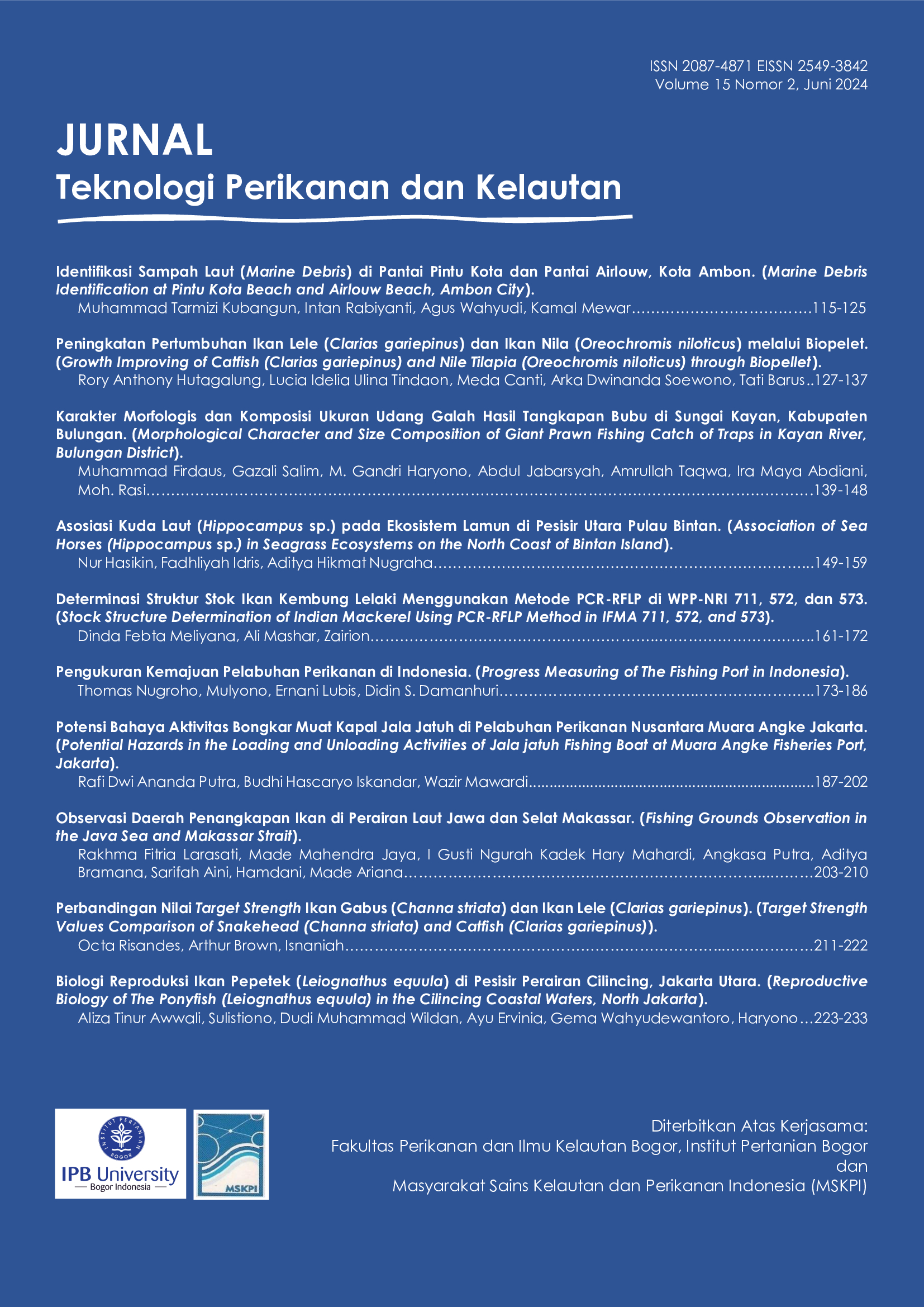
PERBANDINGAN NILAI TARGET STRENGTH IKAN GABUS (Channa striata) DAN IKAN LELE (Clarias gariepinus)
DOI:
https://doi.org/10.24319/jtpk.15.211-222Keywords:
catfish, snakehead fish, target strengthAbstract
Catfish has an elongated and slender body, with a relatively large head and a wide mouth. Its skin is smooth and dark, often leaning towards black or bluish-gray, adorned with small white spots. On the other hand, snakehead boasts fine, greenish-gray scales with small black spots on its dorsal and lateral sides. Snakehead possesses well-developed swim bladders, whereas catfish has underdeveloped ones. The objective of this research is to measure the Target Strength (TS) values of catfish and snakehead based on their length and weight, as well as to compare the TS values between the catfish and snakehead concerning their swim bladders using a splitbeam echosounder. The measurements were conducted ex-situ in a water tank, with the fish tethered using monofilament lines, maintaining a distance of approximately 1 m between the transducer surface and the fish. The results of this study revealed that the average TS value for catfish was -55.79 dB, while snakehead fish exhibited an average TS value of -50.89 dB. The higher TS value of snakehead could be attributed to their larger size in terms of length and weight. Additionally, snakehead is well-developed swim bladders played a role in this discrepancy, whereas catfish, despite having swim bladders, had them in an underdeveloped state and exhibited smaller dimensions in both length and weight.
Downloads
Downloads
Published
Issue
Section
License
This journal is published under the terms of the Creative Commons Attribution-NonCommercial 4.0 International License. Authors who publish with this journal agree to the following terms: Authors retain copyright and grant the journal right of first publication with the work simultaneously licensed under a Creative Commons Attribution-NonCommercial 4.0 International License. Attribution — You must give appropriate credit, provide a link to the license, and indicate if changes were made. You may do so in any reasonable manner, but not in any way that suggests the licensor endorses you or your use. NonCommercial — You may not use the material for commercial purposes.
How to Cite