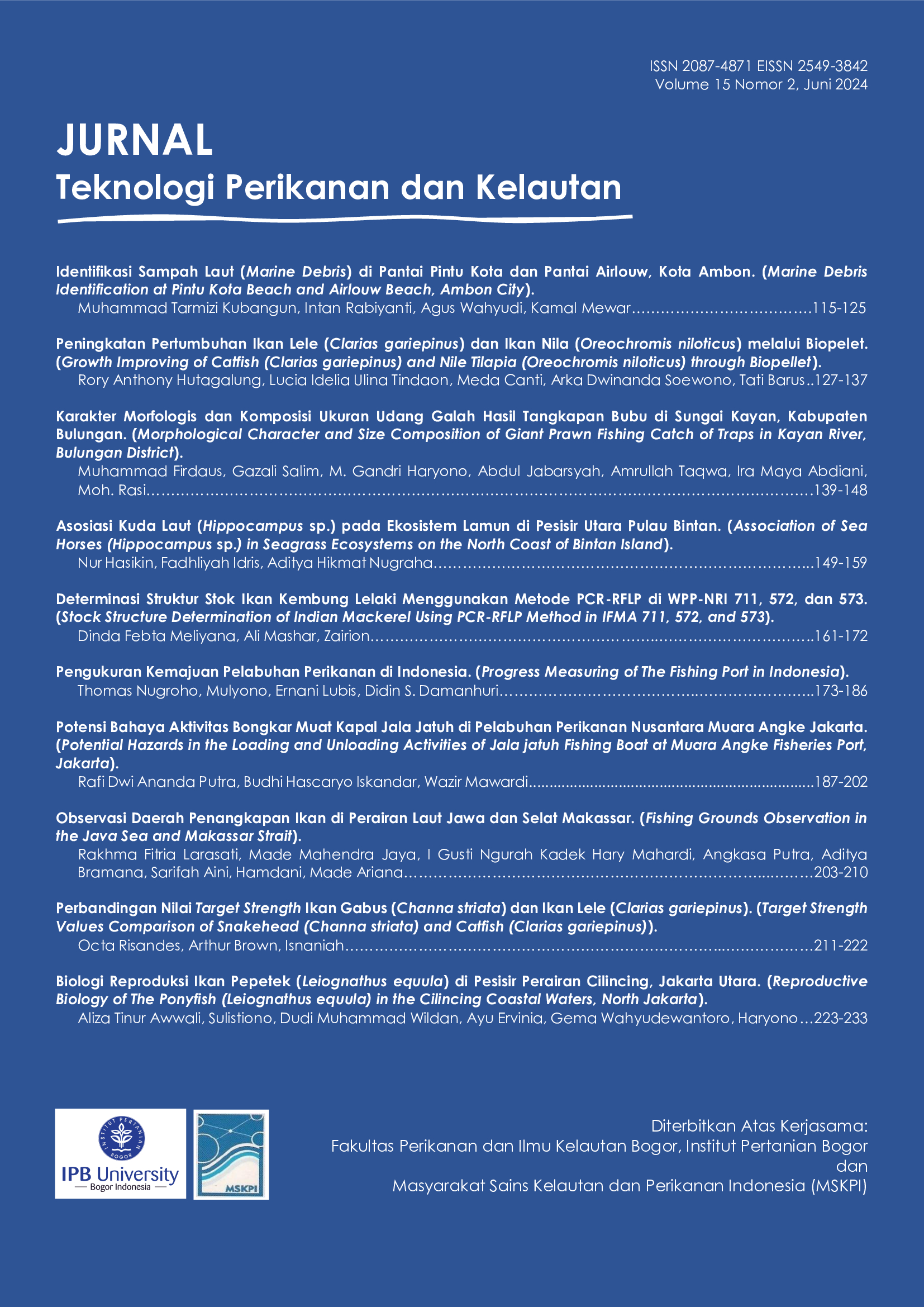
PENINGKATAN PERTUMBUHAN IKAN LELE (Clarias gariepinus) DAN IKAN NILA (Oreochromis niloticus) MELALUI BIOPELET
DOI:
https://doi.org/10.24319/jtpk.15.127-137Keywords:
aquaponics, biofloc, biopellet, fishAbstract
Biofloc material in aquaponics has been successfully produced into biopellets. However, the efficacy of these biopellets in enhancing fish growth and survival requires testing. This research aims to increase the survival and growth of catfish (Clarias gariepinus) and nile tilapia (Oreochromis niloticus), as well as the efficiency of the fish farming system, by utilizing biopellets made from biofloc as feed. The research was conducted using a factorial design method, with three repetitions and two types of treatment, namely fish species (sangkuriang catfish and red tilapia) and pellet types, namely commercial pellets, biopellets, and a combination of both pellets. Fish 5 g weight were kept in an aquarium size 40 x 60 x 40 cm3, with a density of 0.4 fish/L per aquarium. Biopellets formulation was carried out using biofloc and tapioca flour in a ratio of 7:5. Fish were fed 2 times a day. The variables measured were survival and growth rate, both in weight and length. A significant interaction (p: 0.035) between fish species and feed types was observed in the fourth week, where the combination feed was significantly higher (p: 0.042) than the biopellets for both types of fish. This shows that biopellet can produce good growth and survival rates when combined with commercial pellets. However, the combination feed did not perform the highest efficiency in both types of fish.
Downloads
Downloads
Published
Issue
Section
License
This journal is published under the terms of the Creative Commons Attribution-NonCommercial 4.0 International License. Authors who publish with this journal agree to the following terms: Authors retain copyright and grant the journal right of first publication with the work simultaneously licensed under a Creative Commons Attribution-NonCommercial 4.0 International License. Attribution — You must give appropriate credit, provide a link to the license, and indicate if changes were made. You may do so in any reasonable manner, but not in any way that suggests the licensor endorses you or your use. NonCommercial — You may not use the material for commercial purposes.
How to Cite