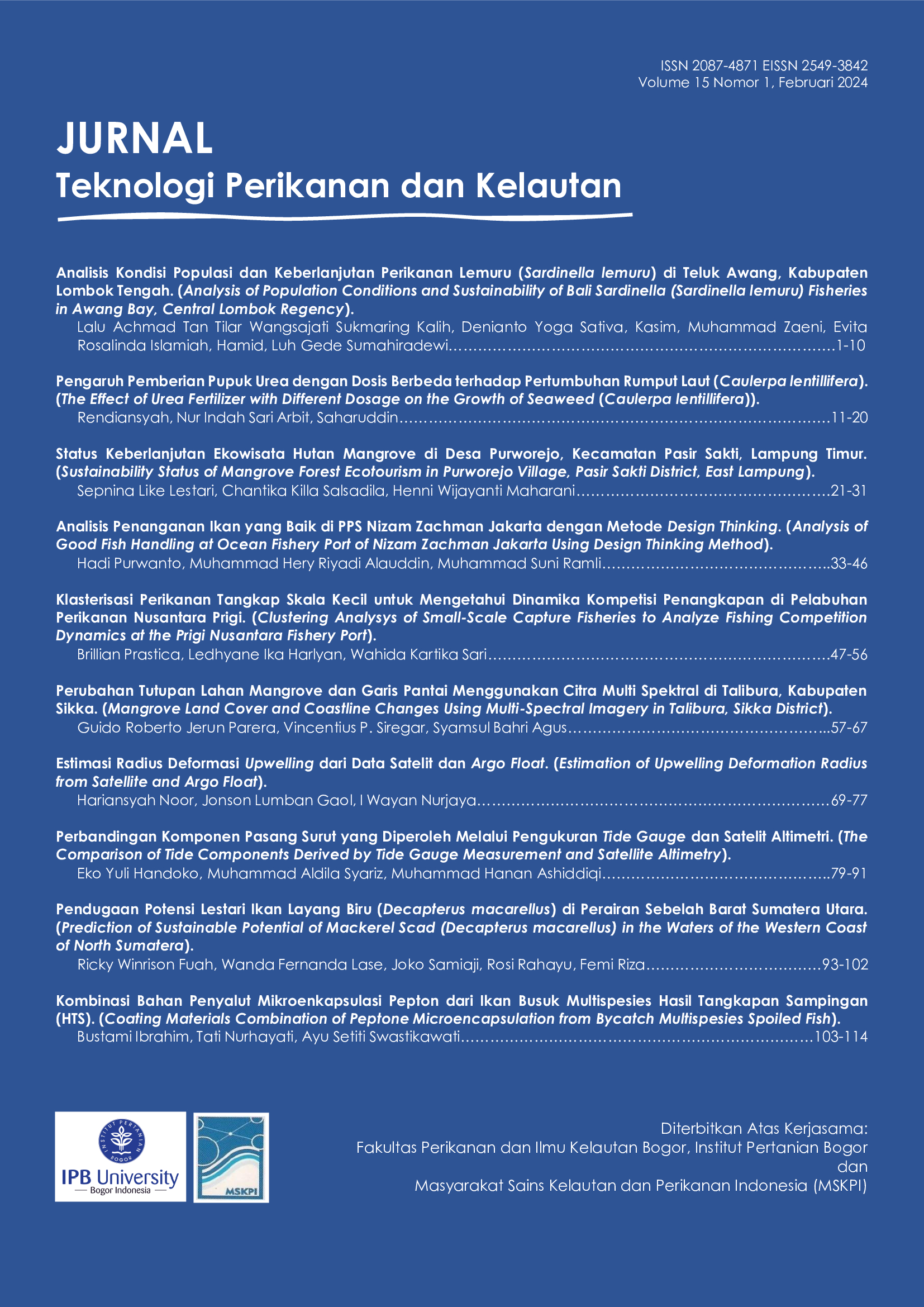
ANALISIS PENANGANAN IKAN YANG BAIK DI PPS NIZAM ZACHMAN JAKARTA DENGAN METODE DESIGN THINKING
DOI:
https://doi.org/10.24319/jtpk.15.33-46Keywords:
automatic temperature recorder, EU export, fish qualityAbstract
The quality and safety of fishery products is an important thing to ensure the quality of fishery commodities. One form of concern for the quality of capture fishery products is the issuance of Good Fish Handling Practices (CPIB) certificates for fishing vessels. Nizam Zachman Ocean Fishing Port (PPS) of Jakarta is one of the largest fishing ports in Indonesia. However, fish demolition activities carried out at the Nizam Zachman Fishing Port are still manual and not hygienic. It is proven that a small number of ships based at the ocean fishery port have CPIB certificates. Of the approximately 1,700 vessels based on the ocean fishery port, only about 500 vessels have CPIB certificates. This activity aims to find problems faced in the process of handling fish properly so the quality of fish is maintained. The design thinking method was used in this research. Data analysis was carried out using the cumulative frequency analysis method presented in the form of Tables and Paretto Diagrams. In 2022, out of 34 vessels applying for CPIB certificates, 25 vessels did not fulfill the parameter of automatic temperature recorder. An automatic temperature recorder is one of the requirements to carry out export activities to the European Union. The design thinking method was used to solve the problem through an automatic temperature recording device innovation with an Internet of Things (IoT) approach.
Downloads
Downloads
Published
Issue
Section
License
This journal is published under the terms of the Creative Commons Attribution-NonCommercial 4.0 International License. Authors who publish with this journal agree to the following terms: Authors retain copyright and grant the journal right of first publication with the work simultaneously licensed under a Creative Commons Attribution-NonCommercial 4.0 International License. Attribution — You must give appropriate credit, provide a link to the license, and indicate if changes were made. You may do so in any reasonable manner, but not in any way that suggests the licensor endorses you or your use. NonCommercial — You may not use the material for commercial purposes.
How to Cite