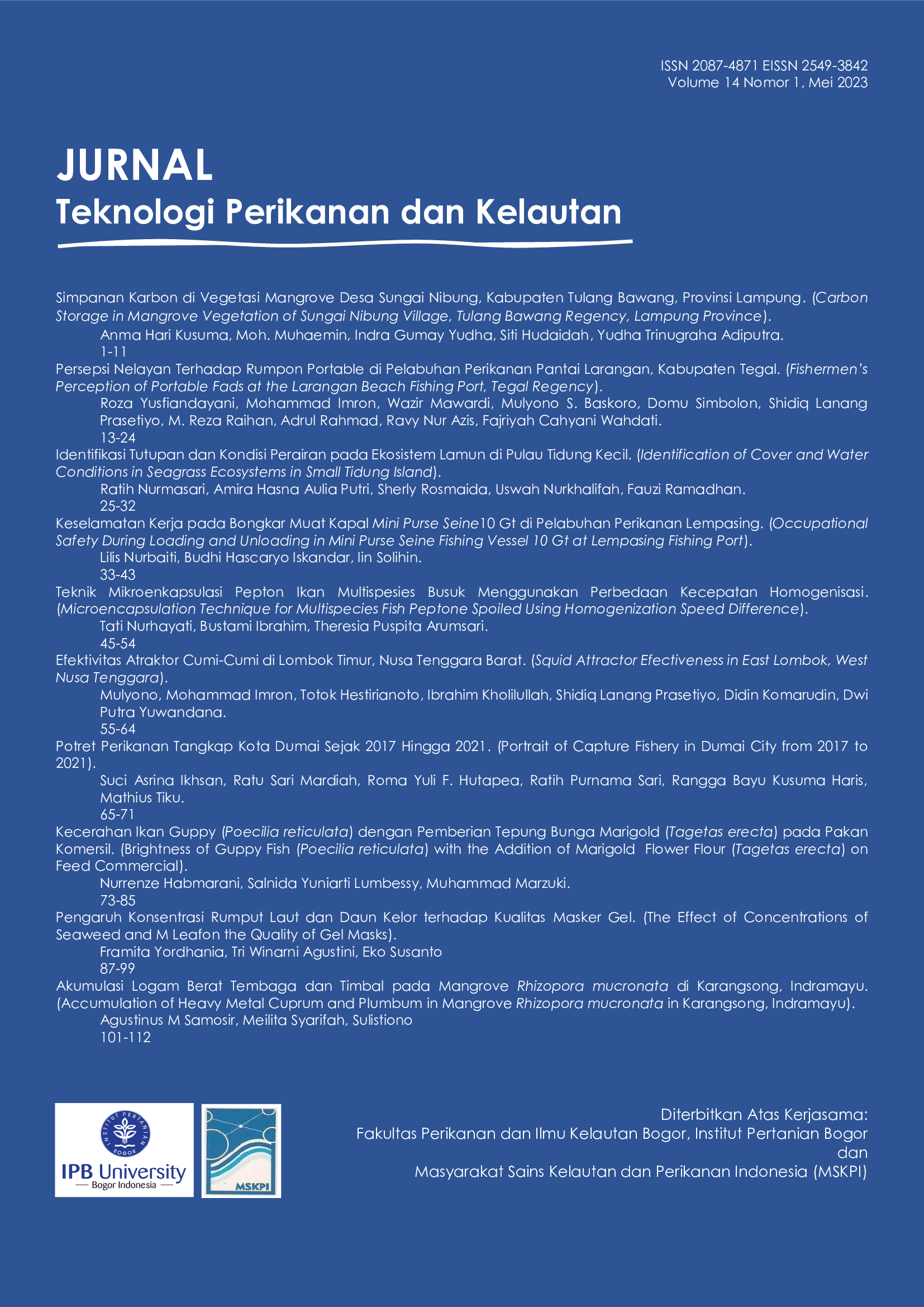
TEKNIK MIKROENKAPSULASI PEPTON IKAN MULTISPESIES BUSUK MENGGUNAKAN PERBEDAAN KECEPATAN HOMOGENISASI
DOI:
https://doi.org/10.24319/jtpk.14.45-54Keywords:
bycatch product, fish peptone, homogenization, maltodextrin, microencapsulationAbstract
Peptone is hygroscopic so it needs to be protected by microencapsulation technique. The research aimed to determine the effect of different homogenization speeds on fish peptone microencapsulation using speed levels of 16,000 rpm, 22,000 rpm, 28,000 rpm, and their application as a bacterial medium. The best globule size stability was made by using homogenization speed of 22,000 rpm. The result analysis of rendement was 41.76%. Peptone microencapsulate had contents of 8.21% moisture, 1.69% ash, 0.64% fat, and 15.5% protein, respectively. The value of solubility test was 75.5%, the nitrogen total 1.656%, salt content 1.53%, reduction sugar 23.78%, and pH 6.013. The value of white degree was 95.91%. Amino acids of fish peptone microencapsulate contained 15 kinds of amino acids. The dominant amino acids on the fish peptone microencapsulate were alanine and glutamic acid.
Downloads
Downloads
Published
Issue
Section
License
This journal is published under the terms of the Creative Commons Attribution-NonCommercial 4.0 International License. Authors who publish with this journal agree to the following terms: Authors retain copyright and grant the journal right of first publication with the work simultaneously licensed under a Creative Commons Attribution-NonCommercial 4.0 International License. Attribution — You must give appropriate credit, provide a link to the license, and indicate if changes were made. You may do so in any reasonable manner, but not in any way that suggests the licensor endorses you or your use. NonCommercial — You may not use the material for commercial purposes.
How to Cite