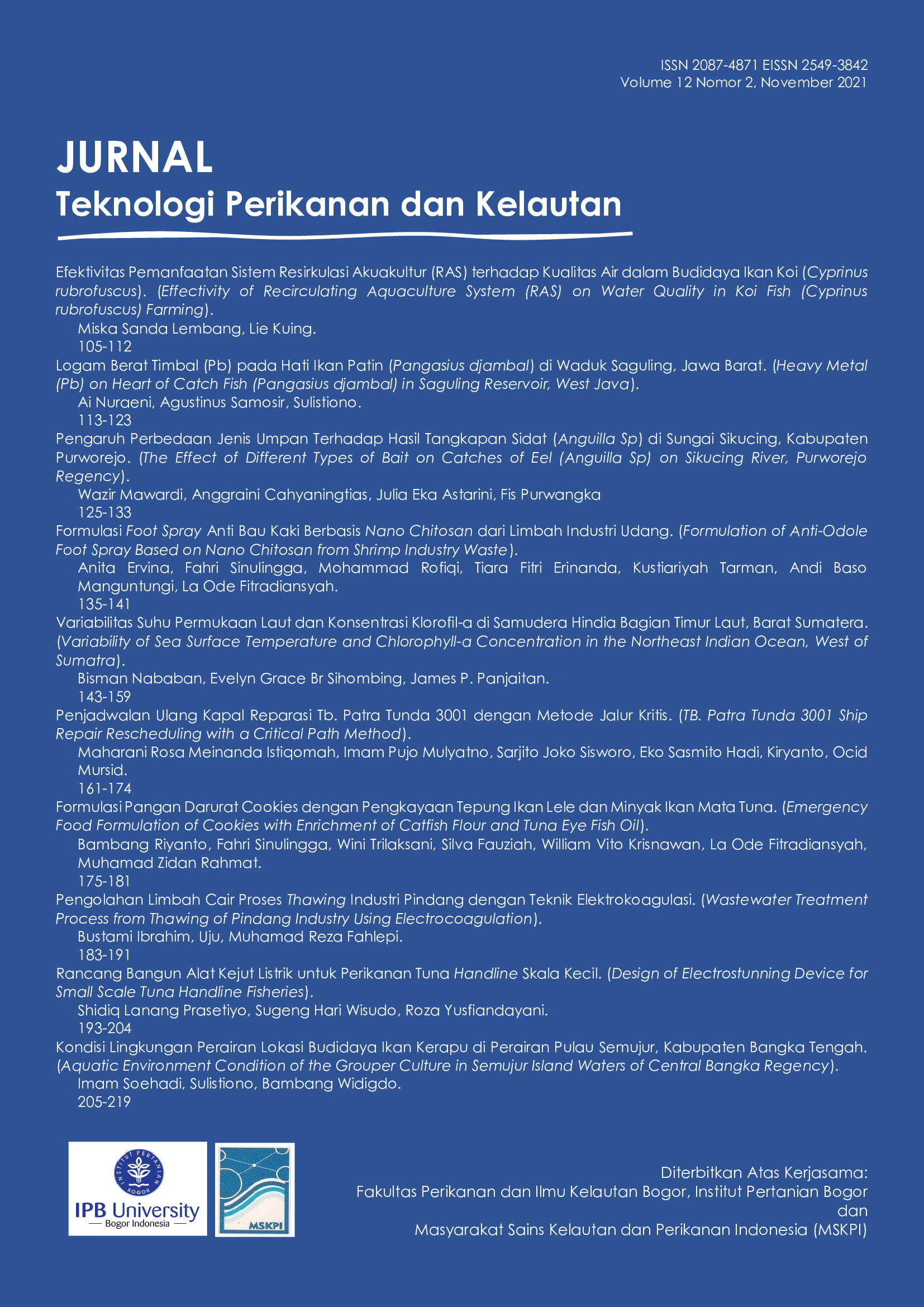
PENGOLAHAN LIMBAH CAIR PROSES THAWING INDUSTRI PINDANG DENGAN TEKNIK ELEKTROKOAGULASI
DOI:
https://doi.org/10.24319/jtpk.12.183-191Keywords:
electrocoagulation, organic component, thawing, wastewaterAbstract
Fishery industry waste contains organic components, namely protein, fat, and other organic components that can still be used in different levels. The organic components come from washing process water, cooking residue and pressing fish, including wastewater from thawing process. Treatment of wastewater from thawing process needs to removing for components of the pollutant load in wastewater. This study aims to determine the best electrical voltage and electrical contact time with the electrocoagulation method. The main material used is thawing water of Salem fish which will be processed to pindang product. Aluminium plate (10x2 cm2) was used as an electrode, and DC adapter was used as a power source. The treatments used combination of voltage variation and contact time. The applied voltage is 6, 9, and 12 volt, and the variations of the contact time (30, 60, and 90 minutes). The factorial combination between the electrical contact time and voltage of electrocoagulation method affected the value of the wastewater quality. The higher the voltage and the length of time contact resulted effectively reduction of BOD5 (92.31)%, COD (48.14)%, TSS (71.15)%, TDS (90.84)%, turbidity (99.13)%, protein (95.87)% as well as the pH raising values.
Downloads
Downloads
Published
Issue
Section
License
This journal is published under the terms of the Creative Commons Attribution-NonCommercial 4.0 International License. Authors who publish with this journal agree to the following terms: Authors retain copyright and grant the journal right of first publication with the work simultaneously licensed under a Creative Commons Attribution-NonCommercial 4.0 International License. Attribution — You must give appropriate credit, provide a link to the license, and indicate if changes were made. You may do so in any reasonable manner, but not in any way that suggests the licensor endorses you or your use. NonCommercial — You may not use the material for commercial purposes.
How to Cite