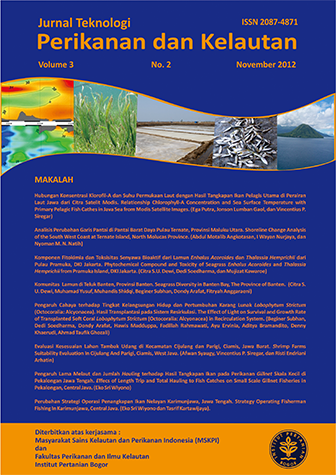
KERAGAMAN LAMUN DI TELUK BANTEN, PROVINSI BANTEN
DOI:
https://doi.org/10.24319/jtpk.3.29-34Keywords:
Seagrass, Diversity, Banten BayAbstract
Seagrass ecosystem is one distinguish component, which has an important role in tropical ecology. Seagrass also known as a potential organisms that contain bioactive compounds as raw material for medicine, so its distribution is important to be analyzed. The aim of this study were to provided information about distribution, diversity, density, and percent cover of seagrass in Banten Bay. This study was conducted by Line Intercept Transect (LIT) method at three station. There are five species of seagrass that were found in Banten Bay, namely: Cymodocea rotundata, Cymodocea serrulata, Enhalus acoroides, Halophila ovalis, dan Thalassia hemprichii. The highest density of seagras found at Tunda Island (193 individu/m2), and the lowest found at Panjang Island (44 individu/m2). The highest percent cover of seagrass found at Kalih Island (90%), while the lowest found at Panjang Island (62.5%). Enhalus acoroides is the most dominant species of seagrass that found on Banten Bay. The percent cover of seagrass inform that seagrass ecosystem in Banten Bay relatively healthy/wealthy.
Downloads
Downloads
Published
Issue
Section
License
This journal is published under the terms of the Creative Commons Attribution-NonCommercial 4.0 International License. Authors who publish with this journal agree to the following terms: Authors retain copyright and grant the journal right of first publication with the work simultaneously licensed under a Creative Commons Attribution-NonCommercial 4.0 International License. Attribution — You must give appropriate credit, provide a link to the license, and indicate if changes were made. You may do so in any reasonable manner, but not in any way that suggests the licensor endorses you or your use. NonCommercial — You may not use the material for commercial purposes.
How to Cite