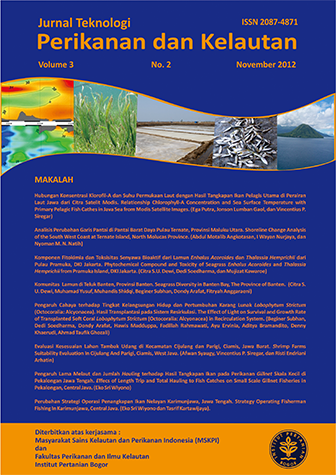
KOMPONEN FITOKIMIA DAN TOKSISITAS SENYAWA BIOAKTIF DARI LAMUN ENHALUS ACOROIDES DAN THALASSIA HEMPRICHII DARI PULAU PRAMUKA, DKI JAKARTA
DOI:
https://doi.org/10.24319/jtpk.3.23-27Keywords:
Enhalus acoroides, Thalassia hemprichii, phytochemicals, toxicityAbstract
Some of marine bioactive research has been done using seagrass, such as Enhalus acoroides and Thalassia hemprichii. Respect to the bioactive compound in Enhalus acoroides and Thalassia hemprichii as medicine, and other pharmaceuticals, it is necessary to observations phytochemical components and toxicity level. This study informs the toxicity level and phytochemical compounds which is contained in Enhalus acoroides and Thalassia hemprichii from Pramuka Island, Jakarta. Phytochemical test of Enhalus acoroides and Thalassia hemprichii showed that there are containing flavonoids, alkaloids, and steroids. Toxicity test wich is conducted with Brain Shrimp Lethal Toxic (BSLT) method showed that methanol extract of Enhalus acoroides is highly toxic with LC50 = 5.74 ppm, while the n-hexane extract of Enhalus acoroides is not toxic, indicated by LC50 = 1309.42 ppm.
Downloads
Downloads
Published
Issue
Section
License
This journal is published under the terms of the Creative Commons Attribution-NonCommercial 4.0 International License. Authors who publish with this journal agree to the following terms: Authors retain copyright and grant the journal right of first publication with the work simultaneously licensed under a Creative Commons Attribution-NonCommercial 4.0 International License. Attribution — You must give appropriate credit, provide a link to the license, and indicate if changes were made. You may do so in any reasonable manner, but not in any way that suggests the licensor endorses you or your use. NonCommercial — You may not use the material for commercial purposes.
How to Cite