
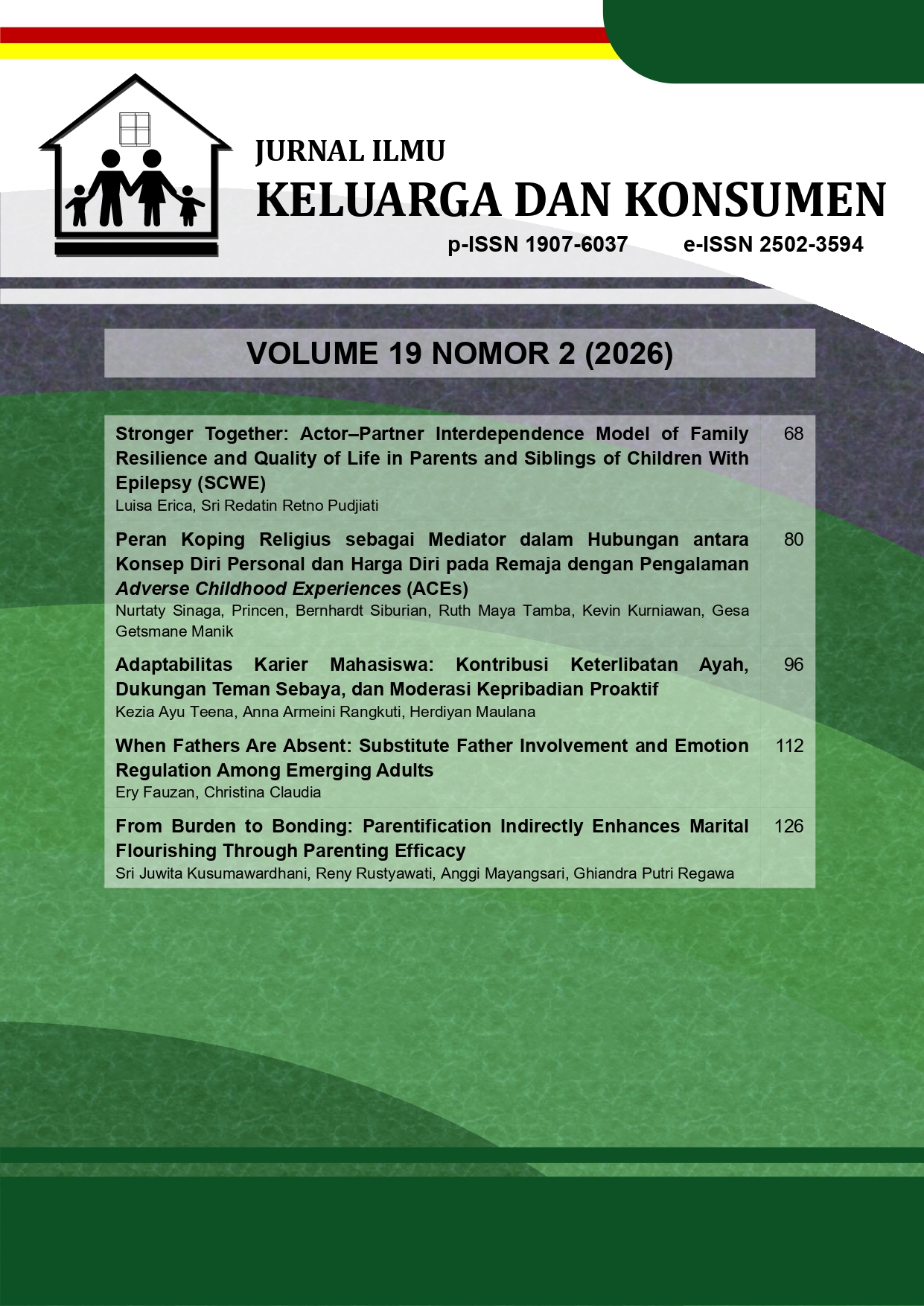
When Fathers Are Absent: Substitute Father Involvement and Emotion Regulation Among Emerging Adults
DOI:
https://doi.org/10.24156/jikk.2026.19.2.112Keywords:
cognitive reappraisal, emerging adulthood, emotion regulation, father absence, substitute father involvementAbstract
Father absence remains a significant issue in Indonesia, with roughly one in five children growing up without a biological father, but whether substitute male caregivers can compensate for that absence remains an underexplored question. This study examined whether involvement from substitute father figures (e.g., grandfathers and stepfathers) predicts emotion regulation strategies among emerging adults who experienced biological father absence before age 12. A cross-sectional quantitative design was employed, involving 100 participants aged 18–25 years who were recruited through purposive sampling. Participants completed a modified Father Involvement Scale (FIS) and the Emotion Regulation Questionnaire (ERQ). Simple linear regression analyses showed that higher substitute father involvement significantly predicted greater use of cognitive reappraisal (β = 0.34, p < 0.001, R² = 0.12) and lower use of expressive suppression (β = −0.25, p = 0.01, R² = 0.06). These findings indicate that consistent involvement from substitute father figures is linked to more adaptive emotion regulation among father-absent emerging adults. The study emphasizes that substitute male caregivers may play an important role in fostering healthy emotional functioning in emerging adulthood among individuals who experience father absence.
References
Amato, P. R., & Anthony, C. J. (2014). Estimating the effects of parental divorce and death with fixed effects models. Journal of Marriage and Family, 76(2), 370–386. https://doi.org/10.1111/jomf.12100
Angelica, F. A. M., & Himawan, K. K. (2022). Tahan atau pikir kembali: Strategi regulasi emosi dan kepuasan pernikahan pada masa pandemi COVID-19. Persona: Jurnal Psikologi Indonesia, 11(1), 107–122. https://doi.org/10.30996/persona.v11i1.6294
Aritonang, S. D., Hastuti, D., & Puspitawati, H. (2020). Pengasuhan ibu, keterlibatan ayah dalam pengasuhan, dan perkembangan kognitif anak usia 2–3 tahun di wilayah prevalensi stunting. Jurnal Ilmu Keluarga dan Konsumen, 13(1), 38–48. https://doi.org/10.24156/jikk.2020.13.1.38
Arnett, J. J., Žukauskienė, R., & Sugimura, K. (2014). The new life stage of emerging adulthood at ages 18–29 years: Implications for mental health. The Lancet Psychiatry, 1(7), 569–576. https://doi.org/10.1016/S2215-0366(14)00080-7
Banun, J. S., Aurora, A., Larasati, A. M., Manurung, I. H., & Hastuti, R. (2025). Pengaruh keterlibatan ayah dengan regulasi emosi Gen Z. Paedagogy: Jurnal Ilmu Pendidikan dan Psikologi, 5(2), 451–461. https://doi.org/10.51878/paedagogy.v5i2.5321
Boldt, L. J., Goffin, K. C., & Kochanska, G. (2020). The significance of early parent–child attachment for emerging regulation: A longitudinal investigation of processes and mechanisms from toddler age to preadolescence. Developmental Psychology, 56(3), 431–443. https://doi.org/10.1037/dev0000862
Brewer, S. K., Zahniser, E., & Conley, C. S. (2016). Longitudinal impacts of emotion regulation on emerging adults: Variable- and person-centered approaches. Journal of Applied Developmental Psychology, 47, 1–12. https://doi.org/10.1016/j.appdev.2016.09.002
Cabrera, N. J., Volling, B. L., & Barr, R. (2018). Fathers are parents, too! Widening the lens on parenting for children’s development. Child Development Perspectives, 12(3), 152–157. https://doi.org/10.1111/cdep.12275
Choi, J., Kim, H. K., Capaldi, D. M., & Snodgrass, J. J. (2021). Long-term effects of father involvement in childhood on their son’s physiological stress regulation system in adulthood. Developmental Psychobiology, 63(6), e22152. https://doi.org/10.1002/dev.22152
Coall, D. A., Hilbrand, S., Sear, R., & Hertwig, R. (2016). A new niche? The theory of grandfather involvement. In A. Buchanan & A. Rotkirch (Eds.), Grandfathers: Global perspectives (pp. 21–44). Palgrave Macmillan. https://doi.org/10.1057/978-1-137-56338-5_2
Colmenero-Navarrete, L., García-Sancho, E., & Salguero, J. M. (2022). Relationship between emotion regulation and suicide ideation and attempt in adults and adolescents: A systematic review. Archives of Suicide Research, 26(4), 1702–1735. https://doi.org/10.1080/13811118.2021.1999872
d’Orsi, D., Veríssimo, M., & Diniz, E. (2023). Father involvement and maternal stress: The mediating role of coparenting. International Journal of Environmental Research and Public Health, 20(8), 5457. https://doi.org/10.3390/ijerph20085457
Diniz, E., Brandão, T., Monteiro, L., & Veríssimo, M. (2021). Father involvement during early childhood: A systematic review of the literature. Journal of Family Theory & Review, 13(1), 77–99. https://doi.org/10.1111/jftr.12410
East, L., Jackson, D., & O’Brien, L. (2006). Father absence and adolescent development: A review of the literature. Journal of Child Health Care, 10(4), 283–295. https://doi.org/10.1177/1367493506067869
Fauzi, A., & Sihaloho, R. B. (2025). Gerakan Ayah Teladan Indonesia (GATI): Upaya peningkatan keterlibatan ayah dalam pengasuhan anak. Pendas: Jurnal Ilmiah Pendidikan Dasar, 10(4), 221–230. https://doi.org/10.23969/jp.v10i04.38726
Flouri, E., Midouhas, E., & Narayanan, M. K. (2016). The relationship between father involvement and child problem behaviour in intact families: A 7-year cross-lagged study. Journal of Abnormal Child Psychology, 44(5), 1011–1021. https://doi.org/10.1007/s10802-015-0077-9
Greene, A. D., Halle, T. G., Le Menestrel, S., & Moore, K. A. (2001). Measuring father involvement in young children’s lives: Recommendations for a fatherhood module for the ECLS-B. National Center for Education Statistics. https://nces.ed.gov/pubs2001/200102.pdf
Gross, J. J., & John, O. P. (2003). Individual differences in two emotion regulation processes: Implications for affect, relationships, and well-being. Journal of Personality and Social Psychology, 85(2), 348–362. https://doi.org/10.1037/0022-3514.85.2.348
Hendriani, W., Tedjadipura, A. A., Khaerunnisa, S. M., Wulandari, P. Y., & Cahyono, R. (2024). Peran ayah dalam pengasuhan yang memperkuat resiliensi digital anak: The role of father in parenting that strengthens children digital resilience. Jurnal Ilmu Keluarga dan Konsumen, 17(2), 132–145. https://doi.org/10.24156/jikk.2024.17.2.132
Jeng, C.-C. (2023). Why a variance inflation factor of 10 is not an ideal cutoff for multicollinearity diagnostics. Jiaoyu Yanjiu Xuebao [Educational Research Journal] 57, 67–93. https://doi.org/10.53106/199044282023105702004
Jensen, T. M. (2022). Stepparent–child relationships and child outcomes: A systematic review and meta-analysis. Journal of Family Nursing, 28(4), 321–340. https://doi.org/10.1177/10748407221097460
Karreman, A., de Moor, E. L., & Laceulle, O. M. (2025). Developmental change in cognitive emotion regulation profiles in the transition from childhood to adolescence. Research on Child and Adolescent Psychopathology, 53(12), 2003–2016. https://doi.org/10.1007/s10802-025-01375-1
Khofifah, A. N., Musawwir, M., & Purwasetiawatik, T. F. (2023). Pengaruh father involvement terhadap regulasi emosi remaja akhir di Kota Makassar. Jurnal Psikologi Karakter, 3(1), 56–64. https://doi.org/10.56326/jpk.v3i1.2043
Krisna, A., Rosalina, M. P., Ramadhan, F., & Pascalia, M. J. (2025, October 8). Seperlima anak Indonesia tanpa pengasuhan ayah. Kompas.id. https://www.kompas.id/artikel/anak-anak-yang-berpotensi-fatherless-dari-keluarga-terpisah-hl-h1
Lamb, M. E., & Lewis, C. (2010). The development and significance of father-child relationships in two-parent families. In M. E. Lamb (Ed.), The role of the father in child development (5th ed., pp. 94–153). John Wiley & Sons.
Lamb, M. E., Pleck, J. H., Charnov, E. L., & Levine, J. A. (2017). A biosocial perspective on paternal behavior and involvement. In Parenting across the life span (pp. 111–142). Routledge. https://doi.org/10.4324/9781315126005-7
McLanahan, S., Tach, L., & Schneider, D. (2013). The causal effects of father absence. Annual Review of Sociology, 39, 399–427. https://doi.org/10.1146/annurev-soc-071312-145704
Minuchin, S. (2018). Families and family therapy. Routledge.
Morris, A. S., Criss, M. M., Silk, J. S., & Houltberg, B. J. (2017). The impact of parenting on emotion regulation during childhood and adolescence. Child Development Perspectives, 11(4), 233–238. https://doi.org/10.1111/cdep.12238
Morris, A. S., Silk, J. S., Steinberg, L., Myers, S. S., & Robinson, L. R. (2007). The role of the family context in the development of emotion regulation. Social Development, 16(2), 361–388. https://doi.org/10.1111/j.1467-9507.2007.00389.x
Pratiwi, A., Morawska, A., & Haslam, D. (2026). Father involvement in Asian families: A systematic literature review. Journal of Family Issues, 47(3), 333–376. https://doi.org/10.1177/0192513X251370678
Puglisi, N., Rattaz, V., Favez, N., & Tissot, H. (2024). Father involvement and emotion regulation during early childhood: A systematic review. BMC Psychology, 12(1), 675. https://doi.org/10.1186/s40359-024-02182-x
Radde, H. A., Nurrahmah, N., Nurhikmah, N., & Saudi, A. N. A. (2021). Uji validitas konstrak dari Emotion Regulation Questionnaire versi bahasa Indonesia dengan menggunakan confirmatory factor analysis. Jurnal Psikologi Karakter, 1(2), 152–160. https://doi.org/10.56326/jpk.v1i2.1284
Raposo, B., & Francisco, R. (2022). Emotional (dys)regulation and family environment in (non)clinical adolescents’ internalizing problems: The mediating role of well-being. Frontiers in Psychology, 13, 703762. https://doi.org/10.3389/fpsyg.2022.703762
Robinson, E. L., StGeorge, J., & Freeman, E. E. (2021). A systematic review of father–child play interactions and the impacts on child development. Children, 8(5), 389. https://doi.org/10.3390/children8050389
Rogier, G., Garofalo, C., & Velotti, P. (2019). Is emotional suppression always bad? A matter of flexibility and gender differences. Current Psychology, 38(2), 411–420. https://doi.org/10.1007/s12144-017-9623-7
Rolo, C., Diniz, E., Babore, A., & Brandão, T. (2024). Mothers’ responses to children’s emotions and children’s behavior: The mediating role of children’s emotion regulation. European Journal of Investigation in Health, Psychology and Education, 14(7), 1940–1952. https://doi.org/10.3390/ejihpe14070129
Schäfer, J. Ö., Naumann, E., Holmes, E. A., Tuschen-Caffier, B., & Samson, A. C. (2017). Emotion regulation strategies in depressive and anxiety symptoms in youth: A meta-analytic review. Journal of Youth and Adolescence, 46(2), 261–276. https://doi.org/10.1007/s10964-016-0585-0
Settersten, R. A. (2012). The contemporary context of young adulthood in the USA: From demography to development, from private troubles to public issues. In A. Booth, S. L. Brown, N. S. Landale, W. D. Manning, & S. M. McHale (Eds.), Early adulthood in a family context (pp. 3–26). Springer. https://doi.org/10.1007/978-1-4614-1436-0_1
Sutanto, S. H., & Suwartono, C. (2021). Peran keterlibatan ayah dan kesepian terhadap kepuasan hidup remaja. Intuisi: Jurnal Psikologi Ilmiah, 13(1), 48–59. https://doi.org/10.15294/intuisi.v13i1.28619
Thomas, C., & Zolkoski, S. (2020). Preventing stress among undergraduate learners: The importance of emotional intelligence, resilience, and emotion regulation. Frontiers in Education, 5, Article 94. https://doi.org/10.3389/feduc.2020.00094
Troy, A. S., Shallcross, A. J., Brunner, A., Friedman, R., & Jones, M. C. (2018). Cognitive reappraisal and acceptance: Effects on emotion, physiology, and perceived cognitive costs. Emotion, 18(1), 58–74. https://doi.org/10.1037/emo0000371
Wakadia, D. (2025, June 30). Gerakan ayah teladan Indonesia. BKKBN. https://kampungkb.kemendukbangga.go.id/kampung/4578/intervensi/1753920/gerakan-ayah-teladan-indonesia
Wilson, S. V., Szwedo, D. E., & Allen, J. P. (2024). Interparental and parent–teen relationships during adolescence as predictors of intra- and interpersonal emotion regulation in young adulthood. Youth, 4(4), 1417–1436. https://doi.org/10.3390/youth4040090
Woodward, E. C., & Viana, A. G. (2018). The desire to emulate parental emotional strategies and its relation to emotion dysregulation among emerging adults. Emotional & Behavioural Difficulties, 23(3), 245–253. https://doi.org/10.1080/13632752.2018.1455648
Wu, J., Zhu, J., Lei, Y., & Shi, L. (2025). Effects of grandparents’ involvement on young children’s resilience: Mother’s parenting stress and family strength as mediators. Psicologia: Reflexão e Crítica, 38, 33. https://doi.org/10.1186/s41155-025-00370-1
Zhu, D., Lozada, F. T., Smith, C. L., Bell, M. A., & Dunsmore, J. C. (2025). Maternal emotion coaching and child emotion regulation: Within-interaction sequences in early childhood. Affective Science, 6(2), 214–223. https://doi.org/10.1007/s42761-024-00285-7
Zitzmann, J., Rombold-George, L., Rosenbach, C., & Renneberg, B. (2024). Emotion regulation, parenting, and psychopathology: A systematic review. Clinical Child and Family Psychology Review, 27(1), 1–22. https://doi.org/10.1007/s10567-023-00452-5
Downloads
Published
Issue
Section
License
Copyright (c) 2026 Jurnal Ilmu Keluarga dan Konsumen

This work is licensed under a Creative Commons Attribution-ShareAlike 4.0 International License.
























 This work is licensed under a