Pain management approach in a cat with feline arterial thromboembolism assessed using the Feline Grimace Scale

Downloads
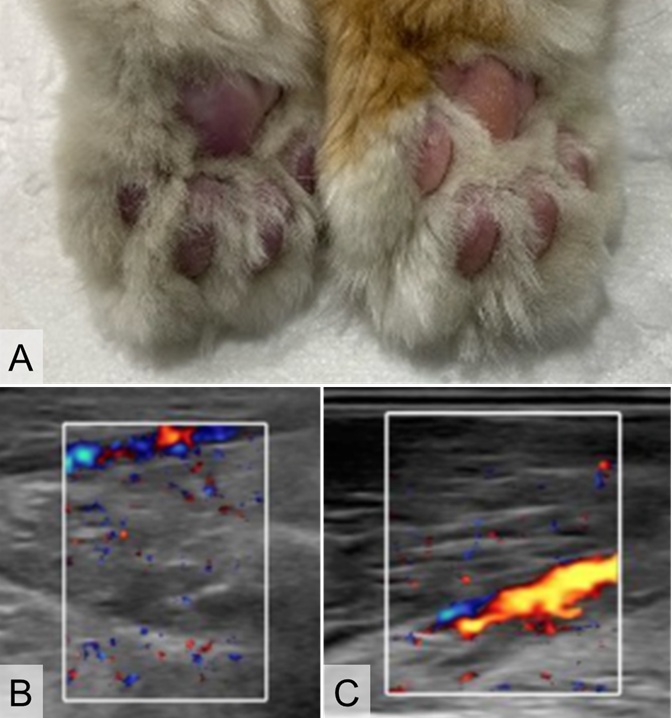
Feline arterial thromboembolism (FATE) is a life-threatening condition characterized by partial or complete arterial obstruction due to thrombus formation, most commonly secondary to hypertrophic cardiomyopathy (HCM). The resulting ischemia causes severe pain, which is often overlooked in clinical practice. The Feline Grimace Scale (FGS) provides a rapid and objective tool for pain assessment in cats. This report describes an adult female cat presenting with left hindlimb paresis, cyanosis, and femoral pulse deficit, with an initial FGS score of 6/10. Blood chemistry showed elevated creatine kinase (CK) levels, and echocardiography confirmed reduced femoral arterial flow and myocardial hypertrophy, consistent with HCM. A multimodal management approach was applied, including gabapentin, tramadol, clopidogrel, furosemide, and heparin therapy. Despite treatment, the affected limb developed gangrene, necessitating amputation. Preoperative analgesia consisted of pethidine, ketamine, and xylazine, followed by regional lidocaine nerve blocks and postoperative fentanyl continuous rate infusion. The surgical site healed completely within 21 days, and over a four-month follow-up period, the FGS score improved from 9 to 0, indicating complete pain resolution.
Chintari LK. 2022. Comparative study of feline arterial thromboembolism treated with the combination of atenolol-clopidogrel and single clopidogrel. ARSHI Veterinary Letters 6(3):43-44. https://doi.org/10.29244/avl.6.3.43-44
Luis Fuentes V. 2012. Arterial thromboembolism: risks, realities and a rational first-line approach. Journal of Feline Medicine and Surgery 14(7):459-470. https://doi.org/10.1177/1098612X12451547 | PMid:22736680 PMCid:PMC10822381
Monteiro BP, Lascelles BDX, Murrell J, Robertson S, Steagall PVM, Wright B. 2023. 2022 WSAVA guidelines for the recognition, assessment and treatment of pain. Journal of Small Animal Practice. 64(4):177-254. https://doi.org/10.1111/jsap.13566
Nicholls D, Merchant-Walsh M, Dunne J, Cortellini NP, Adami C. 2022. Use of mechanical thresholds in a model of feline clinical acute pain and their correlation with the glasgow feline composite measure pain scale scores. Journal of Feline Medicine and Surgery. 24(6):517-23. https://doi.org/10.1177/1098612X211035051 | PMid:34328358 PMCid:PMC11104254
Ray CC, Wolf J, Guillaumin J. 2025. Use of alteplase continuous rate infusion, pentoxifylline, and cyproheptadine in association or not, in acute feline aortic thromboembolism: a study of nine cats. Frontiers in Veterinary Science. 12:1512649. https://doi.org/10.3389/fvets.2025.1512649 | PMid:40420956 PMCid:PMC12105108
Robinson AR, Steagall PV. 2024. Effects of training on Feline Grimace Scale scoring for acute pain assessment in cats. Journal of Feline Medicine and Surgery. 6(10):1098612X241275284. https://doi.org/10.1177/1098612X241275284 | PMid:39466280 PMCid:PMC11529081
Smith SA, Tobias AH. 2004. Feline arterial thromboembolism: an up-date. Veterinary Clinics of North America - Small Animal Practice. 34(5):1245-1271. https://doi.org/10.1016/j.cvsm.2004.05.006 | PMid:15325481
Zachary, James F. 2017. Pathologic Basis of Veterinary Disease. Sixth Edition. Elsevier: Missouri.
Copyright (c) 2025 CC-BY-SA

This work is licensed under a Creative Commons Attribution-ShareAlike 4.0 International License.
All articles published in this journal are licensed under a Creative Commons Attribution-ShareAlike 4.0 International License (CC BY-SA 4.0).
This license permits use, distribution, reproduction, and adaptation in any medium, including for commercial purposes, provided the original work is properly cited, a link to the license is given, and any changes made are indicated. Any derivative work must be distributed under the same license or a compatible license.
How to Cite