Management of type 2 diabetes mellitus and feline infectious peritonitis in a Persian Peaknose cat

Downloads
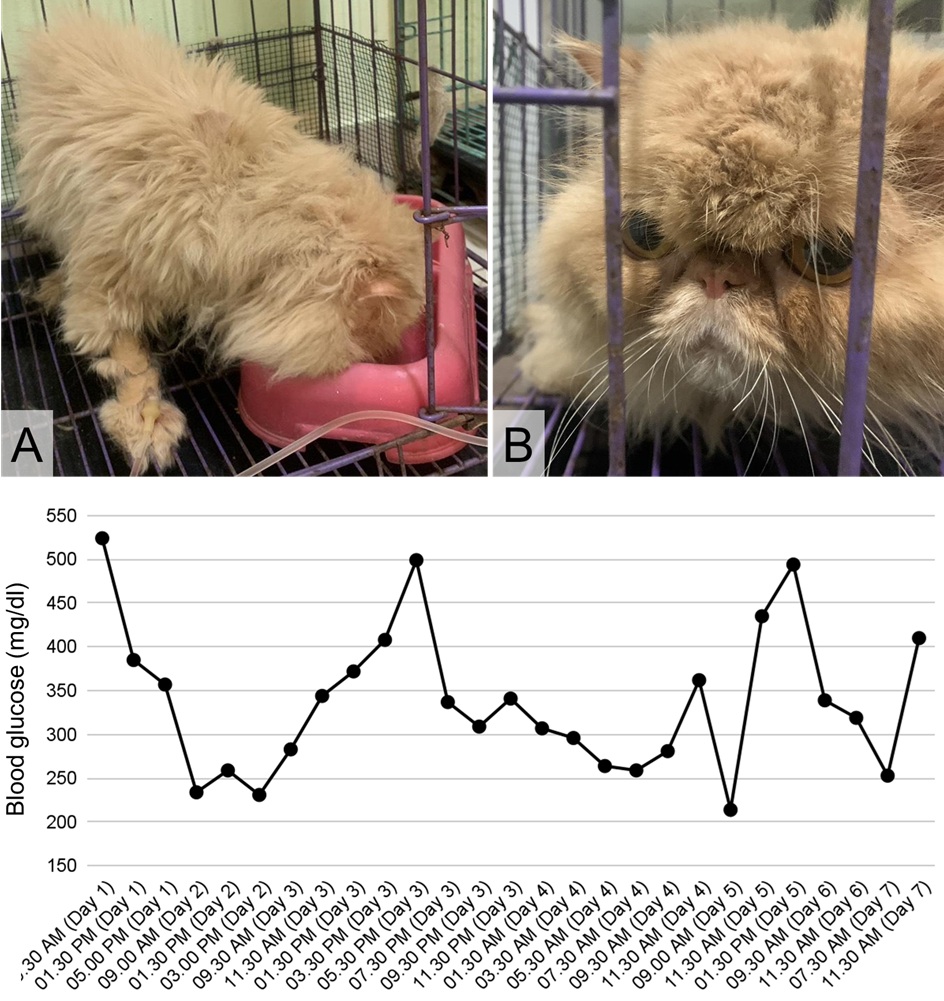
Feline diabetes mellitus (DM) and infectious peritonitis (FIP) are challenging metabolic and infectious diseases in cats that require long-term management and therapeutic strategies. This case report describes the clinical management of a 7-year-old male Persian peaknose cat diagnosed with type 2 DM and non-effusive FIP at the West Java Animal Hospital. The cat presented with polyuria, polydipsia, and severe weight loss over seven days. Hematological findings showed hyperchromic microcytic anemia and elevated MID%, while biochemical analysis indicated hyperglycemia (524 mg/dL), increased ALT, and a low albumin-to-globulin (A/G) ratio (0.6), consistent with type 2 DM and FIP. Treatment included Molnupiravir, Glimepiride as an antihyperglycemic agent; Ornipural for hepatodigestive support; vitamin supplementation (B complex, A, D, and E); and a low-sugar diet. Blood glucose levels monitored daily for seven days showed a progressive decrease but remained above the normal threshold. This case demonstrates the importance of comprehensive management combining causative, symptomatic, and supportive therapies in feline patients with concurrent disorders. This highlights the need for glucose monitoring, nutritional adjustment, and client education regarding insulin therapy to achieve glycemic control in complex feline comorbidities.
Barker E, Tasker S. 2020. Update on feline infectious peritonitis. In Practice. 42(7):372-383. https://doi.org/10.1136/inp.m3187
Behrend E, Holford A, Lathan P, Rucinsky R, Schulman R. 2018. 2018 AAHA diabetes management guidelines for dogs and cats. Journal of the American Animal Hospital Association. 54(1):1-21. https://doi.org/10.5326/JAAHA-MS-6822 | PMid:29314873
Gilor C, Rudinsky AJ, Hall MJ. 2016. New approaches to feline diabetes mellitus: Glucagon-like peptide-1 analogs. Journal of Feline Medicine and Surgery. 18(9):733-743. https://doi.org/10.1177/1098612X16660441 | PMid:27562982 PMCid:PMC11148896
Gottlieb S, Rand J. 2018. Managing feline diabetes: current perspec-tives. Veterinary Medicine: Research and Reports. 9:33-42. https://doi.org/10.2147/VMRR.S125619 | PMid:30050865 PMCid:PMC6053045
Kleinert M, Clemmensen C, Hofmann SM, Moore MC, Renner S, Woods SC, Huypens P, Beckers J, Angelis MH, Schürmann A, Bakhti M, Klingenspor M, Heiman M, Cherrington AD, Ristow M, Lickert H, Wolf E, Havel PJ, Müller TD, Tschöp MH. 2018. Animal models of obesity and diabetes mellitus. Nature Reviews Endocrinology, 14(3):140-162. https://doi.org/10.1038/nrendo.2017.161 | PMid:29348476
Koral E, Sevinc M. 2022. Diabetes mellitus in cats: an update on physi-ology, etiopathogenesis, clinical diagnosis, treatment. in Berkan Balpetek, editor. New Trends in Health Sciences. İzmir: Duvar Pub-lishing. p 145-167.
Morozenko D, Vashchyk Y, Zakhariev A, Seliukova N, Berezhnyi D, Gliebova K. 2022. Diabetes mellitus in domestic cats: clinical cases from veterinary practice. ScienceRise: Biological Science. 4(33):31-34. https://doi.org/10.15587/2519-8025.2022.266536
Nakrani MN, Wineland RH, Anjum F. 2023. Physiology, Glucose Metabolism. In: StatPearls. Treasure Island (FL): StatPearls Publishing.
Pérez‐López L, Boronat M, Melián C, Saavedra P, Brito‐Casillas Y, Wägner AM. 2019. Assessment of the association between diabetes mellitus and chronic kidney disease in adult cats. Journal of veteri-nary internal medicine. 33(5):1921-1925. https://doi.org/10.1111/jvim.15559 | PMid:31305000 PMCid:PMC6766521
Riemer F, Kuehner KA, Ritz S, Sauter-Louis C, Hartmann K. 2016. Clinical and laboratory features of cats with feline infectious perito-nitis-a retrospective study of 231 confirmed cases (2000-2010). Journal of feline medicine and surgery. 18(4);348-356. https://doi.org/10.1177/1098612X15586209 | PMid:26185109 PMCid:PMC11112253
Tamizharasan S, Pasumarthi V, Kumar HV, Savitha S, Chandrasekar M, Srinivasan D, Kavitha S, Vairamuthu S. 2022. Feline diabetes mellitus-diagnosis and its clinical management: A case report. The Pharma Innovation Journal. 11(6):1423-1425.
Copyright (c) 2025 CC-BY-SA

This work is licensed under a Creative Commons Attribution-ShareAlike 4.0 International License.
All articles published in this journal are licensed under a Creative Commons Attribution-ShareAlike 4.0 International License (CC BY-SA 4.0).
This license permits use, distribution, reproduction, and adaptation in any medium, including for commercial purposes, provided the original work is properly cited, a link to the license is given, and any changes made are indicated. Any derivative work must be distributed under the same license or a compatible license.
How to Cite