Neurological deficits and hematological changes in a rat model of ischemic stroke induced by middle cerebral artery occlusion

Downloads
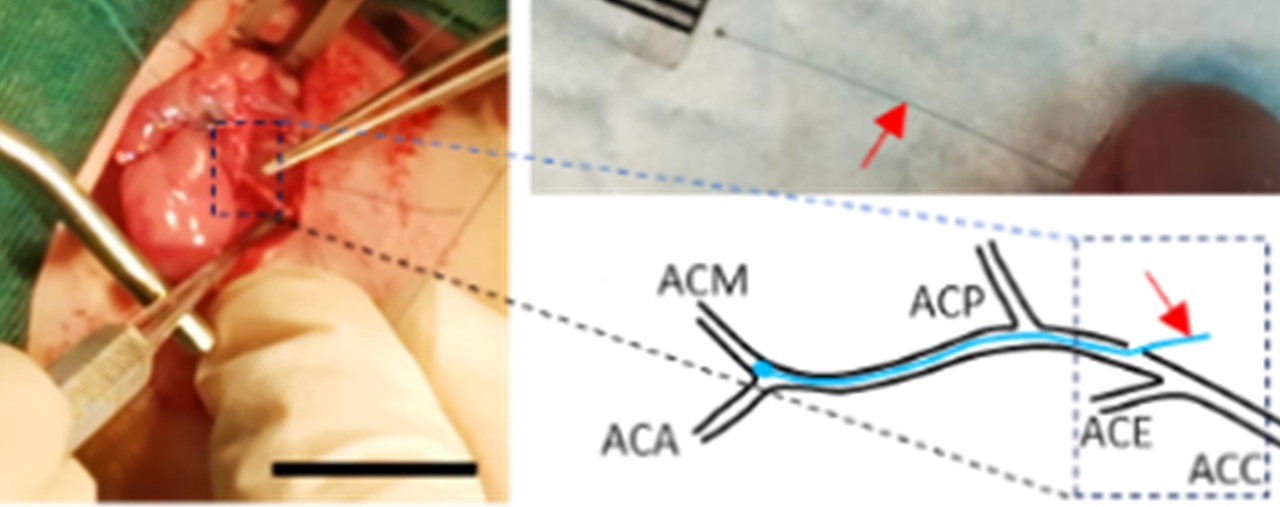
Stroke is a neurological disorder caused by impaired blood flow to specific regions of the brain, often resulting in paralysis and functional deficits in the affected area. Among its subtypes, ischemic stroke is the most prevalent in the general population. This study aimed to establish a rat model of ischemic stroke induced by middle cerebral artery occlusion (MCAO). Eight male Sprague-Dawley rats aged 8–10 weeks were randomly assigned to two groups: control and treatment group. In the treatment group, the middle cerebral artery was occluded for 45 min. Neurological assessment using the Bederson scale revealed a neurological deficit score (NDS) of 1, characterized by contralateral flexion after left-brain injury. Hematological analysis demonstrated significantly higher white blood cell (WBC) counts (p < 0.05), whereas red blood cell (RBC) counts, hemoglobin concentration, and hematocrit values were significantly lower (p < 0.05) than those in the control group. These findings indicate that the MCAO method with a 45-minute occlusion successfully induced a mild neurological deficit accompanied by distinct hematological alterations, thereby providing a reproducible animal model for ischemic stroke research.
Bouët V, Freret T, Toutain J, Divoux D, Boulouard M, Schumann-Bard P. 2007. Sensorimotor and cognitive deficits after transient middle cerebral artery occlusion in the mouse. Experimental Neurology. 203(2):555-567. https://doi.org/10.1016/j.expneurol.2006.09.006 | PMid:17067578
Desland FA, Afzal A, Warraich Z, Mocco J. 2014. Manual versus automated rodent behavioral assessment: comparing efficacy and ease of bederson and garcia neurological deficit scores to an open field video-tracking system. Journal of Central Nervous System Disease. 6:7-14. https://doi.org/10.4137/JCNSD.S13194 | PMid:24526841 PMCid:PMC3921024
Doll DN, Barr TL, Simpkins JW. 2014. Cytokines: their role in stroke and potential use as biomarkers and therapeutic targets. Aging and disease, 5(5): 294-306. https://doi.org/10.14336/ad.2014.0500294 | PMid:25276489 PMCid:PMC4173796
Feigin VL, Brainin M, Norrving B, Martins S, Sacco RL, Hacke W, Fisher M, Pandian J, Lindsay P. 2022. World stroke organization (WSO): global stroke fact sheet 2022. International Journal of Stroke. 17(1):18-29. https://doi.org/10.1177/17474930211065917 | PMid:34986727
Fluri F. Schuhmann MK, Kleinschnitz C. 2015. Animal models of ischemic stroke and their application in clinical research. Drug Design, Development and Therapy. 9:3445-3454. https://doi.org/10.2147/DDDT.S56071 | PMid:26170628 PMCid:PMC4494187
He Q, Su G, Liu K, Zhang F, Jiang Y, Gao J, Liu L, Jiang Z, Jin M, Xie H. 2017. Sex-specific reference intervals of hematologic and bio-chemical analytes in Sprague-Dawley rats using the nonparametric rank percentile method. Public Library of Science. 12(12):e0189837. https://doi.org/10.1371/journal.pone.0189837 | PMid:29261747 PMCid:PMC5738108
Hui C, Tadi P, Khan Suheb MZ, Patti L. 2024. Ischemic Stroke. [Up-dated 2024 Apr 20]. In: StatPearls [Internet]. https://www.ncbi.nlm.nih.gov/books/NBK499997/
Li Y, Zhang J. 2021. Animal models of stroke. Animal Models and Experimental Medicine. 4(3):204-219. https://doi.org/10.1002/ame2.12179 | PMid:34557647 PMCid:PMC8446711
Mahantayya V Math, Yashoda R Kattimani, Rita M Khadkikar, Sachin M Patel, V Shanti, Ravindra S Inamdar. 2016. Red blood cell count: brief history and new method. MGM Journal of Medical Sciences. 3(3):116-119. https://doi.org/10.5005/jp-journals-10036-1104
Rubattu S, Forte M, Raffa S. 2019. Circulating leukocytes and oxidative stress in cardiovascular diseases: a state of the art. Oxidative Medicine and Cellular Longevity. 2019:2650429. https://doi.org/10.1155/2019/2650429 | PMid:31737166 PMCid:PMC6815586
Shao G, Chen S, Sun Y, Xu H, Ge F. 2021. Chrysoeriol promotes functional neurological recovery in a rat model of cerebral ischemia. Pharmacognosy Magazine. 17(76):802-810. https://doi.org/10.4103/pm.pm_329_21
Copyright (c) 2025 CC-BY-SA

This work is licensed under a Creative Commons Attribution-ShareAlike 4.0 International License.
All articles published in this journal are licensed under a Creative Commons Attribution-ShareAlike 4.0 International License (CC BY-SA 4.0).
This license permits use, distribution, reproduction, and adaptation in any medium, including for commercial purposes, provided the original work is properly cited, a link to the license is given, and any changes made are indicated. Any derivative work must be distributed under the same license or a compatible license.
How to Cite