Utilizing echocardiography to monitor heartworm treatment with melarsomine: A clinical evaluation in a dog

Downloads
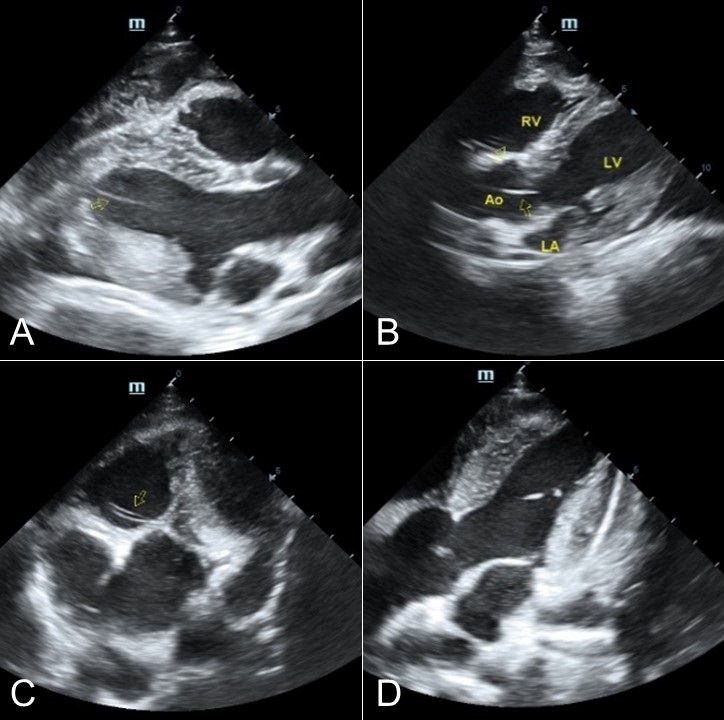
Dirofilariasis is a parasitic disease caused by nematodes in the blood vessels and heart. Echocardiography serves as a diagnostic test to confirm the presence of these worms and assists in staging the disease to determine an appropriate treatment protocol. This case study explored the monitoring of dirofilariasis therapy using cardiac ultrasonography. The results from the case study showed that no adult worms were detectable within the cardiac chambers 19 days after melarsomine treatment, highlighting the efficacy of this therapeutic approach in resolving heartworm infections.
Alia YY, May HK, Amall HA. 2013. Serological study of Dirofilaria immitis in human from some villages in Al-Hindya part of Karbala Governorate. International Journal of Science and Nature. 4(1):185-188.
Lee KJ, Park GM, Yong TS, Im K, Jung SH, Jeong NJ, Lee WY, Yong SJ, Shin KC. 2000. The first Korean case of human pulmonary dirofilariasis. Yonsei Medical Journal. 41(2):285-288. https://doi.org/10.3349/ymj.2000.41.2.285 DOI: https://doi.org/10.3349/ymj.2000.41.2.285
Levine ND. 1990. Parasitologi Veteriner. Gadjah Mada Universitas Press, Yogyakarta.
Romano AE, Saunders AB, Gordon SG, Wesselowski S. 2020. Intracardiac heartworms in dogs: Clinical and echocardiographic characteristics in 72 cases (2010-2019). Journal of Veterinary Internal Medicine 35(1): 88-97. https://doi.org/10.1111/jvim.15985 DOI: https://doi.org/10.1111/jvim.15985
Erawan IG, Tjahajati I, Nurcahyo W, Asmara W. 2017. Prevalence and risk factor of the Dirofilaria immitis infection in dogs slaughtered in Daerah Istimewa Yogyakarta. Jurnal Veteriner. 18(4):541-546. https://doi.org/10.19087/jveteriner.2017.18.4.541 DOI: https://doi.org/10.19087/jveteriner.2017.18.4.541
Erawan IG, Tjahajati I, Nurcahyo W, Asmara W. 2015. Excretory-secretory antigens of male and female heart worms (Dirofilaria immitis) which potentially as a diagnostic marker. Jurnal Veteriner. 16(4):463-467. https://doi.org/10.19087/jveteriner.2015.16.4.463 DOI: https://doi.org/10.19087/jveteriner.2015.16.4.463
All articles published in this journal are licensed under a Creative Commons Attribution-ShareAlike 4.0 International License (CC BY-SA 4.0).
This license permits use, distribution, reproduction, and adaptation in any medium, including for commercial purposes, provided the original work is properly cited, a link to the license is given, and any changes made are indicated. Any derivative work must be distributed under the same license or a compatible license.
How to Cite