Surgical tail amputation for severe traumatic coccygeal injury in a sugar glider (Petaurus breviceps)

Downloads
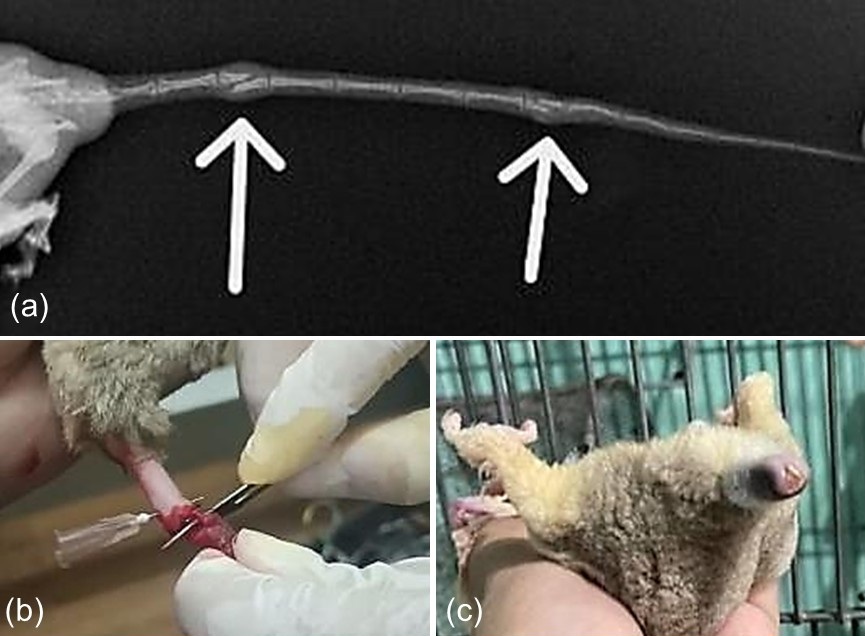
Sugar gliders (Petaurus breviceps) are kept as companion animals and may be predisposed to tail injuries due to aggression, self-mutilation, or environmental trauma. This report describes the clinical presentation, surgical management, and postoperative outcomes of tail amputation in a sugar glider with a coccygeal fracture complicated by self-mutilation. A 2-year-old intact male sugar glider presented with reduced appetite, repeated tail biting, and a five-day history of tail injury. Physical examination revealed an open wound with swelling, purulent discharge, pain on palpation, and crepitus. Radiography confirmed a complete transverse fracture of the distal coccygeal vertebra. Tail amputation was performed under anesthesia using 2% lidocaine at 4 mg/kg. The fractured segment was removed, and the skin was closed using simple interrupted sutures. Postoperatively, the patient was administered enrofloxacin, meloxicam, and topical gentamicin. Complete wound closure occurred by postoperative day 7, without complications.
Fisher CJ, Schiavone S, Gutiérrez JFM, Lopez GT. 2022. Microchip Implant Induced Dermatitis and Self-mutilation in Four Sugar Gliders (Petaurus breviceps). Journal of Exotic Pet Medicine 42:20-25. https://doi.org/10.1053/j.jepm.2022.04.003
Kubiak M. 2021. Sugar gliders. In: Handbook of Exotic Pet Medicine. First Ediction. John Wiley & Sons Ltd; 125-139. https://doi.org/10.1002/9781119389934.ch9
Kurt T, Atespare Zd, Cerkez EE. 2020. Penile Prolapse and Treatment in a Sugar Glider (Petaurus breviceps). Turkish Veterinary Journal 2(21):80-83.
Miwa Y, Sladky KK. 2016. Small mammals: common surgical procedures of rodents, ferrets, hedgehogs, and sugar gliders. Veterinary Clinics of North America: Exotic Animal Practice. 19:205-244. https://doi.org/10.1016/j.cvex.2015.09.001 | PMid:26611930 PMCid:PMC7128107
Wang C, Hua X, Yang H, Zhang K, Zhu Y, Liu D, Lei M, Bao J. 2025. Blood Vessels in The Mouse Tail: Progress in Anatomical Studies. American Journal of Translational Research. 17(5):3982-3993. https://doi.org/10.62347/GEMM6898 | PMid:40535675 PMCid:PMC12170382
Copyright (c) 2026 Raden Roro Allamanda Ardia Wardana, I Putu Krisna Ardhia Pradnyandika, Ni Wayan Apsari Shantika Pratistha

This work is licensed under a Creative Commons Attribution-ShareAlike 4.0 International License.
All articles published in this journal are licensed under a Creative Commons Attribution-ShareAlike 4.0 International License (CC BY-SA 4.0).
This license permits use, distribution, reproduction, and adaptation in any medium, including for commercial purposes, provided the original work is properly cited, a link to the license is given, and any changes made are indicated. Any derivative work must be distributed under the same license or a compatible license.
How to Cite