Tobacco leaf infusion (Nicotiana tabacum) for cutaneous myiasis in a dog

Downloads
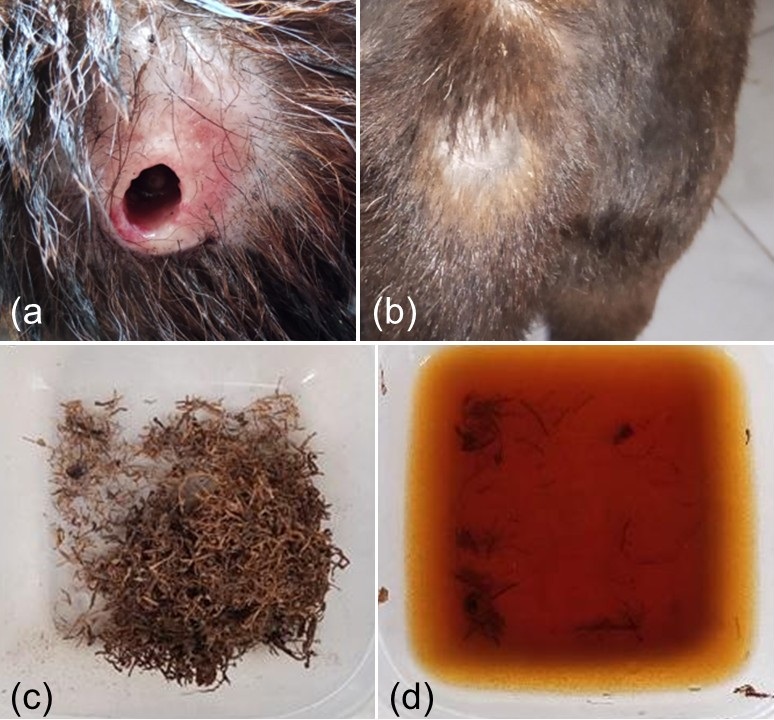
This case report describes the clinical outcome of a dog with cutaneous myiasis treated with topical tobacco leaf infusion (Nicotiana tabacum). An 8-year-old male local dog from Tabanan, Bali, was presented with a foul-smelling open wound at the base of the tail. Physical examination revealed fly larvae within the wound, and cutaneous myiasis was diagnosed. A 2.5% w/v tobacco leaf infusion was prepared by heating 5 g of dried tobacco leaf simplicia in 200 mL of water at 90°C for 30 min, followed by cooling and filtration. The infusion was applied topically at 3–4 drops into the wound twice daily for 10 days. Manual larval extraction and wound suturing were not performed. Larvae emerged from the wound after topical application. Clinical improvement was observed during follow-up, with scab formation on day 7 and complete wound closure by day 14. No adverse clinical signs were reported during the observation period.
Anggraini IA, Darmayanti LP, Sugita IM. 2020. The effects of boiling duration on making herbal drink of sapodilla leaf (Manilkara zapota) on characteristics and inhibitory growth of Escherichia coli. Jurnal Itepa. 9(3):272 - 281. https://doi.org/10.24843/itepa.2020.v09.i03.p03
Ashirbekov G. 2020. Neuro-humoral disorders of the adaptation system under the action of certain classes of pesticides. Georgian Medical News. 308:149-154.
Kristinawati E, Zaetun S, Srigede L. 2019. Efektivitas ekstrak daun tembakau (Nicotiana tabacum) segar dan daun tembakau (Nicotiana tabacum) yang sudah dioven sebagai insektisida nabati lalat hijau (Chrysomya bezziana). Media Bina Ilmiah. 13(10):1657-1664. https://doi.org/10.33758/mbi.v13i10.247
Mutinda KN, Gichohi MP, Maina WR, Maina GS, Agosa KE. 2022. Prevalence, etiology, and risk factors associated with occurrence of canine cutaneous myiasis in Kitui County, Kenya. Veterinary Medicine International. 2022(1):5699060. https://doi.org/10.1155/2022/5699060
PMid:35783917 PMCid:PMC9249507
Oliveira PC, Moraes PA, Scott FB, Verocai GG, Correia TR, Fernandes JI. 2018. Efficacy of spinosad on the treatment of myiasis caused by Cochliomyia hominivorax (Diptera: Calliphoridae) in dogs. Veterinary Parasitology. 258:53-56. https://doi.org/10.1016/j.vetpar.2018.06.006 | PMid:30105978
Orfanou DC, Papadopoulos E, Cripps PJ, Athanasiou LV, Fthenakis GC. 2011. Myiasis in a dog shelter in Greece: epidemiological and clinical features and therapeutic considerations. Veterinary Parasitology. 181(2-4):374-378. https://doi.org/10.1016/j.vetpar.2011.04.006 | PMid:21536388
Panda DN, Pattanaik TK. 2003. Efficacy of Maggacite lotion and Dressol ointment and lotion in the treatment of maggoted and surgical wounds. Indian Veterinary Journal. 80(5):441-442.
Putra TD, Taufiq N, Siswara HN, Aini LN, Huda K. 2022. Studi in vitro tobacco leaf extracts (Nicotiana tabacum) and green binahong leaves (Anredera cordifolia Steenis) as natural insecticides for myiasis in ruminants. Wahana Peternakan. 6(3):144-149. https://doi.org/10.37090/jwputb.v6i3.608
Salant H, Mumcuoglu KY, Baneth G. 2020. Myiasis in a dog in Jerusalem. Israel Journal of Veterinary Medicine. 75(4):221-224.
Shakya M, Singh M, Jayraw AK. 2018. Myiasis in dogs in Mhow, Madhya Pradesh. Journal of Veterinary Parasitology. 32(1):45-47. https://doi.org/10.5958/0974-0813.2018.00009.8
Solomon M, Lachish T, Schwartz E. 2016. Cutaneous myiasis. Current Infectious Disease Reports. 18(9):28. https://doi.org/10.1007/s11908-016-0537-6 | PMid:27443558
Wardhana AH, Abadi I, Cameron MM, Ready PD, Hall MJR. 2018. Epidemiology of traumatic myiasis due to Chrysomya bezziana in Indonesia. Jurnal Ilmu Ternak dan Veteriner. 23(1):45-60. https://doi.org/10.14334/jitv.v23i1.1617
Copyright (c) 2026 I Made Yoga Windu Pradana, Dewa Ayu Windhu Manik Anandagiri, Dewa Ketut Raeyadi Purnama, I Made Bagus Januar Bahari, I Putu Cahyadi Putra

This work is licensed under a Creative Commons Attribution-ShareAlike 4.0 International License.
All articles published in this journal are licensed under a Creative Commons Attribution-ShareAlike 4.0 International License (CC BY-SA 4.0).
This license permits use, distribution, reproduction, and adaptation in any medium, including for commercial purposes, provided the original work is properly cited, a link to the license is given, and any changes made are indicated. Any derivative work must be distributed under the same license or a compatible license.
How to Cite