Infectious keratoconjunctivitis associated with Pseudomonas aeruginosa infection in a fat-tailed sheep reared under semi-open housing conditions

Downloads
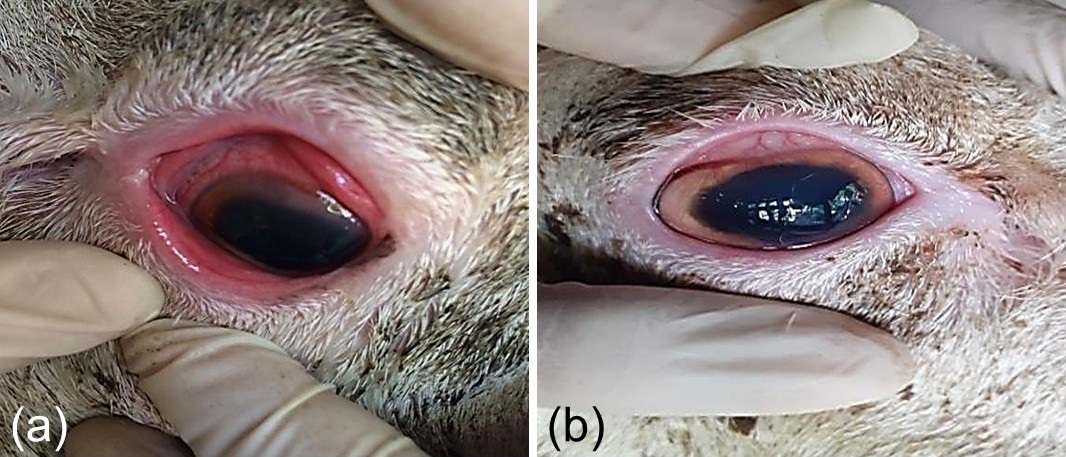
Pink eye, or infectious keratoconjunctivitis, is a contagious disease that can impair vision and welfare if untreated. This case report describes the diagnosis and management of Pseudomonas aeruginosa-associated infectious keratoconjunctivitis in a sheep in Kulonprogo, Yogyakarta, Indonesia. A 3-year-old female fat-tailed sheep weighing 30 kg presented with bilateral redness for two days. Clinical examination revealed photophobia, corneal opacity, lacrimation, and conjunctival inflammation. Hematological examination revealed leukocytosis and neutrophilia, indicating an inflammatory reaction. Bacterial culture of a conjunctival swab identified P. aeruginosa, although antibiotic susceptibility testing was not performed. Based on the history, clinical signs, physical examination, hematological findings, and bacteriological confirmation, the sheep was diagnosed with infectious keratoconjunctivitis associated with P. aeruginosa infection and a favorable prognosis. Empirical treatment consisted of intramuscular dihydrostreptomycin sulfate–procaine penicillin G at 0.1 mL/kg body weight, intramuscular vitamin B12 at 0.01 mg/kg body weight, and topical oxytetracycline to both eyes. Improvement occurred two days after treatment, with reduced lacrimation and clearer corneas.
Akter S, Rahman MM, Islam MS, Uddin MJ, Hossain MA, Rahman M. T. 2025. Clinical and hematological findings of infectious keratoconjunctivitis in small ruminants. Veterinary Medicine and Science, 11(1): 45-53.
Angelos JA. 2015. Infectious keratoconjunctivitis in cattle (pinkeye). Veterinary Clinics: Food Animal Practice, 31(1): 61-79. https://doi.org/10.1016/j.cvfa.2014.11.006 | PMid:25576389
Chapman HM, Murdoch FR, Robertson ID, Beatty DT. 2010. Detection, identification and treatment of infectious ovine keratoconjunctivitis (pink eye) in sheep from a Western Australian pre-export feedlot. WEB: https://researchportal.murdoch.edu.au
García-López C, Rodríguez-Calvo-de-Mora M, Borroni D, Sánchez-González JM, Romano V, Rocha-de-Lossada C. 2023. The role of matrix metalloproteinases in infectious corneal ulcers. Survey of Ophthalmology. 68(5):929-939. https://doi.org/10.1016/j.survophthal.2023.06.007 | PMid:37352980
Kuibagarov M, Nurgozhin T, Abdrakhmanov S. 2023. Risk factors associated with infectious keratoconjunctivitis in ruminants. Veterinary World, 16(3):567-573.
O'Callaghan R, Caballero A, Tang A, Bierdeman M. 2019. Pseudomonas aeruginosa keratitis: protease IV and PASP as corneal virulence mediators. Microorganisms, 7(9): 281. https://doi.org/10.3390/microorganisms7090281 | PMid:31443433 PMCid:PMC6780138
Pang Z, Raudonis R, Glick BR, Lin TJ, Cheng Z. 2019. Antibiotic resistance in Pseudomonas aeruginosa: mechanisms and alternative therapeutic strategies. Biotechnology Advances. 37(1):177-192. https://doi.org/10.1016/j.biotechadv.2018.11.013 | PMid:30500353 PMCid:PMC13010984
Rhaymah M, Rasheed BY, Hussain KJ. 2013. Comparative study on the bacterial causes of ovine keratoconjunctivitis in native breed sheep and goats. Assiut Veterinary Medical Journal, 59(137):77-80. https://doi.org/10.21608/avmj.2013.171487
Zaitoun A, Elseleny M, El Khabaz K. 2021. Clinical study on Moraxella-associated infectious keratoconjunctivitis (IKC) of small ruminants. Benha Veterinary Medical Journal. 40(2):1-4. https://doi.org/10.21608/bvmj.2021.80682.1436
Copyright (c) 2026 Bagas Pria Prasetyo, I Putu Cahyadi Putra, Mettarani Dymia Euis Pefdini, Anis Pramundari

This work is licensed under a Creative Commons Attribution-ShareAlike 4.0 International License.
All articles published in this journal are licensed under a Creative Commons Attribution-ShareAlike 4.0 International License (CC BY-SA 4.0).
This license permits use, distribution, reproduction, and adaptation in any medium, including for commercial purposes, provided the original work is properly cited, a link to the license is given, and any changes made are indicated. Any derivative work must be distributed under the same license or a compatible license.
How to Cite