Effect of a local foot-and-mouth disease vaccine candidate on TNF-α concentration and muscle necrosis in mice

Downloads
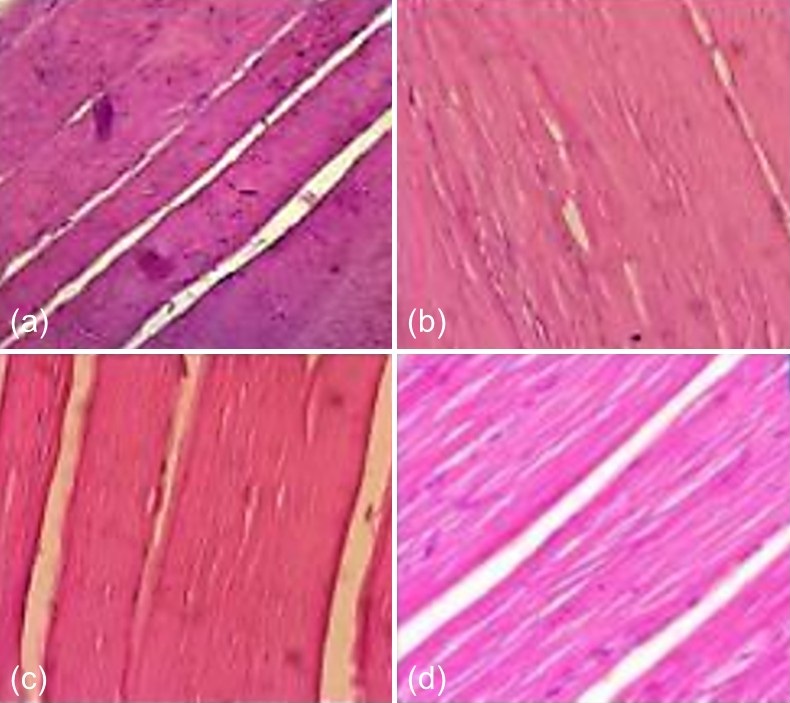
Foot-and-mouth disease (FMD) is a contagious transboundary disease that causes livestock losses. Vaccination is central to FMD control, but its effectiveness depends on the antigenic relevance to field strains. This study evaluated the safety and immunological response of a local isolate-based inactivated FMD vaccine candidate in mice. Eighty BALB/c mice were divided into four groups: adjuvant-only control, inactivated FMD virus antigen at 10⁸ TCID₅₀, 10⁷ TCID₅₀ with Montanide ISA, and 10⁶ TCID₅₀ with Montanide ISA. Immunization occurred intramuscularly on days 0 and 14. Tumor necrosis factor-alpha (TNF-α) concentrations were measured by ELISA, and injection-site tissues were examined histopathologically for necrosis. TNF-α concentrations increased after immunization, peaking post-booster in the adjuvanted 10⁷ TCID₅₀ group. Histopathology showed preserved architecture with no detectable necrosis. These findings suggest a systemic immune response without local muscle damage. Further studies in livestock are required to confirm protective efficacy, neutralizing antibody responses, and field-level safety.
Chen L, Deng H, Cui H, Fang J, Zuo Z, Deng J, Li Y, Wang X, Zhao L. (2018). Inflammatory responses and inflammation-associated diseases in organs. Oncotarget. 9(6):7204-7218. https://doi.org/10.18632/oncotarget.23208 | PMid:29467962 PMCid:PMC5805548
Choi JH, You SH, Ko MK, Jo HE, Shin SH, Jo H, Lee MJ, Kim SM, Kim B, Lee JS, Park JH. (2020). Improved immune responses and safety of foot-and-mouth disease vaccine containing immunostimulating components in pigs. Journal of Veterinary Science. 21(5):e74. https://doi.org/10.4142/jvs.2020.21.e74 | PMid:33016020 PMCid:PMC7533391
Cui X, Chen J, Guan R, Zhang C, Li Z, Shi F. (2019). Early IgG response to foot and mouth disease vaccine formulated with a vegetable oil adjuvant. Vaccines. 7(4):143. https://doi.org/10.3390/vaccines7040143 | PMid:31600943 PMCid:PMC6963984
Knight-Jones TJD, Rushton J. (2013). The economic impacts of foot and mouth disease-what are they, how big are they and where do they occur? Preventive Veterinary Medicine. 112(3-4):161-173. https://doi.org/10.1016/j.prevetmed.2013.07.013 | PMid:23958457 PMCid:PMC3989032
Ko EY, Jung S, Jeong HK, Han JH, Son JH. (2018). Effects of foot-and-mouth disease vaccination location and injection device on the incidence of site lesions in pork. Korean Journal for Food Science of Animal Resources. 38(3):498-505. https://doi.org/10.5851/kosfa.2018.e46 | PMid:30675107 PMCid:PMC6335128
Mahapatra M, Parida S. (2018). Foot and mouth disease vaccine strain selection: current approaches and future perspectives. Expert Review of Vaccines. 17(7):577-591. https://doi.org/10.1080/14760584.2018.1492378 | PMid:29950121
Paton DJ, Valarcher JF, Bergmann I, Matlho OG, Zakharov VM, Palma EL, Thomson GR. (2005). Selection of foot and mouth disease vaccine strains-a review. Revue Scientifique et Technique. 24(3):981-993. https://doi.org/10.20506/rst.24.3.1632
Sudo K, Ochiai M, Yamazaki K, Kube M. (2021). Pathological analysis of batch safety testing of veterinary vaccines using small laboratory animals. Journal of Toxicologic Pathology. 34(2):137-146. https://doi.org/10.1293/tox.2020-0078 | PMid:33976469 PMCid:PMC8100255
Copyright (c) 2026 Vengine Ulyama, Fedik Abdul Rantam, Vega Decline, Yulianna Puspitasari, Hani Plumeriastuti, Jola Rahmahani, Mohammad Anam Al Arif

This work is licensed under a Creative Commons Attribution-ShareAlike 4.0 International License.
All articles published in this journal are licensed under a Creative Commons Attribution-ShareAlike 4.0 International License (CC BY-SA 4.0).
This license permits use, distribution, reproduction, and adaptation in any medium, including for commercial purposes, provided the original work is properly cited, a link to the license is given, and any changes made are indicated. Any derivative work must be distributed under the same license or a compatible license.
How to Cite




Funding data
-
Direktorat Riset dan Pengabdian Masyarakat
Grant numbers 0536/E5/PG.02.00/2023