
Author Guidelines
Journal of Agroindustrial Technology
General Provisions
- Authors must ensure that the submitted manuscript is original and has never been published in any other journal. This must be declared in a statement letter as attached.
- Manuscripts to be published in the Jurnal Teknologi Industri Pertanian may include research articles, policy analyses, short communications, opinions, conceptual papers, and reviews.
- Manuscripts may be written in English using a format that conforms to the grammatical and academic conventions of the respective language. The Editors will not accept manuscripts that do not meet the required guidelines.
- The decision regarding the eligibility of a manuscript for publication shall be determined by the Editorial Board of the Jurnal Teknologi Industri Pertanian based on recommendations from competent peer reviewers.
- Manuscripts must be prepared in Microsoft Word, while figures or graphs should be prepared in Microsoft Excel. The author’s name should be used as the file name. Manuscripts may be submitted online through http://journal.ipb.ac.id/index.php/jurnaltin.
- The copyright of published articles belongs to the Jurnal Teknologi Industri Pertanian. Authors whose manuscripts are accepted for publication are required to pay a publication contribution fee of IDR 1,500,000 per manuscript.
- Authors must propose three competent peer reviewers in the relevant field who hold doctoral degrees, along with their complete addresses, whom the authors expect to review the manuscript.
Manuscript Preparation Standards
- The manuscript should be typed with 1,5 line spacing, except for the title, abstract, figure captions, and table titles, which should be single-spaced. The manuscript should be prepared on A4 paper in a single-column format, with a total length of 4,000 to 7,000 words, including figures and tables.
- The manuscript should be prepared using Microsoft Word. Figures should be provided in JPEG or TIFF format. If graphs are included, the master file or Microsoft Excel file should also be attached. The standard font used in the manuscript is Times New Roman, 11 pt.
- The manuscript should be organized in the following order: title, author names, complete institutional affiliations of all authors, abstract, introduction, materials and methods, results and discussion, conclusion, acknowledgments if any, and references. Institutional addresses, including street name, number, city, postal code, and the author’s email address, must be clearly stated.
- Binomial or trinomial Latin nomenclature, written in italics, should be used for plants, animals, insects, and diseases. The full chemical names of compounds should be used upon their first mention.
- Measurement units must follow the International System of Units, or SI.
- Decimal numbers should be written using a dot (.).
Manuscript Writing Guidelines
Title. The title must be concise, specific, and informative, accurately reflecting the content of the manuscript. It should contain a maximum of 15 words and be written in English. The title should be followed by the names of the authors, their institutions and addresses, as well as a footnote indicating the corresponding author, including complete mailing address, telephone and facsimile numbers, and email address.
Abstract. Abstract. The abstract must be written in both English and Indonesian. It should consist of 200–250 words and be written in a single paragraph. The abstract should summarize the entire manuscript, including the background, objectives, methods, key findings, discussion, and conclusion. The use of abbreviations should be avoided, except for those that are commonly used.
Keywords. The keywords should be written in English, consisting of three to five words or phrases. They should be arranged according to their level of importance and presented at the end of the abstract.
Introduction. This section should present the background supported by a concise review of relevant literature, the objectives, and, when necessary, the scope of the research. This allows readers to evaluate the findings without having to consult previous publications. The references used must be directly relevant to the research conducted. The literature review should preferably be integrated into the introduction, methodology, and discussion sections.
Materials and Methods. This section should provide detailed technical information so that the experiment can be properly repeated by other researchers. If special equipment or instruments are used, the specifications of the equipment and operating conditions should be provided.
Results and Discussion. This section presents the research findings in the form of text, tables, or figures. The use of photographs should be limited to clearly presented results. Each figure and table must be numbered sequentially and referred to in the manuscript. “Figure 1,” “Figure 2,” and “Table 1” are examples of how figure and table titles should be written.

Figure 1. Radar graph of sensory analysis for chocolate couverture with different formulations
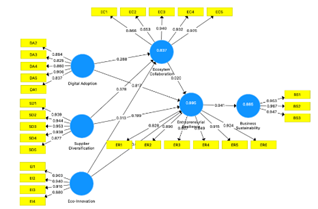
Figure 2. Outer model (measurement model)
Table 1. Descriptive statistics of latent variables
| No | Variables | Mean |
|---|---|---|
| 1 | Digital Adoption | 4.21 |
| 2 | Supplier Diversification | 4.08 |
| 3 | Eco-Innovation | 3.97 |
| 4 | Ecosystem Collaboration | 4.15 |
| 5 | Entrepreneurial Resilience | 4.22 |
Conclusions and RecommendationsThe conclusion should be written concisely while clearly reflecting the substance of the research findings. Recommendations should be stated clearly so that they can be followed up by relevant parties.
Acknowledgments. This section may be used to acknowledge funding agencies, institutions, and individuals who contributed to the research and preparation of the manuscript.
References References are required for all citations and should be arranged alphabetically using the author-date system. The references used should be recent, preferably published within the last ten years, with more than 80 percent consisting of primary and relevant sources. Secondary citations are not permitted as reference sources. This journal should be abbreviated as J Tek Ind Pert. For other journals, abbreviations should follow the Chemical Abstracts abbreviations.
Journals
Nugraha AW, Suparno O, Indrasti NS, Hoerudin. 2020. Free ammonia deliming: effect of tartaric acid addition as a demiling agent on the quality of wet blue and waste water. Tropical Animal Science Journal. 43 (2): 176 – 182
Books
Baker RW. 2004. Membrane Technology and Application. 2nd ed. West Sussex: JohnWiley & Sons, Ltd.
Chaptersin Book
White PJ dan Tziotis A. 2004. New corn starch. Di dalam Eliasson AC (ed.), Starch in Food:
Structure, function and application. Cambridge: CRC Press. P295-320.
Proceedings
Sunarti TC dan Yuliasih I. 2006. Fractionation of Sago Starch Using Hot Water Solubilization Method. Proceedings of Malaysian Chemistry Conference 2006 – International Conference on Green Chemistry. Petaling Jaya, Malaysia. 19-21 September 2006.
Thesis/Dissertation
Kurniati WD. 2016. Packaging design of natural beverage based on Kansei engineering and customer attitudes: a case in CTC black tea powder. [Thesis]. Bogor: Institut Pertanian Bogor.
Electronic Journals
Romo DMR, Grosso MV, Solano NCM, Castano DM. 2007. A most effective method for selecting a broad range of short and medium chain-length polyhidroxyalcanoate producing microorganisms. Electron JBiotechnol. 10:e349-57, doi 10.2225.
Patent
Robinson JM. 2010. Methods of digesting cellulose to glucose using slats and microwave (muwave) energy. US Patent No: US2010/0044210 A1.
STATEMENT LETTER
To:
The Editorial Board of the Journal of Agroindustrial Technology
Place
We hereby submit the following manuscript:
| Title | : ..................................... |
Authors:
| 1. | ............. |
| 2. | ............. |
| etc. |
Institutions:
| 1. | ............. |
| 2. | ............. |
| etc. |
for publication in the Jurnal Teknologi Industri Pertanian.
We declare that the manuscript has never been published elsewhere. While the manuscript is under review and editorial process, it will not be submitted for publication in any other media unless we have officially withdrawn the manuscript from the Jurnal Teknologi Industri Pertanian.
Please address all correspondence to the corresponding author:
| Name | : ....................... |
| Address | : ....................... |
| Telephone/Mobile Phone/Email | : ....................... |
Thank you for your attention and cooperation.
................, ................................... 202...
Sincerely,
( ................................................ )



_page-00013.jpg)






_(1).png)