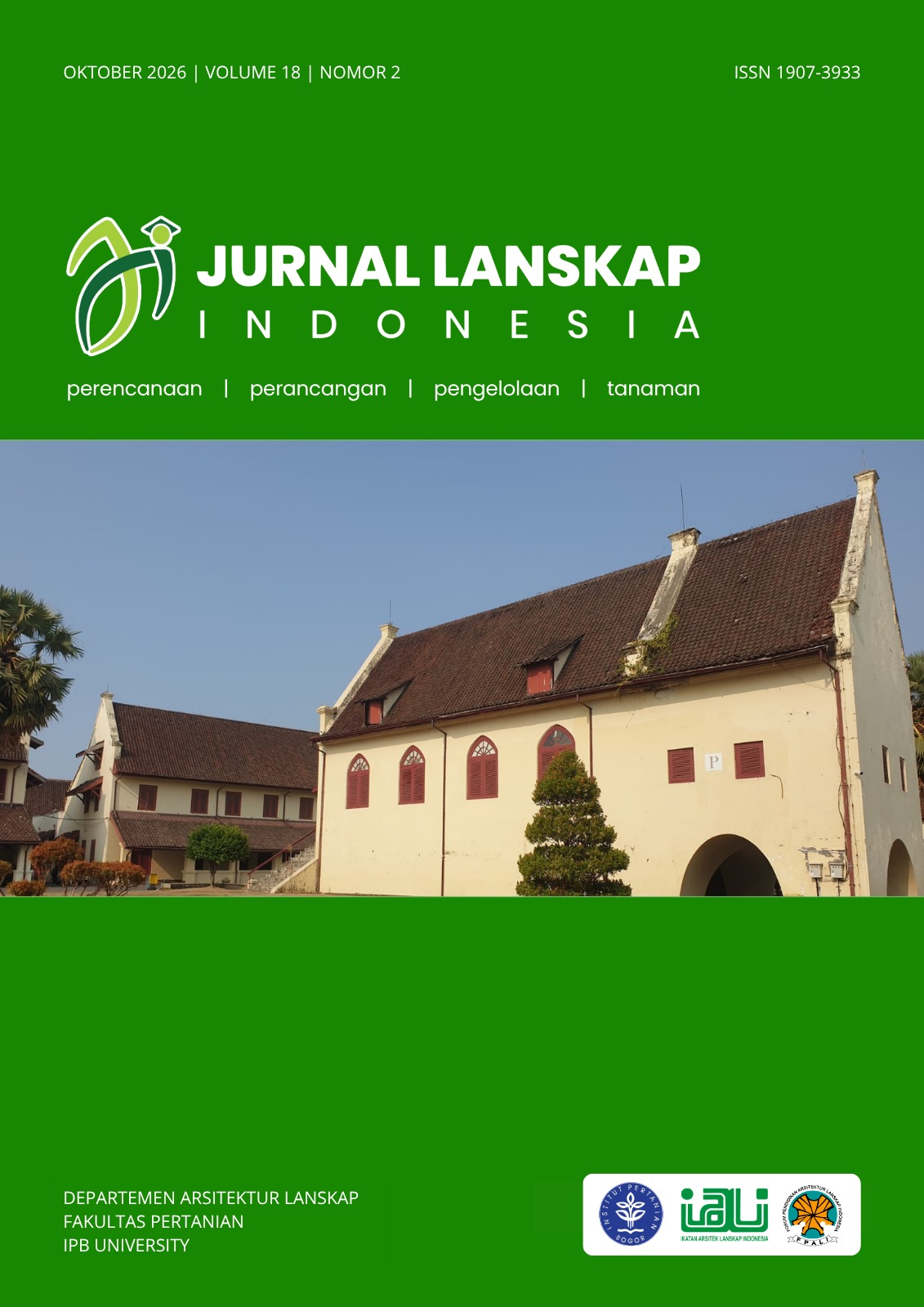
Penilaian Signifikansi pada Situs Kesultanan Serdang dan Kerajaan Bedagai di Kabupaten Serdang Bedagai, Sumatra Utara
DOI:
https://doi.org/10.29244/jli.v18i2.63359Keywords:
Bedagai Kingdom, cultural landscape, Serdang Bedagai Regency, Serdang SultanateAbstract
Serdang Bedagai Regency (Kab-Sergai) is a name taken from two of the four names of the Malay Sultanate/Kingdom (Serdang and Bedagai), namely, the Serdang Sultanate, the Bedagai Kingdom, Padang and Bajalinggai. This area has many remnants of cultural landscapes that are more than 100 years old in the form of Historical Heritage Objects (OPS) such as Objects, Buildings, Structures, Sites, and Areas that have the status of Suspected Cultural Heritage Objects (ODCB) and Cultural Heritage (CB). Problems that occur in objects and sites such as land conversion, data collection and identification are not optimal, minimal budget, no preservation agenda, so that the existence of objects and sites is neglected. This study aims to examine the significance value of objects and sites. The selection of comprehensive methods that are in accordance with the facts in the field is needed, such as survey methods with qualitative and spatial descriptive analysis with an approach to 11 landscape elements and the Cultural Heritage Landscape Assessment (CHLA). The results of the study stated that the character of the landscape at both sites has similarities in terms of landscape-forming elements and history. Then the results of the significance assessment obtained, Site-KS and Site-KB are Highly significant. That means the existence of the site must be preserved so that it is useful for history, science, education, religion and culture. This research is expected to be an evaluation material for the Sergai Regency Cultural Service to validate the newness of the data. So that it will have an impact on the value of objects and sites for registration applications to become ODCB and ranking to become CB.
Downloads
References
Awalia RN, Nurhayati HSA, Kaswanto RL. 2018. Kajian Karakter Pembentuk Lanskap Budaya Masyarakat Adat Kajang di Sulawesi Selatan. Jurnal Lanskap Indonesia 9(2): 91-100. https://doi.org/10.29244/jli.v9i2.17648
Azhari I, Pakhpahan R, Tanjung M, Faridah, Abdurrahman MK. 2013. Kesultanan Serdang : Perkembangan Islam pada Masa Pemerintahan Sulaiman Shariful alamsyah. Ed ke-1. Dr. Abdurrakhman MH, editor. Jakarta: Puslitbang Lektur dan Khazanah Keagamaan Badan Litbang dan Diklat Kementerian Agama RI.
Bandarrahmat DC. 1981. Datuk Bandarrahmat (Datuk Rahmat Syahbandar Putera Raja Negeri Deli).
[BPS] Badan Pusat Statistik Perbaungan. 2023. Kecamatan Perbaungan Dalam Angka 2023.
[BPS] Badan Pusat Statistik Serdang Bedagai. 2023. Kabupaten Serdang Bedagai Dalam Angka 2023. Sei Rampah.
[BPS] Badan Pusat Statistik Tj Beringin. 2023. Kecamatan Tanjung Beringin Dalam Angka 2023. Indonesia.
Dewi H, Nurhayati, Munandar A. 2016. Kajian Lanskap Budaya untuk Meningkatkan Identitas Kota Medan. Jurnal Lanskap Indonesia 10(2): 71-80. https://doi.org/10.29244/jli.v10i2.14855
Diessen DJ. Van, Ormeling PDFJ. Grote Atlas van Nederlands Oost-Indie, Comprehensive Atlas of the Netherlands East Indies. Medan: [Koleksi Perpustakaan Beranda Warisan Sumatra (BWS)].
Efendi M, Nurhayati, Arifin HS. 2024. Strategi Pengelolaan Lanskap Wisata di Perkampungan Budaya Betawi Setu Babakan Jakarta. Jurnal Lanskap Indonesia 16(1):84–98. https://doi.org/10.29244/jli.v16i1.48700
Fadillah. 2021. Analisis Peninggalan Kerajaan Bedagai di Kecamatan Dolok Masihul Kabupaten Serdang Bedagai.
Fitri H. 2014. Latar Belakang Sejarah Berdirinya Serdang Bedagai Sebagai Kabupaten di Provinsi Sumatra Utara. Wahana Inovasi 3(1):120–126.
Gerhandoko D, Nasution Z, Purwoko A. 2022. The Influence of Cultural Heritage Tourism Development in the Regional Development of Serdang Bedagai Regency. Budapest Int Res Crities Institure 5(1): 481–487.
Hapsari P, Nurhayati, Kaswanto RL. 2025. Analisis Potensi Daya Tarik Wisata Lanskap Budaya Jayengan Kampung Permata Surakarta. Jurnal Lanskap Indonesia 17(1): 34-42. https://doi.org/10.29244/jli.v17i1.55465
Hardilla D, Nugroho C, Kurniawan P. 2021. Signifikansi Budaya Kampung Wana menuju Pelestarian Landskap Budaya. Di dalam: Prosiding SINTA 4. Volume ke-4. Bandar Lampung. hlm 1–6. https://doi.org/10.23960/nm.v1i2.24
Hasibuan MSR, Nurhayati, Kaswanto. 2014. Karakter Lanskap Budaya Rumah Larik di Kota Sungai Penuh, Provinsi Jambi. Jurnal Lanskap Indonesia 6(2): 13–20. https://doi.org/10.29244/jli.v6i2.16558
Herviyunita F, Irwansyah, Deviyanti R. 2020. Sejarah Istana Kesultanan Serdang.
Herviyunita F, Irwansyah I, Devianty R. 2021. Kesultanan Serdang dan Jejak Peninggalannya. Local History & Heritage 1(2): 63-70. https://doi.org/10.57251/lhh.v1i2.97
ICOMOS Australia IC on M and S. 1999. Australia ICOMOS Burra Charter, 1999. February:1–46.
[KEPBUP] Keputusan Bupati. 2023. Keputusan Bupati Serdang Bedagai no 703/18.26/Tahun 2023 Tentang Penetapan Masjid Raya Sulaimaniyah Perbaungan Sebagai Bangunan Cagar Budaya Peringkat Kabupaten Serdang Bedagai.
[KEPBUP] Keputusan Bupati. 2023. Keputusan Bupati Serdang Bedagai no 704/18.26/Tahun 2023 Tentang Penetapan Makam Sultan Sulaiman Shariful Alamshah Sebagai Struktur Cagar Budaya Peringkat Kabupaten Serdang Bedagai. Indonesia.
Lase MS. 2021. Upaya Pelestarian Masjid Jamik Isma’iliyah di Desa Pekan Tanjung Beringin menjadi Cagar Budaya. [Disertasi] Universitas Sumatra Utara.
Leiden Universiteit. 2016. Digital Collection. [diakses 2024 Des 10]. https://digitalcollections.universiteitleiden.nl/search/Sumatra?type=edismax&cp=collection%3Akitlv_maps.
McClelland LF, Keller JT, Keller GP, Melnick RZ. 1999. Guidelines For Evaluating and Documenting Rural Historic Landscapes: National Register Bulletin 30.
Mindasari RU, Sarwandi A. 2022. Identifikasi Signifikansi Budaya (Cultural Significance) Pada Permukiman Tepian Sungai Musi di Kota Palembang Berdasarkan Elemen Ekistik. Journal of Architectural Design and Development (JAD) 3(2): 79-104. https://doi.org/10.37253/jad.v3i2.7297
Pharmacytha AS, Savitri M. 2023. Pelestarian Nilai Penting Bangunan Cagar Budaya Mustokoweni the Heritage Hotel. Jambura History and Culture Journal 5(1): 1-24. https://doi.org/10.37905/jhcj.v5i1.24226
Rahardjo S. 1992. Beberapa Permasalahan Pelestarian Kawasan Cagar Budaya dan Strategi Solusinya. 7(2): 4–17.
Santiyasa IW. 2010. Modul Distribusi Frekuensi.
Sari PK, Munandar A, Nurhayati. 2020. Karakteristik dan Strategi Pelestarian Lanskap Budaya Gampong Lubuk Sukon, Aceh. Institut Pertanian Bogor.
Sumiati DST, Batubara T. 2019. Dinamika Sejarah Kesultanan Melayu di Sumatra Utara (Menelusuri Jejak Masjid Kesultanan Serdang). Atap Buku.
Susiana. 2013. Identifikasi Bangunan – Bangunan Bersejarah Di Kabupaten Serdang Bedagai. Putri Hijau 1(1):15.
Syam FH, Nurhayati, HS Arifin. 2021. Kajian Potensi Lanskap untuk Pengembangan Wisata Sejarah Kota Medan. Jurnal Lanskap Indonesia 11(2): 48–54. https://doi.org/10.29244/jli.v11i2.22739
[UU] Undang-undang. 2003. Undang-Undang Republik Indonesia Nomor 36 Tahun 2003 Tentang Pembentukan Kabupaten Samosir dan Kabupaten Serdang Bedagai di Provinsi Sumatra Utara.
Zaida SNA, Nurhayati, HS Arifin. 2010. SURAKARTA: Perkembangan Kota Sebagai Akibat Pengaruh Perubahan Sosial Pada Bekas Ibukota Kerajaan di Jawa. Jurnal Lanskap Indonesia 2(2):83–92.
Downloads
Published
Issue
Section
License
Copyright (c) 2026 Dedi Saputra, Nurhayati, Hadi Susilo Arifin

This work is licensed under a Creative Commons Attribution 4.0 International License.
This journal permits and encourages authors to post items submitted to the journal on personal websites or institutional repositories both prior to and after publication, while providing bibliographic details that credit, if applicable, its publication in this journal. However, after the article is submitted and published in this journal, it is fully copyrighted by the Jurnal Lanskap Indonesia or JLI. If excerpts from other copyrighted works are included, the author must obtain written permission from the copyright owner and give credit to the source in the article. Then, the writer or reader is allowed to copy, share, and redistribute articles/material in any form. But it must still include the appropriate source and credit because the article in this journal is licensed by Creative Commons Attribution 4.0 International License (CC BY 4.0).
I. Proposed Policy for Journals That Offer Open Access
Authors who publish with this journal agree to the following terms:
- Authors retain copyright and grant the journal right of first publication with the work simultaneously licensed under a Creative Commons Attribution License that allows others to share the work with an acknowledgement of the work's authorship and initial publication in this journal.
- Authors are able to enter into separate, additional contractual arrangements for the non-exclusive distribution of the journal's published version of the work (e.g., post it to an institutional repository or publish it in a book), with an acknowledgement of its initial publication in this journal.
- Authors are permitted and encouraged to post their work online (e.g., in institutional repositories or on their website) prior to and during the submission process, as it can lead to productive exchanges, as well as earlier and greater citation of published work (See The Effect of Open Access).
II. Proposed Policy for Journals That Offer Delayed Open Access
Authors who publish with this journal agree to the following terms:
- Authors retain copyright and grant the journal right of first publication, with the work after publication simultaneously licensed under a Creative Commons Attribution License that allows others to share the work with an acknowledgement of the work's authorship and initial publication in this journal.
- Authors are able to enter into separate, additional contractual arrangements for the non-exclusive distribution of the journal's published version of the work (e.g., post it to an institutional repository or publish it in a book), with an acknowledgement of its initial publication in this journal.
- Authors are permitted and encouraged to post their work online (e.g., in institutional repositories or on their website) prior to and during the submission process, as it can lead to productive exchanges, as well as earlier and greater citation of published work (See The Effect of Open Access).