
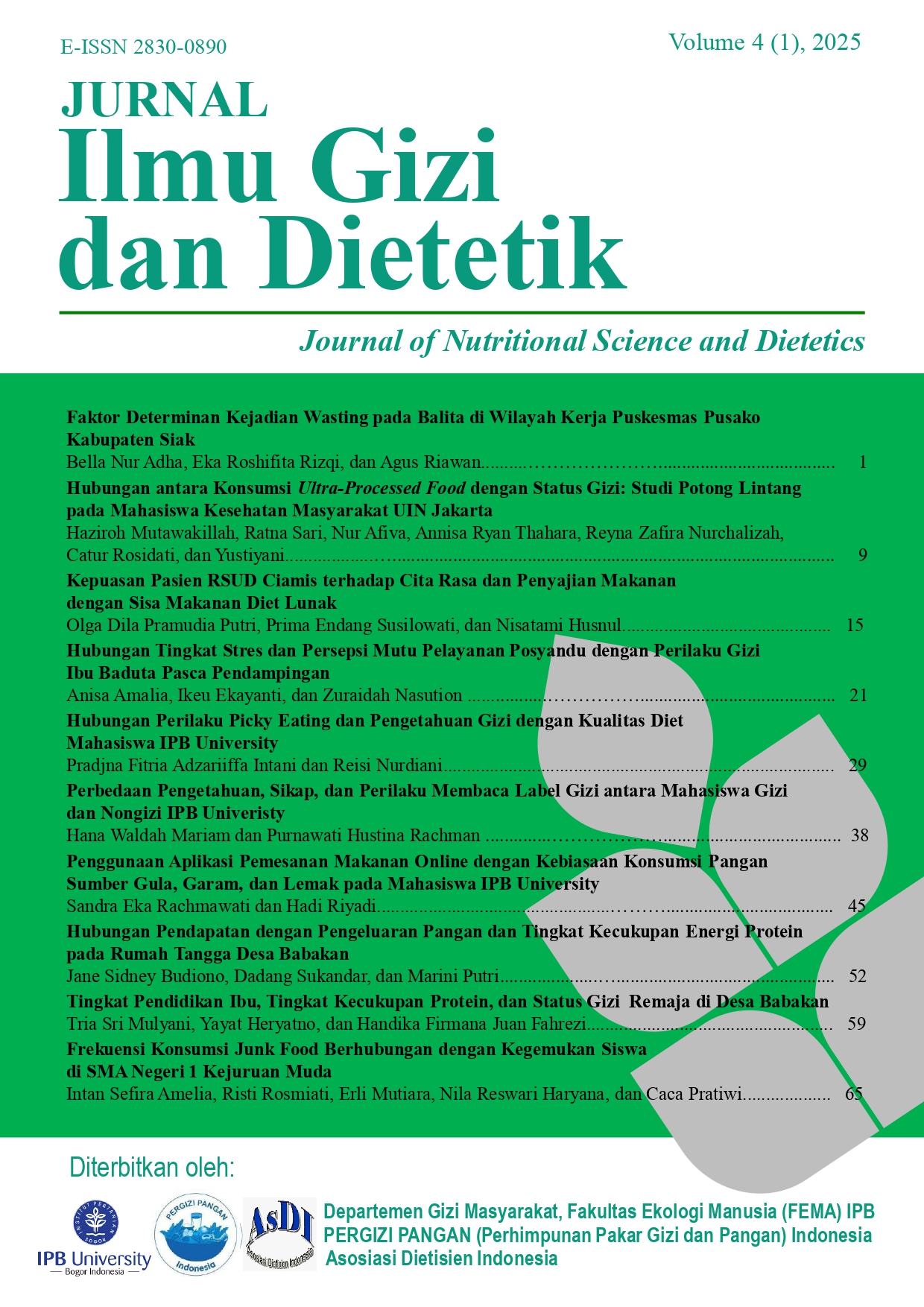
Penggunaan Aplikasi Pemesanan Makanan Online dengan Kebiasaan Konsumsi Pangan Sumber Gula, Garam, dan Lemak pada Mahasiswa IPB University
The Use of Online Food Ordering Applications and the Habit of Consuming Food Sources of Sugar, Salt, and Fat among IPB University Students
DOI:
https://doi.org/10.25182/jigd.2025.4.1.45-51Keywords:
fat, online food ordering, salt, students, sugarAbstract
Students have high mobility and busyness levels and limited time to fulfill food consumption that suits their needs, so many students use practical and instant ways to fulfill their food needs, one of which is by using online food ordering applications. This study aims to analyze the correlation between the intensity of the use of online food ordering applications and the habit of consuming food sources of sugar, salt, and fat among IPB University students. The study used a cross-sectional study design involving 73 subjects and was conducted in March 2024. Data collection was carried out using a questionnaire and the Semi Quantitative Food Frequency Questionaire (SQ-FFQ). Most of the subjects were female, aged 18-22 years, from 9 different faculties, had an average pocket money of Rp 1.635.616±Rp 453.725/month, and an average percent of food expenditure was 70.4%±19.1%. The results showed that there was a positive significant correlation (p<0.05) between the intensity of the use of online food ordering applications and the frequency of consuming food sources of sugar, salt, and fat.












2.png)

