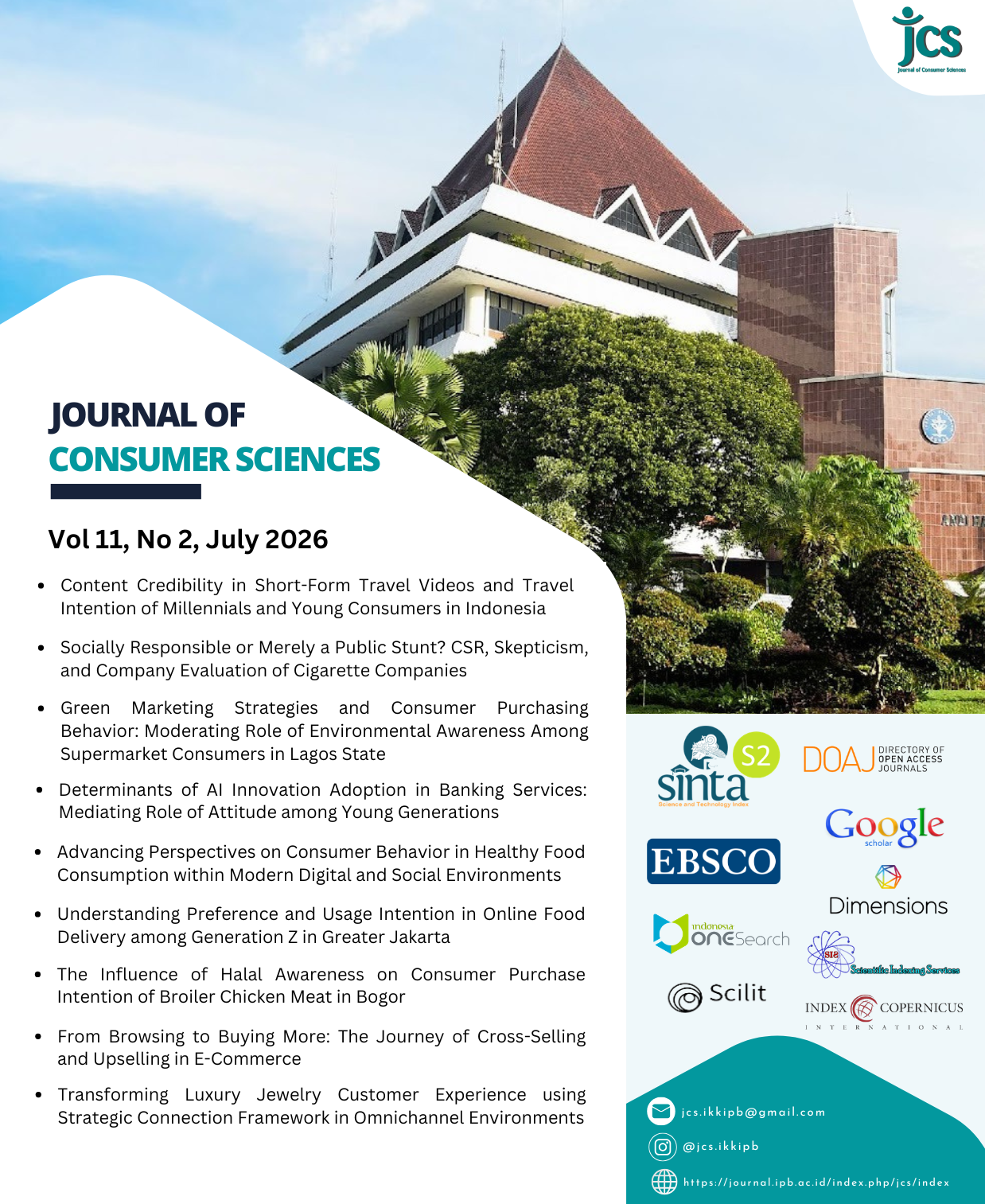
Understanding Preference and Usage Intention in Online Food Delivery among Generation Z in Greater Jakarta
DOI:
https://doi.org/10.29244/jcs.11.2.347-369Keywords:
conditional value, emotional value, generation Z, online food delivery, usage intention, usage preferenceAbstract
Background: Generation Z is the primary users of Online Food Delivery services (OFD). Therefore, it is important to understand their preferences and intentions regarding the use of OFD.
Purpose: This study examines how the five dimensions of the Theory of Consumption Values, consisting of functional, social, emotional, epistemic, and conditional values, influence usage preferences and usage intentions among Generation Z in the Greater Jakarta area.
Method: This study employed a cross-sectional survey design, collecting data from 120 Generation Z respondents aged 18 years and older who had used OFD services in the past three months through voluntary sampling. Structural Equation Modeling Partial Least Squares (SEM-PLS) was used for analysis.
Findings: Emotional and conditional values significantly influenced preference, while functional, social, and epistemic values did not. Emotional value also had a significant direct effect on intention, while emotional and conditional value indirectly affected intention through preference. In addition, preference significantly influences intention.
Conclusions: The findings indicate that Generation Z’s OFD behavior is driven more by enjoyable experiences and situational relevance than by utilitarian, social, or novelty-based considerations.
Research implication: OFD businesses should strengthen the emotional appeal and practical convenience of their offerings in specific situations to enhance user preference and increase usage intention. Future research could expand the model by including additional variables.
References
Ahmad, P., Kumar, A., Bellamkonda, R. S., & Kumari, P. (2025). Design matters, and so does the consumption value in consumers’ intention to reuse food delivery apps. British Food Journal, 127(7), 2452 – 2469. https://doi.org/10.1108/BFJ-10-2024-1044
Ajzen, I. (1991). The theory of planned behavior. Organizational Behavior and Human Decision Processes, 50(2), 179–211. https://doi.org/10.1016/0749-5978(91)90020-T
Akdoğan, Ç., & Yılmaztürk, Y. (2025). Investigation of the relationship between the theory of consumption values and consumers’ perceptions of mobile food delivery apps in the scope of technology acceptance model. Journal of Foodservice Business Research, 28(6), 1382 – 1420. https://doi.org/10.1080/15378020.2025.2499767
Annur, C. M. (2024, February). Indonesia dominates Southeast Asia’s online food delivery market in 2023. Databoks. https://databoks.katadata.co.id/en/technology-telecommunications/statistics/ffb024a74faa9ac/indonesia-dominates-southeast-asias-online-food-delivery-market-in-2023
Ayhün, S. E., Köse, B. Ç., & Aydin, E. (2024). Determinants of customers’ intention to use online food delivery services: A study of Generation Z. Wseas Transactions on Business and Economics, 21, 1642–1656. https://doi.org/10.37394/23207.2024.21.134
Chakraborty, D., Kayal, G., Mehta, P., Nunkoo, R., & Rana, N. P. (2022). Consumers’ usage of food delivery app: A theory of consumption values. Journal of Hospitality Marketing & Management, 31(5), 601–619. https://doi.org/10.1080/19368623.2022.2024476
Chakraborty, D., & Paul, J. (2023). Healthcare apps’ purchase intention: A consumption values perspective. Technovation, 120, 102481. https://doi.org/10.1016/j.technovation.2022.102481
Clingingsmith, D., & Sheremeta, R. M. (2018). Status and the demand for visible goods: experimental evidence on conspicuous consumption. Experimental Economics, 21(4), 877–904. https://doi.org/10.1007/s10683-017-9556-x
Cohen, J. (1988). Statistical power analysis for the behavioral sciences (2nd ed.). https://doi.org/10.4324/9780203771587
Elverda, E., Nahdah, T. A., & Hamali, S. (2025). Analysis of factors affecting consumer decision-making in choosing online food delivery in Indonesia. Journal of Consumer Sciences, 10(1), 118–144. https://doi.org/10.29244/jcs.10.1.118-144
Ganesan, Y., Linganathar, N., Allah Pitchay, A., Shaharudin, M. S., & Gui, A. (2026). The role of consumption values to intention to use food delivery apps in Malaysia: The moderating role of technology anxiety. Journal of Science and Technology Policy Management, 1–31. https://doi.org/10.1108/JSTPM-03-2024-0110
Hair, J. F., Black, W. C., Babin, B. J., & Anderson, R. E. (2010). Multivariate data analysis (7th ed.). Pearson Education.
Hair, J. F., Hult, G. T. M., Ringle, C. M., Sarstedt, M., Danks, N. P., & Ray, S. (2021). An introduction to structural equation modeling. In Partial Least Squares Structural Equation Modeling (PLS-SEM) Using R: A Workbook (pp. 1–29). Springer International Publishing. https://doi.org/10.1007/978-3-030-80519-7_1
Henseler, J., Ringle, C. M., & Sarstedt, M. (2015). A new criterion for assessing discriminant validity in variance-based structural equation modeling. Journal of the Academy of Marketing Science, 43(1), 115–135. https://doi.org/10.1007/s11747-014-0403-8
Hezberg, F. (1959). The motivation to work (2nd ed.). John Wiley & Sons.
Homer, P., & Kahle, L. (1988). A structural equation test of the value–attitude–behavior hierarchy. Journal of Personality and Social Psychology, 54, 638–646. https://doi.org/10.1037/0022-3514.54.4.638
Jun, K., Yoon, B., Lee, S., & Lee, D. S. (2022). Factors influencing customer decisions to use online food delivery service during the covid-19 pandemic. Foods, 11(1), 1–15. https://doi.org/10.3390/foods11010064
Kaur, P., Dhir, A., Talwar, S., & Ghuman, K. (2021). The value proposition of food delivery apps from the perspective of theory of consumption value. International Journal of Contemporary Hospitality Management, 33(4), 1129–1159. https://doi.org/10.1108/IJCHM-05-2020-0477
Koay, K. Y., & Leong, M. K. (2023). Understanding consumers’ intentions to use drone food delivery services: A perspective of the theory of consumption values. Asia-Pacific Journal of Business Administration, 16(5), 1226–1240. https://doi.org/10.1108/APJBA-04-2023-0155
Kock, N. (2015). Common method bias in PLS-SEM. International Journal of E-Collaboration, 11(4), 1–10. https://doi.org/10.4018/ijec.2015100101
Liu, X., Wang, J., & Liu, C. (2024). Are you still willing to use pre-made dishes? Examining young customers’ continuous usage intention in the Chinese emerging market. British Food Journal, 127(1), 73–91. https://doi.org/10.1108/BFJ-07-2024-0693
Pereira, C. V., Vp, S., & Yeshawanth, R. (2024). Exploring the role of hedonic motivation in customer satisfaction with online food delivery: An AHP perspective. 4(3), 1702–1707. https://doi.org/10.52783/jier.v4i3.1507
Permasih, D., Suroso, A. I., & Hasanah, N. (2024). Intention to use and over-ordering in online food delivery services: An extension of the theory of planned behavior. Journal of Consumer Sciences, 9(3), 315–337. https://doi.org/10.29244/jcs.9.3.315-337
Priporas, C. V., Stylos, N., & Fotiadis, A. (2017). Generation Z consumers’ expectations of interactions in smart retailing: A future agenda. Computers in Human Behavior, 77, 374e381. https://doi.org/10.1016/j.chb.2017.01.058
Purwianti, L., Ariyanto, H. H., & Christella, C. (2025). Attitude and the mediating role in online food delivery continuance intention. Journal of Consumer Sciences, 10, 577–600. https://doi.org/10.29244/jcs.10.3.577-600
Rebollo, H. P., & Hinlayagan, K. (2023). Understanding the influence of hedonic and convenience motivation and e-service quality towards customer satisfaction in online food delivery services among Generation Z consumers. Journal of Production, Operations Management and Economics, 26–39. https://doi.org/10.55529/jpome.34.26.39
Ringle, C. M., Wende, S., & Becker, J. M. (2022). SmartPLS 4. SmartPLS. https://doi.org/https://www.smartpls.com/
Rungruangjit, W., & Charoenpornpanichkul, K. (2024). What motivates consumers’ continued usage intentions of food delivery applications in post-COVID-19 outbreak? Comparing Generations X, Y and Z. Journal of Asia Business Studies, 18(1), 224–251. https://doi.org/10.1108/JABS-06-2023-0234
Samuelson, P. A. (1948). Consumption theory in terms of revealed preference. Economica, 15(60), 243–253. http://www.jstor.org/stable/2549561
Sari, D. A. P., Febrilia, I., Krissanya, N., Berutu, M. B., & Sekardhani, M. (2025). Integrating theory of consumption values and the unified theory of acceptance and use of technology to predict continued use of food delivery applications post COVID-19 outbreak. Social Sciences and Humanities Open, 12, 101671. https://doi.org/10.1016/j.ssaho.2025.101671
Saxena, N. K., Saxena, R., Bhandari, R. S., & Gupta, S. (2025). Exploring Generation Z’s brand experience drivers: A paradigm shift for food delivery platform. International Journal of System Assurance Engineering and Management, 16(7), 2445 – 2454. https://doi.org/10.1007/s13198-025-02780-x
Sheth, J. N., Newman, B. I., & Gross, B. L. (1991). Why we buy what we buy: A theory of consumption values. Journal of Business Research, 22(2), 159–170. https://doi.org/10.1016/0148-2963(91)90050-8
Tandon, A., Kaur, P., Bhatt, Y., Mäntymäki, M., & Dhir, A. (2021). Why do people purchase from food delivery apps? A consumer value perspective. Journal of Retailing and Consumer Services, 63(July), 102667. https://doi.org/10.1016/j.jretconser.2021.102667
Tenggara Strategics. (2022, June). Survei persepsi & perilaku konsumsi online food delivery (OFD) di Indonesia. Tenggara Strategics. https://asset.tenggara.id/assets/source/file-research/OFD/Tenggara_Strategics_-_2022_OFD_Research_-_Presentation.pdf
Tsang, L. W.-S., Tavitiyaman, P., & Lo, J. S.-K. (2024). Customers’ perception of consumption values of online food delivery towards their satisfaction, purchase intention and switching intention post-COVID-19 pandemic. Journal of Foodservice Business Research, 29(1), 7–35. https://doi.org/10.1080/15378020.2024.2368912
Veblen, T. (1899). The theory of the leisure class: An economic study of institutions. Macmillan.
Vu, T. D., Nguyen, H. V., Vu, P. T., Tran, T. H. H., & Vu, V. H. (2023). Gen Z customers’ continuance intention in using food delivery application in an emerging market: Empirical evidence from Vietnam. Sustainability (Switzerland), 15(20). https://doi.org/10.3390/su152014776
Zhang, Q., Wang, Y., & Ariffin, S. K. (2024). Consumers purchase intention in livestreaming e-commerce: A consumption value perspective and the role of streamer popularity. PLoS ONE, 19(2), 1–32. https://doi.org/10.1371/journal.pone.0296339
Downloads
Published
Issue
Section
License
Copyright (c) 2026 Journal of Consumer Sciences

This work is licensed under a Creative Commons Attribution 4.0 International License.
Authors who publish with this journal agree to the following terms:
- Authors retain copyright and grant the journal right of first publication with the work simultaneously licensed under a

This work is licensed under a Creative Commons Attribution 4.0 International License. that allows others to share the work with an acknowledgement of the work's authorship and initial publication in this journal. - Authors are able to enter into separate, additional contractual arrangements for the non-exclusive distribution of the journal's published version of the work (e.g., post it to an institutional repository or publish it in a book), with an acknowledgement of its initial publication in this journal.
- Authors are permitted and encouraged to post their work online (e.g., in institutional repositories or on their website) prior to and during the submission process, as it can lead to productive exchanges, as well as earlier and greater citation of published work (See The Effect of Open Access).
How to Cite