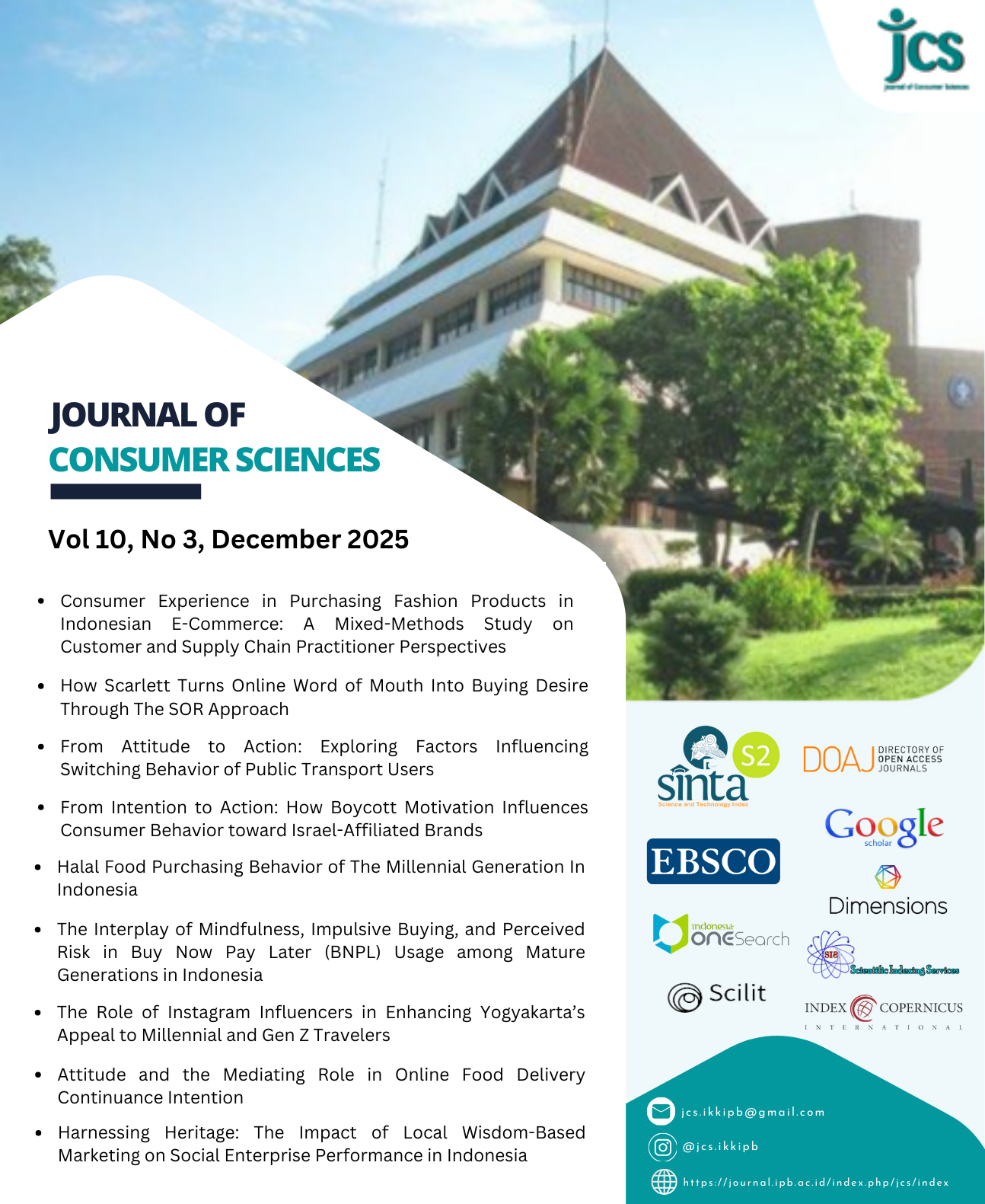
From Attitude to Action: Exploring Factors Influencing Switching Behavior of Public Transport Users
DOI:
https://doi.org/10.29244/jcs.10.3.461-483Keywords:
attitudes, attributes related to service, public transportation, service quality, switching decisionsAbstract
Background: The number of vehicles in Denpasar has increased, while the public still hesitates to use public transportation, contributing to traffic congestion in Denpasar. Scientifically, this behavior can be explained by the Theory of Planned Behavior (TPB), in which perceptions of service quality and service attributes shape attitudes towards public transportation and influence switching behavior.
Purpose: This study examines how these factors influence the public's willingness to switch from private vehicles to public transportation in Denpasar.
Method: The research design used is quantitative research with a non-probability sampling approach, using accidental sampling as the sampling technique. Data were obtained using a questionnaire distributed to 180 respondents who use public transportation. Using SmartPLS, the data was analyzed using Partial Least Squares Structural Equation Modeling (SEM-PLS).
Findings: This study found that service quality, service-related attributes, and attitudes significantly influence the decision to switch to public transportation. Attitude partially mediates the influence of service quality and service-related attributes on the decision to switch.
Conclusions: Based on the results of this study, it is recommended to improve the quality of public transportation services, particularly by reducing passenger waiting time and improving connectivity, so that bus stops are easily accessible to the public.
Research implication: The results of this study are important for decision-making related to strategic planning to improve public transportation services, thereby increasing public willingness to switch to public transportation.
References
Adinata, R., Wike, W., & Wanto, A. H. (2021). Public transport in developing countries. Journal of Public Administration Studies, 6(2), 35–39. https://doi.org/10.21776/ub.jpas.2021.006.02.7
Ajzen, I. (2020). The theory of planned behavior: Frequently asked questions. Human Behavior and Emerging Technologies, 2(4), 314–324. https://doi.org/10.1002/hbe2.195
Ajzen, I., & Fishbein, M. (2000). Attitudes and the attitude–behavior relation: Reasoned and automatic processes. European Review of Social Psychology, 11(1), 1–33. https://doi.org/10.1080/147927799430001
Andini, T. P., Adawiyah, R., & Indriani, Y. (2023). Attitudes, decision making and purchasing patterns of online vegetable consumers. Journal of Consumer Sciences, 8(3), 296–317. https://doi.org/10.29244/jcs.8.3.296-317
Aryani, E. T., & Kurnianingsih, H. (2023). Pengaruh inovasi produk, kepercayaan merek, dan keragaman produk terhadap keputusan pembelian Honda Beat di Surakarta. Jurnal Maneksi (Management Ekonomi dan Akuntansi), 12(2), 368–377.
Baksi, A. K., & Parida, B. B. (2011). Service quality and switching behavior of customers. Management Science Letters, 1(4), 405–414. https://doi.org/10.5267/j.msl.2011.06.014
Bechler, C. J., Tormala, Z. L., & Rucker, D. D. (2021). The attitude–behavior relationship revisited. Psychological Science, 32(8), 1285–1297. https://doi.org/10.1177/0956797621995206
Bhutto, S., Marvi, H., & Kumar, R. (2022). Assessing the impact of electronic word of mouth on brands switching. Global Regional Review, 7(1), 286–299. https://doi.org/10.31703/grr.2022(vii-i).25
Bulumulle, S. P., Mahadewa, S. N., Herath, M. D., Nishshanka, T. P., & De Mel, D. H. (2022). Impact of service quality and network quality on brand switching behaviour: With reference to internet service providers. World Journal of Advanced Research and Reviews, 15(2), 562–570. https://doi.org/10.30574/wjarr.2022.15.2.0848
Filieri, R., Galati, F., & Raguseo, E. (2021). The impact of service attributes and category on eWOM helpfulness: An investigation of extremely negative and positive ratings using latent semantic analytics and regression analysis. Computers in Human Behavior, 114, 106527. https://doi.org/10.1016/j.chb.2020.106527
Ghamry, S., & Shamma, H. M. (2022). Factors influencing customer switching behavior in Islamic banks: Evidence from Kuwait. Journal of Islamic Marketing, 13(3), 688–716. https://doi.org/10.1108/JIMA-01-2020-0021
Guirao, B., García-Pastor, A., & López-Lambas, M. E. (2016). The importance of service quality attributes in public transportation: Narrowing the gap between scientific research and practitioners’ needs. Transport Policy, 49, 68–77. https://doi.org/10.1016/j.tranpol.2016.04.003
Hair, J. F., Howard, M. C., & Nitzl, C. (2020). Assessing measurement model quality in PLS-SEM using confirmatory composite analysis. Journal of Business Research, 109, 101–110. https://doi.org/10.1016/j.jbusres.2019.11.069
Haridasan, A. C., Fernando, A. G., & Balakrishnan, S. (2021). Investigation of consumers’ cross-channel switching intentions: A push-pull-mooring approach. Journal of Consumer Behaviour, 20(5), 1092–1112. https://doi.org/10.1002/cb.1918
Hidayat, M., & Aulia, A. (2023). The effect of work life balance on millennial generation productivity in Makassar City. Journal La Sociale, 4(2), 76–86. https://doi.org/10.37899/journal-la-sociale.v4i3.1608
Hidayat, A., Soesanto, H., & Mahfudz, M. (2018). The effects of product quality, service quality and attributes related to service as brand switching anticipation and their implication on customers’ satisfaction. Jurnal Sains Pemasaran Indonesia (Indonesian Journal of Marketing Science), 16(3), 203–220. https://doi.org/10.14710/jspi.v16i3.203-220
Hidayat, A., Wijaya, T., Ishak, A., Ekasasi, S. R., & Zalzalah, G. G. (2021). Model of the consumer switching behavior related to healthy food products. Sustainability (Switzerland), 13(6), Article 3555. https://doi.org/10.3390/su13063555
Islamy, M. R., Trisnawati, J. D., & Rahayu, S. (2022). The effect of perceived service quality, perceived value, destination image, attitude to visiting behavior, tourist satisfaction on tourist loyalty. Journal of Entrepreneurship & Business, 3(1), 35–48. https://doi.org/10.24123/jeb.v3i1.4827
Jung, J., Han, H., & Oh, M. (2017). Travelers’ switching behavior in the airline industry from the perspective of the push-pull-mooring framework. Tourism Management, 59, 139–153. https://doi.org/10.1016/j.tourman.2016.07.018
Li, J., Embry, P., Mattingly, S. P., Sadabadi, K. F., Rasmidatta, I., & Burris, M. W. (2007). Who chooses to carpool and why? Examination of Texas carpoolers. Transportation Research Record, 2021, 110–117. https://doi.org/10.3141/2021-13
Lisana, L. (2023). Factors affecting university students switching intention to mobile learning: A push-pull-mooring theory perspective. Education and Information Technologies, 28(5), 5341–5361. https://doi.org/10.1007/s10639-022-11410-z
Madahi, A., & Sukati, I. (2016). An empirical study of Malaysian consumers’ channel-switching intention: Using theory of planned behaviour. Global Business Review, 17(3), 489–523. https://doi.org/10.1177/0972150916630447
Mainingrum, R., Sjarlis, S., Oktaviani, A. R., & Meuthia, R. F. (2023). The effect of audit findings, follow-up audit recommendations, and BPK opinions from the previous year on the determination of opinions in local government financial statements. Economics, Business, Accounting & Society Review, 2(1), 58–73.
Malhotra, A., & Malhotra, C. K. (2013). Exploring switching behavior of US mobile service customers. Journal of Services Marketing, 27(1), 13–24. https://doi.org/10.1108/08876041311296347
Monoarfa, T. A., Sumarwan, U., Suroso, A. I., & Wulandari, R. (2023). Switch or stay? Applying a push–pull–mooring framework to evaluate behavior in e-grocery shopping. Sustainability (Switzerland), 15(7), Article 6018. https://doi.org/10.3390/su15076018
Ngo, V. M., & Pavelková, D. (2017). Moderating and mediating effects of switching costs on the relationship between service value, customer satisfaction and customer loyalty: Investigation of retail banking in Vietnam. Journal of International Studies, 10(1), 9–33. https://doi.org/10.14254/2071-8330.2017/10-1/1
Nguyen, H. T., & Nguyen, N. T. (2022). Identifying the factors affecting the consumer behavior in switching to e-wallets in payment activities. Polish Journal of Management Studies, 25(1), 292–311. https://doi.org/10.17512/pjms.2022.25.1.18
Nguyen, T. H. N., Yeh, Q. J., & Huang, C. Y. (2022). Understanding consumers’ switching intention toward traceable agricultural products: Push-pull-mooring perspective. International Journal of Consumer Studies, 46(3), 870–888. https://doi.org/10.1111/ijcs.12733
Nimako, S. G. (2012). Consumer switching behaviour: A theoretical review and research agenda. The International Journal’s Research Journal of Social Science & Management, 2(3), 74–82
Nurhasan, H., & Putro, U. (2021). An analysis of consumer behaviors in choosing public transportation. Journal of Indonesian Applied Economics, 9(2), 17–26. https://doi.org/10.21776/ub.jiae.2021.009.02.3
Nurlinda, R. A., & Anam, C. (2024). Factors influencing customer switching intentions in online food delivery: A perspective of the push-pull-mooring model. Jurnal Manajemen Perhotelan, 10(1), 43–54. https://doi.org/10.9744/jmp.10.1.43-54
Parasuraman, A., Zeithaml, V. A., & Berry, L. L. (2017). SERVQUAL: A multiple-item scale for measuring consumer perceptions of service quality. Journal of Retailing, 64(1), 12–40.
Patel, N. K. (2024). Antecedents of consumers’ brand switching behavior in mobile service providers. South Asian Journal of Marketing, 5(1), 15–31. https://doi.org/10.1108/sajm-11-2022-0075
Pookulangara, S., Hawley, J., & Xiao, G. (2011). Explaining consumers’ channel-switching behavior using the theory of planned behavior. Journal of Retailing and Consumer Services, 18(4), 311–321. https://doi.org/10.1016/j.jretconser.2011.02.005
Rafid, M., Risdwiyanto, A., Kraugusteeliana, K., & Razali, G. (2023). The effects of service quality, experience, consumer satisfaction, and brand switching behavior (Case study of Karadenta Care). GEMILANG: Jurnal Manajemen dan Akuntansi, 3(2), 151–163. https://doi.org/10.56910/gemilang.v3i2.439
Rawis, S. O., Nasution, R. A., Hadiansyah, L. S., Adiani, W., & Aprianingsih, A. (2022). Systematic literature review of switching behavior in service industry. Binus Business Review, 13(1), 1–17. https://doi.org/10.21512/bbr.v13i1.7618
Setyo, R. (2023, November 28). Kendaraan di Bali 4,7 juta unit, jumlah penduduk Pulau Dewata 4,3 juta. Detik Bali. https://www.detik.com/bali/berita/d-7087682/kendaraan-di-bali-4-7-juta-unit-jumlah-penduduk-pulau-dewata-4-3-juta#:~:text=Data%20BPS%20Bali%20menyebutkan%20jumlah
Sharma, A., & Sharma, R. R. K. (2018). Culture and consumer brand switching: Moderating role of consumer involvement and service value. Proceedings of the International Conference on Industrial Engineering and Operations Management, 2018(March), 683–688.
Şimşekoğlu, Ö., Nordfjærn, T., & Rundmo, T. (2015). The role of attitudes, transport priorities, and car use habit for travel mode use and intentions to use public transportation in an urban Norwegian public. Transport Policy, 42, 113–120. https://doi.org/10.1016/j.tranpol.2015.05.019
Singh, P., PV, R., Fathihah, N., Kee, D. M. H., Nuralina, N., Nurdiyanah, N., & Nursyahirah, N. (2021). Service quality dimension and customers’ satisfaction: An empirical study of Tesco Hypermarket in Malaysia. International Journal of Applied Business and International Management, 6(3), 102–114. https://doi.org/10.32535/ijabim.v6i3.1333
Sivakumaran, V., & Peter, S. (2020). Model to assess consumer switching behaviour. Proceedings of the International Conference on Industrial Engineering and Operations Management, March, 1056–1062
Sunan, U., & Surabaya, G. (2022). Literature review on antecedents of customer switching behavior. Technology and Society, 1(3), 1–5. https://inti.ejournalmeta.com/index.php/inti/article/view/13/13
Surman, V., Tóth, Z. E., & Danó, G. (2022). Defining service quality attributes at different levels of operation in higher education institutions: How could the service quality perceptions of students contribute to a better understanding of improvement directions? Zagreb. International Review of Economics and Business, 25(s1), 1–15. https://doi.org/10.2478/zireb-2022-0021
Suryawardani, B., & Wulandari, A. (2020). Determinant factors of customers switching behavior to customer satisfaction and loyalty in online transportation users in Bandung. Jurnal Dinamika Manajemen, 11(1), 12–26. https://doi.org/10.15294/jdm.v11i1.21432
Sutisna, M. S., & Juwita. (2023). Service quality and trust as predictors of online purchasing decisions mediated by perceived risk. Journal of Consumer Sciences, 8(2), 187–203. https://doi.org/10.29244/jcs.8.2.187-203
Taan, H. (2020). The service quality of population document to improve community satisfaction index. Asia Pacific Journal of Management and Education, 3(2), 58–66. https://doi.org/10.32535/apjme.v3i2.847
Tanuwijaya, E., & Oktavia, T. (2023). Analysis of the factors influencing customer switching behaviour of the millennials in digital banks. Journal of System and Management Sciences, 13(2), 122–133. https://doi.org/10.33168/JSMS.2023.0209
Taufik, A., Santoso, S., Fahmi, M. I., Restuanto, F., & Yamin, S. (2022). The role of service and product quality on customer loyalty. Journal of Consumer Sciences, 7(1), 68–82. https://doi.org/10.29244/jcs.7.1.68-82
Tricahyaningtyas, Y., Livani, R., & Natakoesoemah, S. (2023). Shopping experience of Indonesian diaspora in Europe related to Primark’s reputation and customer attitude towards unethical and unsustainable business practice brands. International Journal of Applied Business and International Management, 8(2), 99–114. https://doi.org/10.32535/ijabim.v8i2.2180
van den Berge, R., Magnier, L., & Mugge, R. (2021). Too good to go? Consumers’ replacement behaviour and potential strategies for stimulating product retention. Current Opinion in Psychology, 39, 66–71. https://doi.org/10.1016/j.copsyc.2020.07.014
Widyaningrum, H. W., Farida, N., & Prihatini, A. E. (2022). Pengaruh product quality dan service quality terhadap brand switching melalui customer value (Studi pada mantan pelanggan Indihome di Kota Semarang). Jurnal Ilmu Administrasi Bisnis, 11(2), 281–289. https://doi.org/10.14710/jiab.2022.34660
Wong, W. F. (2022). The round trip effect: Endogenous transport costs and international trade. American Economic Journal: Applied Economics, 14(4), 127–166. https://doi.org/10.1257/app.20190721
Zeng, Z., Li, S., Lian, J. W., Li, J., Chen, T., & Li, Y. (2021). Switching behavior in the adoption of a land information system in China: A perspective of the push–pull–mooring framework. Land Use Policy, 109, 105629. https://doi.org/10.1016/j.landusepol.2021.105629
Zhou, Z., Pan, T., Zhao, Q., Cheng, X., & Wang, D. (2024). Factors influencing seniors’ switching to m-government services: A mixed-methods study through the lens of push-pull-mooring framework. Information & Management, 61(3). https://doi.org/10.1016/j.im.2024.103928
Zia, A. (2022). Discovering the linear relationship of service quality, satisfaction, attitude and loyalty for banks in Albaha, Saudi Arabia. PSU Research Review, 6(2), 90–104. https://doi.org/10.1108/PRR-07-2020-0023
Downloads
Published
Issue
Section
License
Copyright (c) 2025 Journal of Consumer Sciences

This work is licensed under a Creative Commons Attribution 4.0 International License.
Authors who publish with this journal agree to the following terms:
- Authors retain copyright and grant the journal right of first publication with the work simultaneously licensed under a

This work is licensed under a Creative Commons Attribution 4.0 International License. that allows others to share the work with an acknowledgement of the work's authorship and initial publication in this journal. - Authors are able to enter into separate, additional contractual arrangements for the non-exclusive distribution of the journal's published version of the work (e.g., post it to an institutional repository or publish it in a book), with an acknowledgement of its initial publication in this journal.
- Authors are permitted and encouraged to post their work online (e.g., in institutional repositories or on their website) prior to and during the submission process, as it can lead to productive exchanges, as well as earlier and greater citation of published work (See The Effect of Open Access).
How to Cite