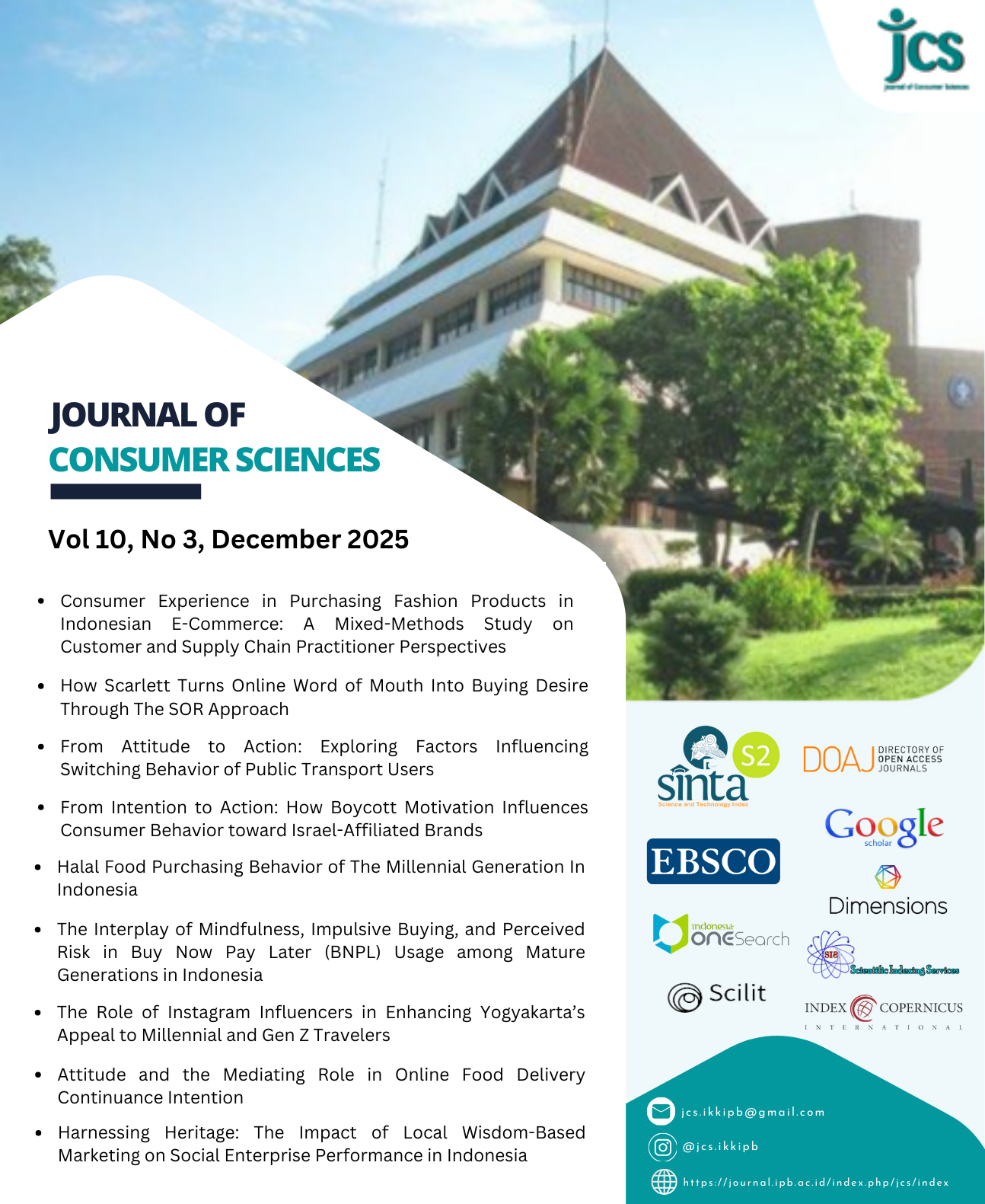
Harnessing Heritage: The Impact of Local Wisdom-Based Marketing on Social Enterprise Performance in Indonesia
DOI:
https://doi.org/10.29244/jcs.10.3.601-624Keywords:
entrepreneurial marketing, entrepreneurial marketing mix, market orientation, religiosity, social enterprise performanceAbstract
Background: To advance economic development and societal well-being, it is essential to conduct comprehensive research analyzing the social entrepreneurship’s effect on the performance of economic and social aspects, together with the principal factors influencing these outcomes.
Purpose: This study seeks to improve the efficacy of social entrepreneurship by highlighting its contribution to economic and social progress. The study employs a marketing management approach that incorporates aspects of local wisdom, rooted in Indonesian society's religious and cultural values.
Method: This study involved 350 social entrepreneurs from 20 provinces in Indonesia. The study employs a quantitative method approach, utilizing Structural Equation Modeling (SEM).
Findings: Both religiosity-based entrepreneurial marketing (REM) and the entrepreneurial marketing mix (EMM) substantially affect social enterprise performance (SEP). EMM shows a positive, substantial correlation with SEP, whereas REM shows a negative, statistically significant effect. Moreover, REM does not substantially influence the link between market orientation and SEP. Likewise, market orientation (MO) exhibits no substantial direct impact on the social enterprise performance.
Conclusions: This research finds that EMM has a favorable and significant influence on SEP, while MO does not significantly affect social enterprise performance. Instead of mediating, REM shows a large yet negative impact. These results highlight the complexity of integrating REM with MO strategies in SEP.
Research implication: This research provides valuable insights for social entrepreneurs, governments, and academics on the strategic integration of local wisdom heritage in marketing to accelerate SEP in Indonesia.
References
Abdullah, A., Taliang, A., Efendi, B., Kasmi, M., & Aman, A. (2024). Examining the effects of entrepreneurial mindset, digital marketing innovation and networking on SME performance. Journal of System and Management Sciences, 14(6), 113–127. https://doi.org/10.33168/jsms.2024.0608
Aboalhool, T., Alzubi, A., & Iyiola, K. (2024). Humane entrepreneurship in the circular economy: the role of green market orientation and green technology turbulence for sustainable corporate performance. Sustainability (Switzerland), 16(6). https://doi.org/10.3390/su16062517
Achsa, A., Verawati, D. M., & Novitaningtyas, I. (2023). Implementation of marketing strategy innovation and business model development: Study of SMEs in Tourism Village. Airlangga Journal of Innovation Management, 4(2), 172–184. https://doi.org/10.20473/ajim.v4i2.49859
Adetoyinbo, A., & Mithöfer, D. (2025). Inter-firm relations and resource-based performance: a contingent relational view of small-scale farmers in Zambia. Journal of Agribusiness in Developing and Emerging Economies, 15(4), 738–759. https://doi.org/10.1108/JADEE-06-2023-0134
Adiguzel, Z., Cakir, F. S., Zehir, S. Y., & Zehir, C. (2024). Examination of the effects of learning capabilities and market orientation of logistics companies on innovation and logistics performance. Industrial and Commercial Training, 56(3), 240–257. https://doi.org/10.1108/ict-08-2023-0059/full/html
Afriyie, S., Du, J., & Appiah, K. (2018). The role of marketing capabilities as a resource-based view on organizational performance. American Scientific Research Journal for Engineering, Technology, and Sciences (ASRJETS), 41(1), 109–124. https://doi.org/https://ew-ere-67979560/3940
Alekam, J. M. E. (2018). The preceding role of social: Innovation, knowledge, capital and entrepreneurship as mediating effects in building Malaysian SME business performance. Indian Journal of Public Health Research and Development, 9(11), 1509–1514. https://doi.org/10.5958/0976-5506.2018.01662.5
Alfarizy, R. S., Fahmi, I., & Santoso, M. H. (2024). Analysis of marketing mix and MSME loan distribution strategies at Bank Tabungan Negara. Journal of Consumer Sciences, 9(1), 63–81. https://doi.org/10.29244/jcs.9.1.63-81
Alimin, E., Putra, A. S., Nasib, N., Salqaura, S. A., & Tambunan, D. (2025). Exploring local friendliness, perceived discrimination, and brand love’s mediation on tourist behavior in Tangkahan, North Sumatra. Journal of Applied Sciences in Travel and Hospitality, 8(1), 36–50. https://doi.org/10.31940/jasth.v8i1.36-50
Alkandi, I., & Helmi, M. A. (2024). The impact of strategic agility on organizational performance: the mediating role of market orientation and innovation capabilities in emerging industrial sector. Cogent Business and Management, 11(1). https://doi.org/10.1080/23311975.2024.2396528
Alwinie, A. A., Nurhayati, P., & Sartono, B. (2024). The role of 7P marketing mix toward consumer satisfaction and loyalty of XYZ Beauty Clinic. Journal of Consumer Sciences, 9(1), 40–62. https://doi.org/10.29244/jcs.9.1.40-62
Amin, H. J. (2021). Influence of marketing strategies on the performance of SMEs: Evidence from Abuja SMEs. The Asian Institute of Research Journal of Economics and Business, 4(1), 294–307. https://doi.org/10.31014/aior.1992.04.01.338
Anggoro, Y., Realita, T. N., Anggoro, Y., & Aditama, R. A. (2021). Social entrepreneurship, career choice and religiosity: Ziswaf institution perspective. Jurnal Ilmiah Ekonomi Islam, 7(2). https://doi.org/10.29040/jiei.v7i2.2060
Ariana, N., Sutama, I. K., Pujaastawa, I. B. G., Wiranatha, A. S., Yudiastina, I. G. B. A., & Panca P, W. A. P. P. (2025). Tourism marketing: Channel, factor, and strategy for foreign market share in Badung Regency. Journal of Applied Sciences in Travel and Hospitality, 8(1), 1–23. https://doi.org/10.31940/jasth.v8i1.1-23
Astuti, N. C., & Solihin, I. (2024). The mediating role of the TPB in the relationship between entrepreneurship education and entrepreneurial intention among Indonesian undergraduate students. Asian Pacific Journal of Management and Education, 7(3), 168–186. https://doi.org/10.32535/apjme.v7i3.3514
Bandyopadhyay, C., & Ray, S. (2019). Social enterprise marketing: Review of literature and future research agenda. Marketing Intelligence and Planning, 38(1), 121–135. https://doi.org/10.1108/MIP-02-2019-0079
Barbosa, S. D., & Smith, B. R. (2024). Specifying the role of religion in entrepreneurial action: A cognitive perspective. Small Business Economics, 62(4), 1315–1336. https://doi.org/10.1007/s11187-023-00839-2
Bhattarai, C. R., Kwong, C. C. Y., & Tasavori, M. (2019). Market orientation, market disruptiveness capability and social enterprise performance: An empirical study from the United Kingdom. Journal of Business Research, 96(March 2018), 47–60. https://doi.org/10.1016/j.jbusres.2018.10.042
Butkouskaya, V., Llonch-Andreu, J., & Alarcón-del-Amo, M. del C. (2024). Market orientation, integrated marketing communications, and small and medium-sized enterprises (SMEs) performance: A comparison between developed and developing economies. European Research on Management and Business Economics, 30(3), 100260. https://doi.org/10.1016/J.IEDEEN.2024.100260
Chen, Y., Klyver, K., & Zhang, H. (2024). Altruistic entrepreneurs: How does religious belief affect entrepreneurial career persistence? Journal of Small Business Management, 62(5), 2638–2669. https://doi.org/10.1080/00472778.2023.2248496
Chhabra, M., Luu, T. T., & Gupta, Y. (2025). Mapping the current and future issues of tourism entrepreneurship research: a systematic review of key themes and research gaps. Current Issues in Tourism. https://doi.org/10.1080/13683500.2025.2507108
Deku, W. A., Wang, J., & Das, N. (2023). Innovations in entrepreneurial marketing dimensions: evidence of Halal food SMES in Ghana. Journal of Islamic Marketing, 3(14), 680–713. https://doi.org/10.1108/jima-03-2021-0098
Devi, S. P., Mahardhika, E. H., Rahayu, W. P., & Winarno, A. (2025). Marketing mix dan kewirausahaan. Jurnal Ekonomi, Bisnis Dan Manajemen, 4(1), 56–76. https://doi.org/10.58192/ebismen.v4i1.3139
Drăguleasa, I. A., Niță, A., Mazilu, M., & Constantinescu, E. (2024). Religious tourism and pilgrimage in Vâlcea County, South-West Oltenia Region: Motivations, belief, and tourists’ perceptions. Religions, 15(3), 1–37. https://doi.org/10.3390/rel15030294
Gautam, P. (2023). Religious tourism and entrepreneurship: A case of Manakamana temple in Nepal. Cogent Social Sciences, 9(1). https://doi.org/10.1080/23311886.2023.2222569
Haddoud, M. Y., Al-Aalawi, A., Al-Jubari, I., Amjed, S., & Elbaz, A. M. (2025). Religiosity and resilience in entrepreneurship: Uncovering the underlying mechanism through the lens of spiritual capital. International Journal of Entrepreneurial Behaviour and Research, 31(5), 1287–1310. https://doi.org/10.1108/IJEBR-02-2024-0187
Hair, J. F., Hult, G. T. M., Ringle, C. M., & Sarstedt, M. (2014). A Primer on Partial Least Squares Structural Equation Modeling (PLS-SEM). SAGE Publications, Inc.
Hanaysha, J. R., & Al-Shaikh, M. E. (2022). An examination of entrepreneurial marketing dimensions and firm performance in small and medium enterprises. Sustainability (Switzerland), 14(18). https://doi.org/10.3390/su141811444
Huda, A., Fitriana, W., & Azriani, Z. (2025). Utilizing social network analysis for the advancement of rural tourism. Journal of Applied Sciences in Travel and Hospitality, 8(1), 96–109. https://doi.org/10.31940/jasth.v8i1.96-109
Hussin, S. R., Adamu, U. G., & Ismail, N. A. (2020). Effect of marketing innovation on performance of small and medium enterprises in Nigeria. International Journal of Innovation, Creativity and Change, 11(12), 353–370. https://doi.org/https://doi.org/10.1016/jk
Iradianty, A., & Sitorus, P. M. (2024). Design analysis to enhance financial education for student entrepreneurs in University. Asia Pacific Journal of Management and Education, 7(2), 227–239. https://doi.org/10.32535/apjme.v7i2.2988
Junaidi, J., Anwar, S. M., & Sahrir, S. (2023). The role of religion and social capital on entrepreneurship self-efficacy and motivation among students in Indonesia. Cogent Business and Management, 10(3). https://doi.org/10.1080/23311975.2023.2265091
Junqueira, M. I. C., Cruz, A. D., & Gratton, P. C. (2023). Not by what we see: How Christian religious beliefs influence market and community logics in a rural context. International Journal of Organizational Analysis, 31(5), 1176–1206. https://doi.org/https://doi.org/10.1108/IJOA-12-2022-3520
Kacar, S. O. (2025). Religiosity and entrepreneurship: women entrepreneurs in Turkiye. International Journal of Entrepreneurial Behaviour and Research, 31(1), 179–196. https://doi.org/10.1108/IJEBR-12-2022-1116
Khan, R. U., Salamzadeh, Y., Kawamorita, H., & Rethi, G. (2021). Entrepreneurial orientation and small and medium-sized enterprises’ performance: Does ‘access to finance’ moderate the relation in emerging economies? Vision: The Journal of Business Perspective, 25(1), 88–102. https://doi.org/10.1177/0972262920954604
Khizar, H. M. U., Iqbal, J., Khalid, J., & Hameed, Z. (2024). Unlocking the complementary effects of multiple strategic orientations on CRM performance: An interplay of entrepreneurial, sustainability, and market orientation. Kybernetes, 53(6), 1939–1957. https://doi.org/https://doi.org/10.1108/K-03-2022-0319
Kruse, D. J., Eling, K., & Herstatt, C. (2025). How social entrepreneurs search for knowledge to solve complex social problems – An empirically based model and typology. Journal of Business Research, 194. https://doi.org/10.1016/j.jbusres.2025.115374
Lahtinen, V., Dietrich, T., & Rundle-Thiele, S. (2020). Long live the marketing mix. Testing the effectiveness of the commercial marketing mix in a social marketing context. Journal of Social Marketing, 10(3), 357–375. https://doi.org/10.1108/JSOCM-10-2018-0122
Li, F., Larimo, J., & Leonidou, L. C. (2023). Social media in marketing research: Theoretical bases, methodological aspects, and thematic focus. In Psychology and Marketing (Vol. 40, Issue 1, pp. 124–145). John Wiley and Sons Inc. https://doi.org/10.1002/mar.21746
Ma, Y. J., Kim, M. J., Heo, J. S., & Jang, L. J. (2012). The effects of entrepreneurship and market orientation on social performance of social enterprise. In Int Conf Econ Market Manager. http://www.ipedr.com/vol28/12-ICEMM2012-T00033.pdf
Mahadewi, L., Surachman, S., Hadiwidjojo, D., & Indrawati, N. K. (2022). Contextualization of religion and entrepreneurial performance: A lens of Buddhist small business entrepreneurs. Frontiers in Psychology, 13. https://doi.org/10.3389/fpsyg.2022.846082
Manansala, L. D., & Vargas, E. A. (2025). The effect of power and internet challenges on the productivity of small enterprises in Southeast Asia: An empirical analysis. International Journal of Applied Business and International Management, 10(1), 154–171. https://doi.org/10.32535/ijabim.v10i1.3758
Martin, D. M. (2009). The entrepreneurial marketing mix. Qualitative Market Research: An International Journal. https://doi.org/10.1108/13522750910993310
Morris, M. H., Schindehutte, M., & LaForge, R. W. (2002). Entrepreneurial marketing: A construct for integrating emerging entrepreneurship and marketing perspectives. Journal of Marketing Theory and Practice, 10(4), 1-19. https://doi.org/10.1080/10696679.2002.11501922
Muflikh, Y. N., Zamborita, D. Z., & Burhani, A.-M. A. I. (2024). Purchasing decisions and consumer preferences of millennials and zoomers at Coffee Shops. Journal of Consumer Sciences, 9(1), 102–121. https://doi.org/10.29244/jcs.9.1.102-121
Naseri, R. N. N., & Abdullah, R. N. R. (2022). Religiosity as a moderator between attitude and intention towards online Halal cosmetic purchasing. International Journal of Academic Research in Business and Social Sciences, 12(6). https://doi.org/10.6007/ijarbss/v12-i6/14074
Nasoha, M., Ngarbingan, H. K., Ginting, G., Maria, M., & Zulfahmi, Z. (2024). Optimizing the use of social crowdfunding in SMEs to encourage the implementation of circular economy (CE) practices. International Journal of Applied Business and International Management, 9(2), 164–181. https://doi.org/10.32535/ijabim.v9i2.3401
Nguyen, H., Hoang, T., Tran, M., Hai, T., Nguyen, Y., Dinh, D., & Truong, D. D. (2021). The influence of competitive advantage on financial performance: A case study of SMEs in Vietnam. Journal of Asian Finance, Economics and Business, 8(5), 335–0343. https://doi.org/10.13106/jafeb.2021.vol8.no5.0335
Nur, Muh., Barqi, S., Budihard, A. M., Asraf, A., & Paluala, K. (2025). Integrated tourism development strategy model in Increasing Regional Revenue (PAD) and community economy in Southeast Sulawesi Province. International Journal of Tourism and Hospitality in Asia Pasific, 8(1), 121–140. https://doi.org/10.32535/ijthap.v8i1.3795
Pinheiro, P., Daniel, A., & Moreira, A. (2021). Social enterprise performance: The role of market and social entrepreneurship orientations. Voluntas, 32(1), 45–60. https://doi.org/10.1007/s11266-020-00266-x
Pruthi, S., & Mitra, J. (2018). Migrant and transnational entrepreneurs: International entrepreneurship and emerging economies. Journal of Entrepreneurship and Innovation in Emerging Economies, 4(2), 209–209. https://doi.org/10.1177/2393957518776536
Pusparini, M. D., Bonang, D., Virgiawan, R., Sukmana, R., Lahuri, S. bin, & Fedro, A. (2025). Does religiosity affect green entrepreneurial intention? Case study in Indonesia. Journal of Islamic Marketing, 16(2), 548–575. https://doi.org/https://doi.org/10.1108/JIMA-12-2023-0419
Rakshit, S., Islam, N., Mondal, S., & Paul, T. (2022). An integrated social network marketing metric for business-to-business SMEs. Journal of Business Research, 150, 73–88. https://doi.org/10.1016/J.JBUSRES.2022.06.006
Rosyidi, L. N., Sukoco, B. M., Mawardi, I., & Aslan, H. (2025). Market orientation and change capability on an Indonesian sharia banking performance: The moderating effect of leadership religiosity. Journal of Islamic Marketing, 16(3), 955–975. https://doi.org/https://doi.org/10.1108/JIMA-07-2024-0287
Ruyani, N. R., Muliawaty, L., Farizah, F., & Ibrahim, M. Y. (2025). Organizational Citizenship Behavior (OCB) in the management of Situ Leutik tourist attraction by the Disporta of Banjar City Government. International Journal of Tourism and Hospitality in Asia Pasific, 8(1), 1–18. https://doi.org/10.32535/ijthap.v8i1.3592
Sabuhari, R., Soleman, M. M., Adam, M. A., & Abdul Haji, S. (2023). Do adaptability and innovation speed matter in increasing sales of MSMEs during the COVID-19 pandemic? Journal of Economics, Business, & Accountancy Ventura, 26(1), 115–128. https://doi.org/10.14414/jebav.v26i1.2994
Sadiku-Dushi, N., Dana, L. P., & Ramadani, V. (2019). Entrepreneurial marketing dimensions and SMEs performance. Journal of Business Research, 100, 86–99. https://doi.org/10.1016/j.jbusres.2019.03.025
Sampaio, C., & Sebastião, J. R. (2024). Social innovation and social entrepreneurship: Uncovering themes, trends, and discourse. Administrative Sciences, 14(3). https://doi.org/10.3390/admsci14030053
Sedeh, A. A., Caiazza, R., Moayed, N., & Gharagozloo, M. M. M. (2023). Enabling social entrepreneurship: Examining the impact of state, market, and religious factors. Management Decision, 61(6), 1754–1772. https://doi.org/10.1108/MD-02-2022-0155
Sharifi-Tehrani, M. (2023). Corporate social entrepreneurial orientation in the hospitality and tourism industry: A religiosity perspective. International Journal of Contemporary Hospitality Management, 35(8), 2890–2915. https://doi.org/10.1108/IJCHM-04-2022-0461
Sharma, G. D., Taheri, B., Cichon, D., Parihar, J. S., & Kharbanda, A. (2024). Using innovation and entrepreneurship for creating edge in service firms: A review research of tourism and hospitality industry. Journal of Innovation & Knowledge, 9(4), 100572. https://doi.org/10.1016/J.JIK.2024.100572
Shin, C., & Park, J. (2019a). Classifying social enterprises with organizational culture, network and socioeconomic performance: Latent profile analysis approach. Journal of Open Innovation: Technology, Market, and Complexity, 5(1), 17. https://doi.org/10.3390/joitmc5010017
Shin, C., & Park, J. (2019b). How social entrepreneurs’ value orientation affects the performance of social enterprises in Korea: The mediating effect of social entrepreneurship. Sustainability (Switzerland), 11(19). https://doi.org/10.3390/su11195341
Sinolungan, A. Y. R. M., & Kimbal, R. W. (2024). Factors influencing the income of micro, small, and medium enterprises (MSMEs) in Minahasa Regency. International Journal of Applied Business & International Management, 9(2), 319–334. https://doi.org/10.32535/ijabim.v9i2.2916
Stokes, D. (2000). Putting entrepreneurship into marketing: The processes of entrepreneurial marketing. Journal of Research in Marketing and Entrepreneurship, 2(1), 1–16. https://doi.org/10.1108/14715200080001536
Stokes, D., & Stokes, D. (2000). Selected papers from the academy of marketing conference entrepreneurial marketing: A conceptualisation from qualitative research. Qualitative Market Research: An International Journal, 3(1), 47–54. https://doi.org/http://dx.doi.org/10.1108/13522750010310497
Stroila, I., & Shi, H. (2025). Gender differences in social entrepreneurial activity engagement: The effect of fundamental preferences. Journal of Business Research, 191. https://doi.org/10.1016/j.jbusres.2025.115270
Sum, D. C., Cheruiyot, T., & Korir, M. (2024). Effects of structural dimension of business networking on organizational efficacy among small and medium enterprises in Nairobi Kenya. Journal of Strategic Management, 8(1), 96–110. https://doi.org/10.53819/81018102t2365
Suwandi, Y. W., Yulianto, E., Komariah, I., Management, M., & Ekuitas, S. (2024). Improving MSME performance through entrepreneurial spirit and business motivation. International Journal of Accounting & Finance in Asia Pasific, 7(3), 376–394. https://doi.org/10.32535/ijafap.v7i3.3558
Tahir, R. (2023). Work and religion: An exploratory study of Muslim entrepreneurs in the United Arab Emirates. Journal of Islamic Marketing, 14(10), 2600–2621. https://doi.org/10.1108/JIMA-11-2021-0378
Telukdarie, A., Dube, T., Munsamy, M., Murulane, K., & Mongwe, R. (2024). Navigating digital challenges for SMEs: A two-tier approach to risks mitigation and sustainability. Sustainability (Switzerland), 16(14). https://doi.org/10.3390/su16145857
Tjahjadi, B. (2020). Human capital readiness and global market orientation in Indonesian micro-, small- and-medium-sized enterprises business performance. International Journal of Productivity and Performance Management. https://doi.org/10.1108/IJPPM-04-2020-0181
Venugopal, P. (2021). Social enterprise: Transiting from product orientation to marketing orientation. Academy of Marketing Studies Journal, 25(2). https://doi.org/https://DOI:1528-2678-25-S2-410/kuq
Wahyono, W., & Hutahayan, B. (2021). The relationships between market orientation, learning orientation, financial literacy, on the knowledge competence, innovation, and performance of small and medium textile industries in Java and Bali. Asia Pacific Management Review, 26(1), 39–46. https://doi.org/10.1016/J.APMRV.2020.07.001
Wakhyuni, E., Rahayu, S., Rusiadi, Novirsari, E., & Nasib. (2024). Fostering SME sustainability through green work engagement: Evidence from Indonesian coffee producers. Journal of Logistics, Informatics and Service Science, 11(12), 131–154. https://doi.org/10.33168/JLISS.2024.1207
Wisker, Z. L. (2020). Examining relationship quality in e-tailing experiences: A moderated mediated model. Marketing Intelligence and Planning, 38(7), 863–876. https://doi.org/10.1108/MIP-05-2019-0284
Zafar, Z., Wenyuan, L., Bait Ali Sulaiman, M. A., Siddiqui, K. A., & Qalati, S. A. (2022). Social entrepreneurship orientation and enterprise fortune: An intermediary role of social performance. Frontiers in Psychology, 12. https://doi.org/10.3389/fpsyg.2021.755080
Zeng, X., Li, Y., Zhang, C., & Yang, X. (2024). Sustainable entrepreneurship in tourism: The interaction between tourism enterprise and community. Journal of Hospitality and Tourism Management, 60, 429–440. https://doi.org/10.1016/J.JHTM.2024.09.001
Zontanos, G., & Anderson, A. R. (2004). Relationships, marketing and small business: An exploration of links in theory and practice. Qualitative Market Research: An International Journal, 7(3), 228–236. https://doi.org/10.1108/13522750410540236
Downloads
Published
Issue
Section
License
Copyright (c) 2025 Journal of Consumer Sciences

This work is licensed under a Creative Commons Attribution 4.0 International License.
Authors who publish with this journal agree to the following terms:
- Authors retain copyright and grant the journal right of first publication with the work simultaneously licensed under a

This work is licensed under a Creative Commons Attribution 4.0 International License. that allows others to share the work with an acknowledgement of the work's authorship and initial publication in this journal. - Authors are able to enter into separate, additional contractual arrangements for the non-exclusive distribution of the journal's published version of the work (e.g., post it to an institutional repository or publish it in a book), with an acknowledgement of its initial publication in this journal.
- Authors are permitted and encouraged to post their work online (e.g., in institutional repositories or on their website) prior to and during the submission process, as it can lead to productive exchanges, as well as earlier and greater citation of published work (See The Effect of Open Access).
How to Cite