
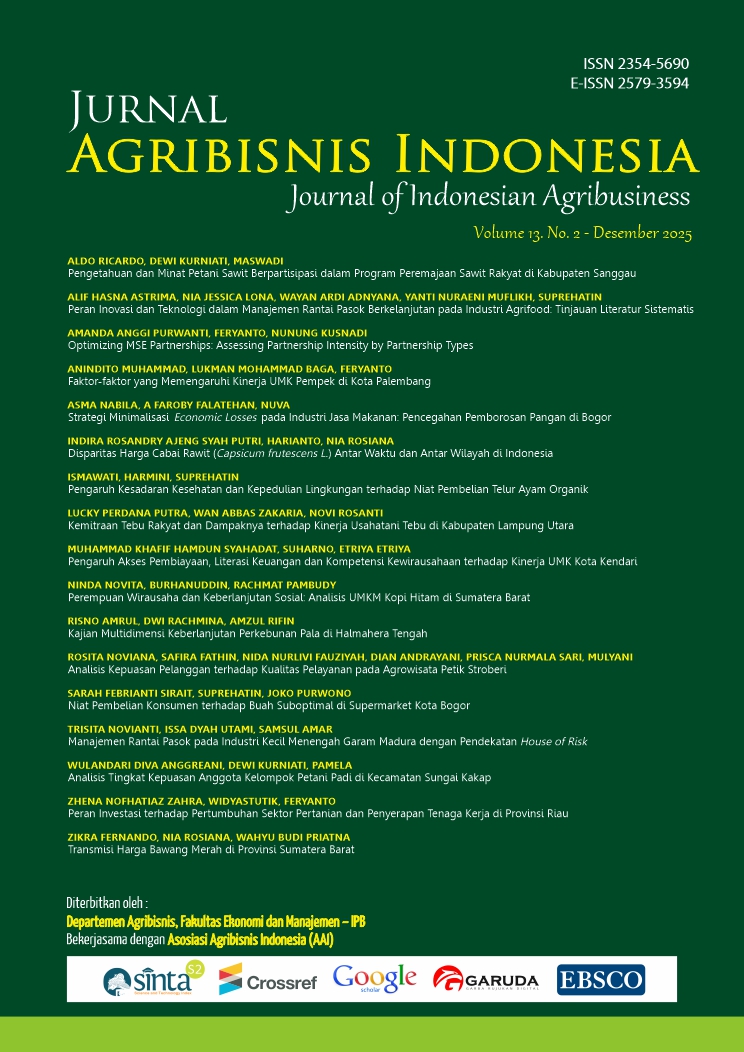
Niat Pembelian Konsumen Terhadap Buah Suboptimal Di Supermarket Kota Bogor
Article Sidebar
Main Article Content
Abstract
Consumer preference for quality fruit products, including perfect physical appearance attributes, has led supermarkets to set and sell fruit with certain quality standards, such as size, color, and ripeness. Currently, some supermarkets sell fruit with physical imperfections, known as suboptimal fruit, along with increasing attention to food waste, especially that resulting from the disposal of less-than-perfect products. This study aims to analyze the factors that influence consumer’s purchase intention on suboptimal fruit in supermarkets. This study uses primary data from 200 respondents who live close to six supermarkets in Bogor City that sell suboptimal fruit. Respondents were selected using voluntary sampling method. This study used the extended Theory of Planned Behavior (TPB) approach and the data were analyzed using structural equation modeling partial least square. The results showed that both TPB variables, namely attitudes, subjective norms and behavioral control and variables added to the model, namely environmental concerns, price discount promotions, and non-price promotions, had a significant effect on the purchase intention of suboptimal fruit in supermarkets. This research provides insight for supermarkets to increase purchase intention of suboptimal fruit through marketing strategies that focus on information, ease of access, product management and display arrangement, and consumer education.
Article Details
Section

This work is licensed under a Creative Commons Attribution 4.0 International License.
Jurnal Agribisnis Indonesia (JAI) is an Open Access Journal. The authors who publish the manuscript in this journal agree to the following terms:
Creative Commons License
JAI is licensed under a Creative Commons Attribution 4.0 International License. This permits anyone to copy, redistribute, remix, transmit, and adapt the work provided the original work and source are appropriately cited.
This means:
(1) Under the CC-BY license, authors retain ownership of the copyright for their article, but authors grant others permission to use the content of publications in Jurnal Agribisnis Indonesia in whole or in part provided that the original work is properly cited. Users (redistributors) of JAI are required to cite the original source, including the author's name, JAI as the initial source of publication, year of publication, volume number, issue, and Digital Object Identifier (DOI); (2) Authors grant JAI the right of first publication. Although authors remain the copyright owner.
How to Cite
References
Argenta LC, Vieira MJ, Souza F, De Pereira WSP, & Edagi FK. (2015). Diagnostico Da Qualidade De Macas No Mercado Varejista Brasileiro. Revista Brasileira de Fruticultura, 37(1), 48–63. doi.org/10.1590/0100-2945-047/14 DOI: https://doi.org/10.1590/0100-2945-047/14
Aschemann-Witzel J, Otterbring T, de Hooge IE, Normann A, Rohm H, Almli VL, & Oostindjer M. (2019). The who, where and why of choosing suboptimal foods: Consequences for tackling food waste in store. Journal of Cleaner Production, 236. doi.org/10.1016/j.jclepro.2019.07.071 DOI: https://doi.org/10.1016/j.jclepro.2019.07.071
Ayu RS, Krisnamurthi B, Rachmina D. (2024). Analisis Keputusan Pembelian Mie Basah Oleh Konsumen Muda Di Kota Bogor. Jurnal Agribisnis Indonesia, 12(2), 345–358. doi.org/10.29244/jai.2024.12.2.345-358 DOI: https://doi.org/10.29244/jai.2024.12.2.345-358
Berdegue JA, Balsevich F, Flores L, & Reardon T. (2005). Central American supermarkets’ private standards of quality and safety in procurement of fresh fruits and vegetables. Food Policy, 30(3), 254–269. doi.org/10.1016/j.foodpol.2005.05.003 DOI: https://doi.org/10.1016/j.foodpol.2005.05.003
Cao Y, & Miao L. (2021). Consumer responses to suboptimal food products. Appetite, 163(March), 105205. doi.org/10.1016/j.appet.2021.105205 DOI: https://doi.org/10.1016/j.appet.2021.105205
Chin WW, & Newsted PR. (1998). The partial least squares approach to structural equation modeling. Modern methods for business research. Statistical Strategies for Small Sample Research, January 1998, 295-336.
de Hooge IE, Oostindjer M, Aschemann-Witzel J, Normann A, Loose SM, & Almli VL. (2017). This apple is too ugly for me!: Consumer preferences for suboptimal food products in the supermarket and at home. Food Quality and Preference, 56, 80–92. doi.org/10.1016/j.foodqual.2016.09.012 DOI: https://doi.org/10.1016/j.foodqual.2016.09.012
Eriksson M, Strid I, & Hansson PA. (2012). Food losses in six Swedish retail stores: Wastage of fruit and vegetables in relation to quantities delivered. Resources, Conservation and Recycling, 68, 14–20. doi.org/10.1016/j.resconrec.2012.08.001 DOI: https://doi.org/10.1016/j.resconrec.2012.08.001
Gefen D, Drexel U, George JF, UFS, Hantula DA, Temple U, Huff S, Wellington VU, Zealand N, Kendall JE, Rutgers U, Munkvold BE, Agder U, Standing CUEC, Figueiredo AD. De & Coimbra U (n.d.). A Note on How to Conduct a Factor-Based PLS-SEM Analysis. IGI Publishing. IJeC Editorial Board.
Gobel C, Langen N, Blumenthal A, Teitscheid P, & Ritter G. (2015). Cutting food waste through cooperation along the food supply chain. Sustainability (Switzerland), 7(2), 1429–1445. doi.org/10.3390/su7021429 DOI: https://doi.org/10.3390/su7021429
Hueppe R, & Zander K. (2024). Perfect apples or sustainable production?—Consumer perspectives from Germany. Journal of Consumer Behaviour, 23(2), 698–710. doi.org/10.1002/cb.2236 DOI: https://doi.org/10.1002/cb.2236
Lim SM, Law H, & Lee SS. (2023). Consumers’ Quality Perception and Acceptance of Suboptimal Food: An Online Survey in Selangor and Kuala Lumpur, Malaysia. Foods, 12(15). doi.org/10.3390/foods12152824 DOI: https://doi.org/10.3390/foods12152824
Lombart C, Millan E, Normand JM, Verhulst A, Labbe-Pinlon B, & Moreau G. (2019). Consumer perceptions and purchase behavior toward imperfect fruits and vegetables in an immersive virtual reality grocery store. Journal of Retailing and Consumer Services, 48(January), 28–40. doi.org/10.1016/j.jretconser.2019.01.010 DOI: https://doi.org/10.1016/j.jretconser.2019.01.010
Mahmud SSO, Pambudy R, & Tinaprilla N. (2024). Preferensi Konsumen Terhadap Atribut Eksternal Produk Beras Organik Di Yogyakarta. Jurnal Agribisnis Indonesia. 12(2), 370–379. doi.org/10.29244/jai.2024.12.2.370-379 DOI: https://doi.org/10.29244/jai.2024.12.2.370-379
Massaglia S, Borra D, Peano C, Sottile F, & Merlino VM. (2019). Consumer preference heterogeneity evaluation in fruit and vegetable purchasing decisions using the best–worst approach. Mdpi, 8(7). DOI: https://doi.org/10.3390/foods8070266
Mattsson L, Williams H, Eriksson M, Strid I, & Hansson PA. (2022). Avoidance of Supermarket Food Waste—Employees’ Perspective on Causes and Measures to Reduce Fruit and Vegetables Waste. Resources, Conservation and Recycling, 68(16), 14–20. doi.org/10.3390/su141610031 DOI: https://doi.org/10.3390/su141610031
Putri RR, Nurmalina R, Suprehatin. (2024). Keputusan Pembelian Dan Kepuasan Konsumen Jeruk Lokal Rimau Gerga Lebong Di Pulau Sumatera. Jurnal Agribisnis Indonesia, Vol 12(2), 330–344. doi.org/10.29244/jai.2024.12.2.330-344 DOI: https://doi.org/10.29244/jai.2024.12.2.330-344
Rieger J, Freund F, Offermann F, Geibel I, & Gocht A. (2023). From fork to farm: Impacts of more sustainable diets in the EU-27 on the agricultural sector. Journal of Agricultural Economics, 74(3), 764–784. doi.org/10.1111/1477-9552.12530 DOI: https://doi.org/10.1111/1477-9552.12530
Rustam K, & Subarkah R. (2021). Studi Pengembangan Ekonomi Lokal Kota Bogor Berbasis Produk Unggulan Daerah Dengan Analisis Swot. Kajian Ekonomi Dan Bisnis, 16(2), 127–146. doi.org/10.51277/keb.v16i2.98 DOI: https://doi.org/10.51277/keb.v16i2.98
Sholihin M. (2021). Analisis SEM-PLS dengan WarpPLS 7.0 untuk Hubungan Nonlinier dalam Penelitian Sosial dan Bisnis (C. Mitak (ed.); 2nd ed.). CV ANDI OFFSET.
Silapeux AGK, Ponka R, Frazzoli C, & Fokou E. (2021). Waste of fresh fruits in Yaoundé, Cameroon: Challenges for retailers and impacts on consumer health. Agriculture (Switzerland), 11(2), 1–12. doi.org/10.3390/agriculture11020089 DOI: https://doi.org/10.3390/agriculture11020089
Siregar AF, Salsabila S, & Tanjung AF. (2020). Analisis Jumlah Penawaran dan Nilai Jual Buah Lokal dan Impor di Pasar Tradisional Kota Medan. In Daun: Jurnal Ilmiah Pertanian dan Kehutanan (Vol. 7, Issue 2, pp. 88–99). doi.org/10.33084/daun.v7i2.2001 DOI: https://doi.org/10.33084/daun.v7i2.2001
Solimun, Rinaldo AA, Fernandes N. (2017). Metode Statistika Multivariat Pemodelan Persamaan Struktural (SEM) Pendekatan WarpPLS (U. Press (ed.); 2nd ed.). UB Press.
Stangherlin I, do C, Duarte Ribeiro JL, & Barcellos M. (2019). Consumer behaviour towards suboptimal food products: a strategy for food waste reduction. British Food Journal, 121(10), 2396–2412. doi.org/10.1108/BFJ-12-2018-0817 DOI: https://doi.org/10.1108/BFJ-12-2018-0817
Sullivan AN, & Lachman ME. (2017). Behavior change with fitness technology in sedentary adults: A review of the evidence for increasing physical activity. Frontiers in Public Health, 4(JAN). doi.org/10.3389/FPUBH.2016.00289 DOI: https://doi.org/10.3389/fpubh.2016.00289
Utami DN, Trimo L, Judawinata MG, & Suminartika E. (2023). Pengaruh Kepercayaan Merek, Citra Merek, dan Promosi Terhadap Keputusan Pemilihan Platform Pembelian Buah dan Sayur Online. Jurnal Agribisnis Indonesia, 11(1), 64–74. doi.org/10.29244/jai.2023.11.1.64-74 DOI: https://doi.org/10.29244/jai.2023.11.1.64-74
Wong SL, Hsu CC, & Chen HS. (2018). To buy or not to buy? Consumer attitudes and purchase intentions for suboptimal food. International Journal of Environmental Research and Public Health, 15(7). doi.org/10.3390/ijerph15071431 DOI: https://doi.org/10.3390/ijerph15071431