
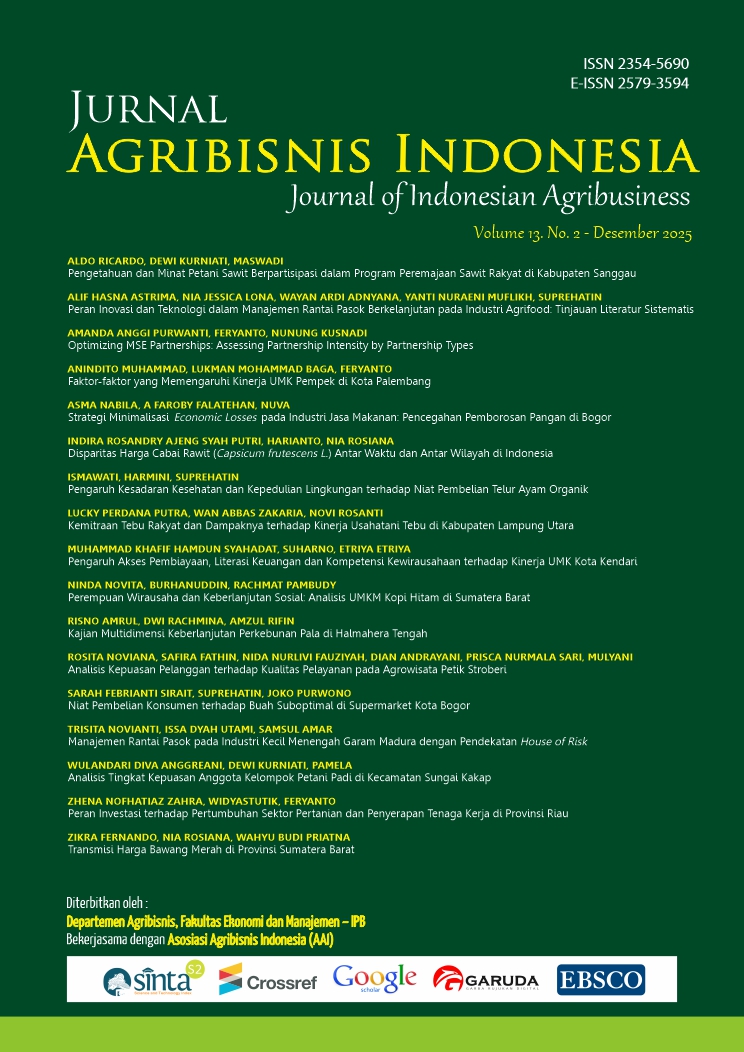
Pengetahuan dan Minat Petani Sawit Berpartisipasi dalam Program Peremajaan Sawit Rakyat di Kabupaten Sanggau
Article Sidebar
Main Article Content
Abstract
Palm oil is one of Indonesia's main exports that brings in a significant amount of foreign exchange. Oil palm farmers face challenges in maximizing their productivity due to a lack of knowledge and interest among farmers in replanting oil palms. Currently, there are still many smallholder plantations that are more than 25 years old but have not been replanted due to lack of replanting costs and farmers do not have a replacement income when the oil palm is replanted. Smallholder oil palm rejuvenation (PSR) is replacing old plants with new, more productive plants with certified superior seeds and is expected to benefit farmers. This research was conducted in Sanggau District, with 100 respondents of oil palm farmers who have replanted, especially in Parindu and Kapuas Sub-districts which are the centers of oil palm plantations. This research uses purposive sampling method (certain considerations) and sequential/stage mixed research method, especially sequential explanatory strategy because it focuses on quantitative data and qualitative data as supporting data. The research aims to see how much the knowledge and interest of the community influence participation in community oil palm replanting. Knowledge theory and interest theory complement each other to form a comprehensive management system or operational system in handling community oil palm replanting from an external and internal perspective. Knowledge and interest have a positive and significant influence on decision-making. The results show that knowledge and interest complement each other and have a strong influence on participation. Good financial management is the key to success and helps farmers improve their farming business because every farming activity requires capital. Knowledge needs to be improved by providing training according to the needs of farmers.
Article Details
Section

This work is licensed under a Creative Commons Attribution 4.0 International License.
Jurnal Agribisnis Indonesia (JAI) is an Open Access Journal. The authors who publish the manuscript in this journal agree to the following terms:
Creative Commons License
JAI is licensed under a Creative Commons Attribution 4.0 International License. This permits anyone to copy, redistribute, remix, transmit, and adapt the work provided the original work and source are appropriately cited.
This means:
(1) Under the CC-BY license, authors retain ownership of the copyright for their article, but authors grant others permission to use the content of publications in Jurnal Agribisnis Indonesia in whole or in part provided that the original work is properly cited. Users (redistributors) of JAI are required to cite the original source, including the author's name, JAI as the initial source of publication, year of publication, volume number, issue, and Digital Object Identifier (DOI); (2) Authors grant JAI the right of first publication. Although authors remain the copyright owner.
How to Cite
References
Abazue, C. M., Choy, E. A., & Lydon, N. . (2019). Oil palm smallholders and certification: exploring the knowledge level of independent oil palm smallholders to certification. Journal of Bioscience and Agriculture Research, 19(1), 1589–1596. https://doi.org/10.18801/jbar.190119.193 DOI: https://doi.org/10.18801/jbar.190119.193
Adams, W. C. (2015). Conducting Semi-Structured Interview. Handbook of Practical Program Evaluation, 1970, 492–505. https://doi.org/https://doi.org/10.1002/9781119171386.ch19 DOI: https://doi.org/10.1002/9781119171386.ch19
Agustira, M. A., Siahaan, D., & Hasibuan, H. A. (2019). Nilai Ekonomi Nira Sawit Sebagai Potensi Pembiayaan Peremajaan Kebun Kelapa Sawit Rakyat. Jurnal Penelitian Kelapa Sawit, 27(2), 115–126. https://doi.org/10.22302/iopri.jur.jpks.v27i2.62 DOI: https://doi.org/10.22302/iopri.jur.jpks.v27i2.62
Anggreany, S., Muljono, P., & Sadono, D. (2016). Partisipasi Petani dalam Replanting Kelapa Sawit di Provinsi Jambi. Jurnal Penyuluhan, 12(1), 1–14. https://doi.org/DOI: https://doi.org/10.25015/penyuluhan.v12i1.11315 DOI: https://doi.org/10.25015/penyuluhan.v12i1.11315
Arwan, Tinaprilla, N., & Burhanuddin. (2023). Faktor-Faktor yang Memengaruhi Pilihan Saluran Pemasaran Tandan Buah Segar Pada Perkebunan Rakyat. Jurnal Agribisnis Indonesia, 11(1), 39–47. https://doi.org/10.29244/jai.2023.11.1.39-47 DOI: https://doi.org/10.29244/jai.2023.11.1.39-47
Asti, P. D. A., Falatehan, A. F., & Kumala Putri, E. I. (2022). Implementasi Peremajaan Sawit Rakyat (Studi Kasus: KUD Tunas Muda Kabupaten Siak-Riau). Forum Agribisnis, 12(2), 126–137. https://doi.org/10.29244/fagb.12.2.126-137 DOI: https://doi.org/10.29244/fagb.12.2.126-137
Bernardin, H. J., & Russell, J. E. A. (1993). Human resource management 6th edition : An experiential approach [Book]. In J.E.A. Russell. https://tp.primo.exlibrisgroup.com/discovery/fulldisplay?docid=alma990001068 880107172&context=L&vid=65SPO_TP:TP&lang=en&search_scope=DBandL ibraryCatalog&adaptor=Local Search Engine&isFrbr=true&tab=Databases&query=isbn,contains,9780071156745&so rtby=date
Creswell, J. W., & Creswell, J. D. (2018). Mixed Methods Procedures. In Research Defign: Qualitative, Quantitative, and Mixed M ethods Approaches. SAGE Publications, Inc. https://spada.uns.ac.id/pluginfile.php/510378/mod_resource/content/1/creswell.pdf
Crow, L. D., & Crow, A. (1973). Essentials Of Education Physicology. https://www.google.co.id/books/edition/ESSENTIALS_OF_EDUCATIONAL_PSYCHOLOGY/RGY2054HE4kC?hl=id&gbpv=0
DISBUNNAK Sanggau. (2022). Statistik Perkebunan Kecamatan. https://disbunnak.kalbarprov.go.id/app/statistik/main?module=statistik&data=thn
Dzikrullah, A. A., & Chasanah, U. (2024). Optimalisasi Peran Koperasi Dalam Mendukung UMKM: Meningkatkan Akses Modal, Penguasaan Teknologi, Dan Ekspansi Pasar. Jurnal Investasi Islam, 5. No 1(2), 635–637. https://doi.org/https://doi.org/10.32806/ivi.v5i1.205 DOI: https://doi.org/10.32806/ivi.v5i1.205
Goh, A. T. (2005). Knowledge diffusion, input supplier’s technological effort and technology transfer via vertical relationships. Journal of International Economics, 66(2), 527–540. https://doi.org/10.1016/j.jinteco.2004.06.010 DOI: https://doi.org/10.1016/j.jinteco.2004.06.010
Gorp, T. Van, & Adams, E. (2012). Design for Emotion. In Design for Emotion. https://doi.org/10.1016/b978-0-12-386531-1.00001-6 DOI: https://doi.org/10.1016/B978-0-12-386531-1.00001-6
Hadi, S., Akhmadi, A. N., & Prayuginingsih, H. (2019). Peran Kelompok Tani dan Persepsi Terhadap Penerapan Budidaya Padi di Kabupatern Jember. Jurnal Penyuluhan, 15(2), 154–168. https://doi.org/https//doi.org/10.25015/15201918492 DOI: https://doi.org/10.25015/15201918492
Hair, J. F., Hult, G. T. M., Ringle, C. M., Sarstedt, M., Danks, N. P., & Ray, S. (2021). Partial least squares structural equation modeling (pls-sem) using R: A workbook (Third). Springer. https://doi.org/https://doi.org/10.1007/978-3-030-80519-7 DOI: https://doi.org/10.1007/978-3-030-80519-7
Hidayati. (2020). Pengendalian Hama Kelapa Sawit (Elaies Guinessis Jacq) Di Pt. Bumi Palma Lestari, Bagan Jaya Kecamatan Enok Kabupaten Indragiri Hilir – Riau. Jurnal Agro Indragiri, 6(2), 42–47. https://doi.org/10.32520/jai.v6i2.1468 DOI: https://doi.org/10.32520/jai.v6i2.1468
Hutasoit, F. R., Hutabarat, S., & Muwardi, D. (2015). Analisis persepsi petani kelapa sawit swadaya bersertifikasi rspo dalam menghadapi kegiatan peremajaan perkebunan kelapa sawit di kecamatan ukui kabupaten pelalawan. Jom Faperta, 2(1), 1–13. https://media.neliti.com/media/publications/202662-analisis-persepsi-petani-kelapa-sawit-sw.pdf
Hutasuhut, S. R., Ayu, S. F., & Chalil, D. (2023). Analisis Efektivitas Program Peremajaan Sawit Rakyat Di Kecamatan Nibung Hangus Kabupaten Batubara, Sumatera Utara, Indonesia. Agro Bali : Agricultural Journal, 6(2), 459–469. https://doi.org/10.37637/ab.v6i2.1126 DOI: https://doi.org/10.37637/ab.v6i2.1126
Hwui, C., & Lay, Y. (2018). Examining the reliability and validity of research instruments using partial least squares structural equation modeling (PLS-SEM). Journal of Baltic Science Education, 17(2), 239–251. https://doi.org/10.33225/jbse/18.17.239 DOI: https://doi.org/10.33225/jbse/18.17.239
Jennex, M. E., Smolnik, S., & Croasdell, D. (2016). The search for knowledge management success. Proceedings of the Annual Hawaii International Conference on System Sciences, 2016-March, 4202–4211. https://doi.org/10.1109/HICSS.2016.521 DOI: https://doi.org/10.1109/HICSS.2016.521
Kemala, N., Alawiyah, W., & Yuanwiarno, P. (2021). Pendapatan Usahatani Kelapa Sawit Pasca Umur Produktif Di Desa Bukit Makmur Kecamatan Sungai Bahar Kabupaten Muaro Jambi. Jurnal MeA (Media Agribisnis), 6(1), 23. https://doi.org/10.33087/mea.v6i1.94 DOI: https://doi.org/10.33087/mea.v6i1.94
Kementerian Koordinator Bidang Perekonomian Republik Indonesia. (2024). Akselerasi Program Peremajaan Sawit Rakyat dan Penyaluran KUR, Menko Airlangga Dengar Langsung Aspirasi Para Pekebun Sawit. KEMENTRIAN KOORDINATOR BIDANG PEREKONOMIAN REPUBLIK INDONESIA. https://ekon.go.id/publikasi/detail/5615/akselerasi-program-peremajaan-sawit-rakyat-dan-penyaluran-kur-menko-airlangga-dengar-langsung-aspirasi-para-pekebun-sawit#
Kurniasari, D., & Iskandar, S. (2020). Dampak Peremajaan (Replanting) Kelapa Sawit Terhadap Kondisi Sosial Ekonomi Petani Kelapa Sawit di Desa Kemang Indah Kecamatan Mesuji Raya Kabupaten Ogan Komering Ilir. Societa, IX(1), 32–36. https://doi.org/https://doi.org/10.32502/jsct.v9i1.3631
Latifah, R. A., Romano., & Baihaqi, A. (2023). Identifikasi Instrumen Faktor Internal Dan Eksternal Pada Pengukuran Keberhasilan Program Peremajaan (replanting) Kelapa Sawit Rakyat Di Kabupaten Nagan Raya. 24, 43–48. https://doi.org/https://doi.org/10.17969/agrisep.v24i1.33304 DOI: https://doi.org/10.17969/agrisep.v24i1.33304
Lauwinata, L., Susanto, H., & Phoek, S. E. M. (2024). Partisipasi Masyarakat Dalam Implementasi ISPO: Analisis Keberlanjutan, Sosio-Ekonomi, Dan Konflik Di Kabupaten Merauke. 4(6). https://doi.org/https://doi.org/10.54957/jolas.v4i6.969 DOI: https://doi.org/10.54957/jolas.v4i6.969
Maharani, A., & Laksmono, B. S. (2021). Peran Gapoktan Karya Bersama Dalam Implementasi Program Peremajaan Sawit Rakyat (Psr) Di Bandar Durian, Aek Natas, Labuhan Batu Utara. Jurnal Pembangunan Manusia, 2(2). https://doi.org/10.7454/jpm.v2i2.1022 DOI: https://doi.org/10.7454/jpm.v2i2.1022
Mardiana Wahyuni, & Barus, F. A. (2021). Peningkatan Pola Pikir Petani Untuk Mengikuti Program Peremajaan Sawit Rakyat Di Desa Laut Tador - Batu Bara- Provinsi Sumatera Utara. Dinamisia : Jurnal Pengabdian Kepada Masyarakat, 5(3), 724–732. https://doi.org/10.31849/dinamisia.v5i3.5545 DOI: https://doi.org/10.31849/dinamisia.v5i3.5545
Medeiros, J. F. de, Garlet, T. B., Ribeiro, J. L. D., & Cortimiglia, M. N. (2022). Success factors for environmentally sustainable product innovation: An updated review. Jurnal Of Cleaner Production. https://doi.org/https://doi.org/10.1016/j.jclepro.2022.131039 DOI: https://doi.org/10.1016/j.jclepro.2022.131039
Midgley, J. (1986). Industrialization and welfare : The Case of the Four Little Tigers. Social Policy & Administration, 20(3). https://doi.org/https://doi.org/10.1111/j.1467-9515.1986.tb00253.x DOI: https://doi.org/10.1111/j.1467-9515.1986.tb00253.x
Molina-Azorin, J. F., Tari, J.-J., Lopez-Gamero, M. D., Pereira-Moliner, J., & Pertusa-Ortega, E. M. (2018). The Implementation and Advantages of Mixed Methods in Competitive Strategy and Management Systems. International Journal of Multiple Research Approaches, 10(1), 412–421. https://doi.org/10.29034/ijmra.v10n1a28 DOI: https://doi.org/10.29034/ijmra.v10n1a28
Murdy, S., Nainggolan, S., & Napitupulu, D. (2021). Analisis finansial peremajaan perkebunan sawit rakyat di Kabupaten Muaro Jambi. Jurnal Paradigma Ekonomika, 16(1), 209–224. https://doi.org/10.22437/jpe.v16i1.12501 DOI: https://doi.org/10.22437/jpe.v16i1.12501
Nasution, N. A. S., Ismiasih, I., & Dinarti, S. I. (2023). Tingkat Pengetahuan Petani Kelapa Sawit Dalam Penerapan Good Agricultural Practices (GAP): Sebuah Analisis Rating Scale. JSEP (Journal of Social and Agricultural Economics), 16(1), 41. https://doi.org/10.19184/jsep.v16i1.37946 DOI: https://doi.org/10.19184/jsep.v16i1.37946
Nurjanah, D. (2021). Faktor-faktor yang mempengaruhi minat petani muda di Kabupaten Temanggung. Agritech, XXIII(1), 1411–1063. https://doi.org/http://dx.doi.org/10.30595/agritech.v23i1.6779
Olubunmi, F. (2015). Knowledge Management As an Important Tool in Organisational Management : a Review of. Library Philosophy and Practice, 4(10), 1–23. http://digitalcommons.unl.edu/libphilprachttp://digitalcommons.unl.edu/libphilprac/1238
Pareira, S. P. (2023). Achieving Indonesian Palm Oil Farm-to-Table Traceability through ISPO-RSPO Harmonization. Center for Indonesian Policy Studies, 56, 1–34. https://repository.cips-indonesia.org/media/publications/560227-achieving-indonesian-palm-oil-farm-to-ta-f23807fd.pdf DOI: https://doi.org/10.35497/560227
Peraturan Menteri Pertanian Republik Indonesia, Nomor 65 PERATURAN MENTERI PERTANIAN REPUBLIK INDONESIA NOMOR: 18/Permentan/KB.330/5/2016 TENTANG PEDOMAN PEREMAJAAN PERKEBUNAN KELAPA SAWIT 2004 (2016). https://spks.or.id/file/publikasi/PERMENTAN-18-2016-PEREMAJAAN-KEBUN-KELAPA-SAWIT.pdf
Phengchan, P., & Thangpreecharparnich, P. (2018). Advantages of knowledge management and supply chain integration. A case study of Thai palm oil production. Management and Production Engineering Review, 9(4), 150–160. https://doi.org/10.24425/119555
Pratama, A. Y., Supriadi, B., & Respati, H. (2022). Demographic factors to strengthen the influence of brand image and store service quality on purchasing decisions. East African Scholars Journal of Economics, Business and Management, 5(11), 406–413. https://doi.org/10.36349/easjebm.2022.v05i11.002 DOI: https://doi.org/10.36349/easjebm.2022.v05i11.002
Ramadhani, M., Marsudi, E., & Baihaqi, A. (2022). Kinerja Pengelolaan Keuangan Petani Kelapa Di Kabupaten Bireuen. Jurnal Ilmiah Mahasiswa Pertanian, 7(4), 505–514. https://doi.org/10.17969/jimfp.v7i4.22088 DOI: https://doi.org/10.17969/jimfp.v7i4.22088
Ratnaningsih, Himawan, D., & Lindawati. (2022). Kajian Pemetaan Komoditas Kelapa Sawit ( Elaeis guineensis jacq .) Pada Skripsi , Tesis dan Disertasi IPB sampai tahun 2022. 21(2). https://doi.org/https://doi.org/10.29244/jpi.21.2.124-239 DOI: https://doi.org/10.29244/jpi.21.2.124-239
Regulasi Keputusan Dirut BPDPKS No KEP-167/DPKS/2020 Tentang Besaran Standar Biaya Dana Peremajaan Perkebunan Sawit Yang Dibiayai BPDPKS (2020). https://www.bpdp.or.id/keputusan-dirut-bpdpks-kep-167dpks2020-tentang-besaran-standar-biaya-dana-peremajaan-perkebunan-sawit-yang-dibiayai-bpdpks
Rizal, S., Dewi Sukma, Roberdi Siberakuno, Tony Liwang, & Sudarsono. (2020). Isolasi dan Karakterisasi Potongan DNA Gen Sterol Metiltransferase 1 (SMT1) Asal Kelapa Sawit. Jurnal Agronomi Indonesia (Indonesian Journal of Agronomy), 48(3), 348–354. https://doi.org/10.24831/jai.v48i3.32205 DOI: https://doi.org/10.24831/jai.v48i3.32205
Rutledge, P. B., & Hogg, J. L. C. (2020). In‐Depth Interviews. The International Encyclopedia of Media Psychology, April, 1–7. https://doi.org/10.1002/9781119011071.iemp0019 DOI: https://doi.org/10.1002/9781119011071.iemp0019
Saragih, I. K., Rachmina, D., & Krisnamurthi, B. (2020). Analisis Status Keberlanjutan Perkebunan Kelapa Sawit Rakyat Provinsi Jambi. Jurnal Agribisnis Indonesia, 8(1), 17–32. https://doi.org/10.29244/jai.2020.8.1.17-32 DOI: https://doi.org/10.29244/jai.2020.8.1.17-32
Septifani, R., Achmadi, F., & Santoso, I. (2014). Pengaruh Green Marketing, Pengetahuan dan Minat Membeli terhadap Keputusan Pembelian. Jurnal Manajemen Teknologi, 13(2), 201–218. https://doi.org/10.12695/jmt.2014.13.2.6 DOI: https://doi.org/10.12695/jmt.2014.13.2.6
Setiawan, D., Ismiasih, I., & Listiyani, L. (2024). Kesiapan Petani Menghadapi Peremajaan (Replanting) Kelapa Sawit Di Desa Rimba Jaya, Kabupaten Kampar. Jurnal Ekonomi Pertanian Dan Agribisnis, 8(1), 268. https://doi.org/10.21776/ub.jepa.2024.008.01.22 DOI: https://doi.org/10.21776/ub.jepa.2024.008.01.22
SPKS. (2016). Standar Operasional Prosedur Manajemen Panen dan Pemasaran TBS. In Dokumen SOP Agronomi untuk Petani Sawit. https://spks.or.id/file/publikasi/12__SOP_PEMANENAN_PENJUALAN_TBS.pdf
Vehovar, V., Toepoel, V., & Steinmetz, S. (2016). Non-probability sampling. In Christof Wolf, D. Joye, T. W. Smith, & Y. Fu (Eds.), The Sage Handbook of Survey Methodology (pp. 329–346). SAGE Publications Inc. https://doi.org/https://doi.org/10.4135/9781473957893 DOI: https://doi.org/10.4135/9781473957893.n22
Wayan Wangiyana, I Ketut Ngawit, Akhmad Zubaidi, & Novita Hidayatun Nufus. (2023). Partisipasi dan Antusiasme Petani pada Demplot Pengelolaan Tanah Tegakan Kelapa di Desa Mumbul Sari Kecamatan Bayan Kabupaten Lombok Utara NTB. Jurnal SIAR ILMUWAN TANI, 4(1), 89–100. https://doi.org/10.29303/jsit.v4i1.102 DOI: https://doi.org/10.29303/jsit.v4i1.102
Wibowo, W. H., & Junaedi, A. (2017). Peremajaan Kelapa Sawit (Elaeis guineensis Jacq.) di Seruyan Estate, Minamas Plantation Group, Seruyan, Kalimantan Tengah. Buletin Agrohorti, 5(1), 107. https://doi.org/10.29244/agrob.5.1.107-116 DOI: https://doi.org/10.29244/agrob.5.1.107-116
Willaby, H., Costa, D., Burns, B., Maccann, C., & Roberts, R. (2015). Testing complex models with small sample sizes: A historical overview and empirical demonstration of what partial least squares (pls) can offer differential psychology. Personality and Individual Differences, 84, 73–78. https://doi.org/10.1016/j.paid.2014.09.008 DOI: https://doi.org/10.1016/j.paid.2014.09.008
Wulandari, S. A., Alamsyah, Z., Napitupulu, D., & Novra, A. (2023). Strategi Pendukung Pelaksanaan Peremajaan Kelapa Sawit di Provinsi Jambi. Jurnal MeA (Media Agribisnis), 8(1), 67. https://doi.org/10.33087/mea.v8i1.166 DOI: https://doi.org/10.33087/mea.v8i1.166
Zalukhu, R. S., Sinurat, Y. M., Collyn, D., Purba, A., Arseto, D. D., & Sagala, Y. M. (2022). Sosialisasi Manajemen Pola Tanam Dan Pengelolaan Keuangan Bagi Petani Milenial Binaan Hkti Kota Tebing Tinggi. ABDIMAS PATIKALA: Jurnal Pengabdian Kepada Masyarakat, 2(1), 508–517. https://doi.org/10.51574/patikala.v2i1.566 DOI: https://doi.org/10.51574/patikala.v2i1.566