
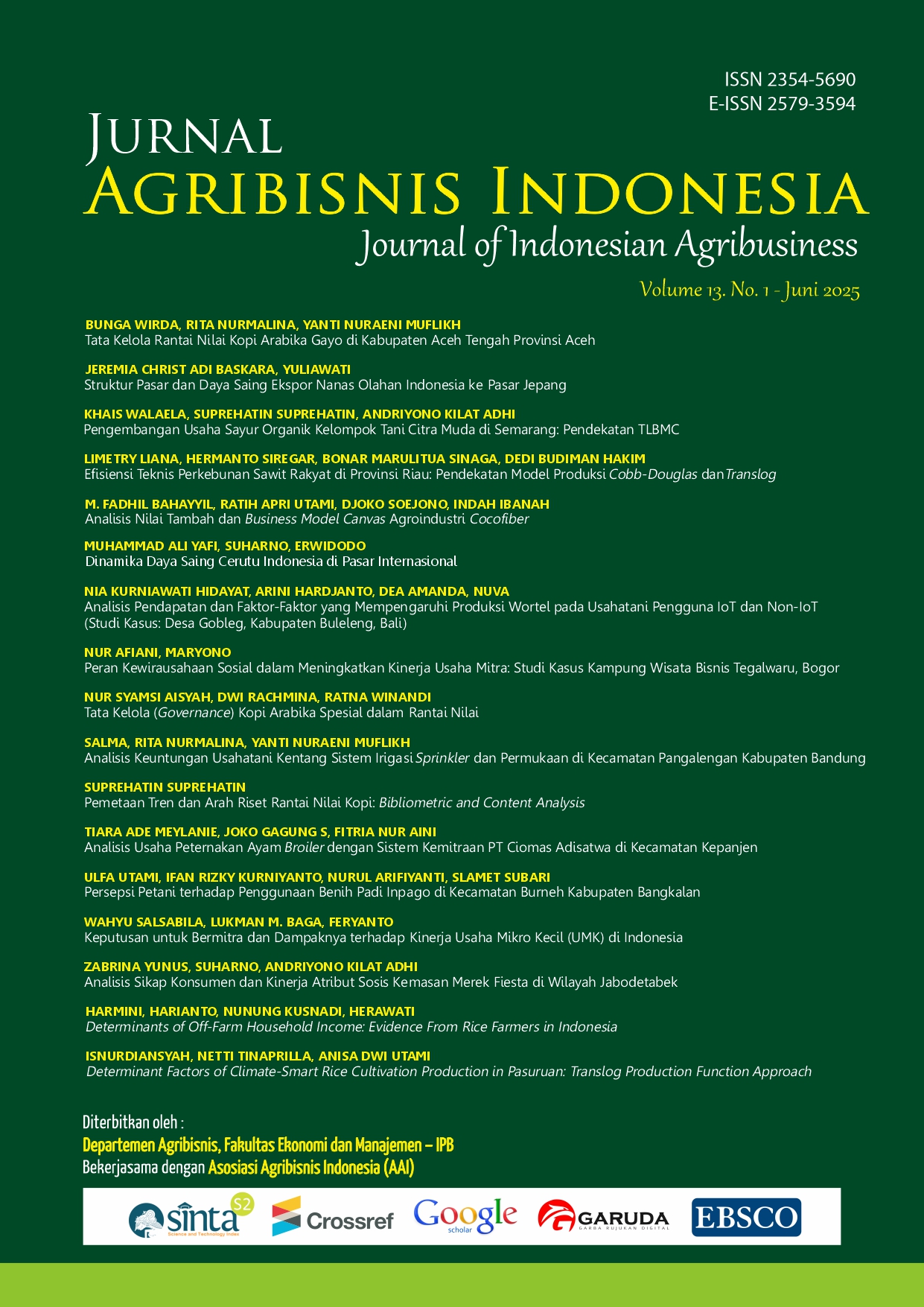
Tata Kelola Rantai Nilai Kopi Arabika Gayo di Kabupaten Aceh Tengah Provinsi Aceh
Article Sidebar
Main Article Content
Abstract
The governance of coffee trade is influenced by disparities in market power and the interdependence among actors within the value chain. In Central Aceh District, dominant actors in the value chain exert significant influence over governance structures, shaping price determination, quality standards, and trading practices. This study aims to analyze the type of governance of the Gayo arabica coffee value chain in Central Aceh District. The research was conducted in two sub-districts, Pegasing and Silih Nara. The method used was a survey of 83 main actors in the Gayo arabica coffee value chain, namely farmers, intermediary traders, cooperatives, exporters, and roasters. The data were analyzed using the Gereffi value chain governance approach. The results showed that cooperatives, exporters, and roasters are the most dominant actors (key actors) in the Arabica coffee value chain in Central Aceh District. Most of Gayo Arabica coffee is exported as green beans by cooperatives and exporting companies, while a smaller portion is distributed to coffee roasters for processing into roasted and ground coffee. The governance type of Gayo arabica coffee value chain in Central Aceh District is categorized as modular governance, characterized by high complexity in the transaction process, high codification of information, and high capability to supply. Upgrading value chain governance and sustainability requires support and collaboration from all actors involved.
Article Details
Section
Jurnal Agribisnis Indonesia (JAI) is an Open Access Journal. The authors who publish the manuscript in this journal agree to the following terms:
Creative Commons License
JAI is licensed under a Creative Commons Attribution 4.0 International License. This permits anyone to copy, redistribute, remix, transmit, and adapt the work provided the original work and source are appropriately cited.
This means:
(1) Under the CC-BY license, authors retain ownership of the copyright for their article, but authors grant others permission to use the content of publications in Jurnal Agribisnis Indonesia in whole or in part provided that the original work is properly cited. Users (redistributors) of JAI are required to cite the original source, including the author's name, JAI as the initial source of publication, year of publication, volume number, issue, and Digital Object Identifier (DOI); (2) Authors grant JAI the right of first publication. Although authors remain the copyright owner.
How to Cite
References
Adam, F., Agustina, R., & Fadhil, R. (2022). Pengujian Cita Rasa Kopi Arabika dengan Metode Cupping Test. Jurnal Ilmiah Mahasiswa Pertanian, 7(1), 517–521. https://doi.org/10.17969/jimfp.v7i1.19021 DOI: https://doi.org/10.17969/jimfp.v7i1.19021
Aisyah, N. S. (2022). Rantai Nilai Global Kopi Arabika Spesial di Kabupaten Bondowoso [tesis]. Institut Pertanian Bogor.
Amalia, F., Irifune, T., Takegami, T., Yusianto, Sumirat, U., Putri, S. P., & Fukusaki, E. (2023). Identification of potential quality markers in Indonesia’s Arabica specialty coffee using GC/MS-based metabolomics approach. Metabolomics, 19(11), 1–11. https://doi.org/10.1007/s11306-023-02051-5 DOI: https://doi.org/10.1007/s11306-023-02051-5
Bagio, Kembaren, E. T., & Manyamsari, I. (2021). Analisis Nilai Tambah Biji Kopi Arabika Premium Bersertifikat Organic Dan Biji Kopi Arabika Premium Tanpa Sertifikat Organik Di Aceh Tengah. Journal Of Agribusiness Sciencess, 4(2), 94–99.
[BPS] Badan Pusat Statistik Aceh Tengah. (2024). Kabupaten Aceh Tengah Dalam Angka 2024.
Cahyanto, G. D., Wibowo, A., & Permatasari, P. (2021). Kemitraan antara Petani Kopi dengan Perusahaan (Studi Kasus Kintamani). SALAM: Jurnal Sosial Dan Budaya Syar-I, 8(1), 173–190. https://doi.org/10.15408/sjsbs.v8i1.19426 DOI: https://doi.org/10.15408/sjsbs.v8i1.19426
Damayanti, T., & Setiadi, H. (2019). The Influence of Certificaton of Gayo Coffee Geographical Indication Against Value Added of Coffee in Gayo Highlands, Aceh. IOP Conference Series: Earth and Environmental Science, 338(1), 0–9. https://doi.org/10.1088/1755-1315/338/1/012028 DOI: https://doi.org/10.1088/1755-1315/338/1/012028
Fajar, A., Fariyanti, A., & Priatna, W. B. (2023). Status Keberlanjutan Perkebunan Kopi Bersertifikasi C.A.F.E. Practices. Jurnal Agribisnis Indonesia, 11(1), 1–16. https://doi.org/10.29244/jai.2023.11.1.1-16 DOI: https://doi.org/10.29244/jai.2023.11.1.1-16
Fitri, I., Maryunianta, Y., Barus, R., & Supriana, T. (2023). Analysis Of Difference In Sales Price Of Arabica Coffee Certified By Sustainable Agriculture Institutes Rainforest Alliance And Fairtrade In Central Aceh (Case Study of Rahmat Kinara Multi-Purpose Cooperative). Agric, 35(1), 61–72. https://doi.org/10.24246/agric.2023.v35.i1.p61-72 DOI: https://doi.org/10.24246/agric.2023.v35.i1.p61-72
Fok, M. (2021). Relational governance, equity and social spill-over of agricultural value chains: Cotton case in Cameroon and beyond. World Development Perspectives, 23, 100352. https://doi.org/10.1016/j.wdp.2021.100352 DOI: https://doi.org/10.1016/j.wdp.2021.100352
Gereffi, G., & Fernandez-Stark, K. (2016). The Second Edition of Global Value Chain Analysis: A Primer. In Duke CGGC (Center on Globalization, Governance & Competitiveness). https://hdl.handle.net/10161/12488.
Gereffi, G., Humphrey, J., & Sturgeon, T. (2005). The governance of global value chains. Review of International Political Economy, 12(1), 78–104. https://doi.org/10.1080/09692290500049805 DOI: https://doi.org/10.1080/09692290500049805
Hair, J. F., Money, A. H., Samouel, P., & Page, M. (2007). Research Methods for Business. Education + Training, 49(4), 336–337. https://doi.org/10.1108/et.2007.49.4.336.2 DOI: https://doi.org/10.1108/et.2007.49.4.336.2
Hamid, A. H., Nugroho, A., Pospos, T. H., & Suherman, G. (2023). Impact of coffee sustainability schemes on rural coffee producer households’ living standard in Aceh province, Indonesia. Acta Agriculturae Slovenica, 119(1), 1–13. https://doi.org/10.14720/aas.2023.119.1.2472 DOI: https://doi.org/10.14720/aas.2023.119.1.2472
Hardana, A. E., & Pratiwi, D. E. (2023). The Impact of Trust and Relationship Quality on Agricultural Cooperative Competitiveness. Habitat, 34(3), 311–320. https://doi.org/10.21776/ub.habitat.2023.034.3.28 DOI: https://doi.org/10.21776/ub.habitat.2023.034.3.28
Hartono, J. (2013). Metodologi Penelitian Bisnis: Salah Kaprah dan Pengalaman-Pengalaman (6th ed.). BPFE.
Høgevold, N., Svensson, G., & Otero-Neira, C. (2020). Trust and commitment as mediators between economic and non-economic satisfaction in business relationships: a sales perspective. Journal of Business and Industrial Marketing, 35(11), 1685–1700. https://doi.org/10.1108/JBIM-03-2019-0118 DOI: https://doi.org/10.1108/JBIM-03-2019-0118
[ICO] International Coffee Organization. (2022). Coffe Development Report 2022-2023.
[ICO] International Coffee Organization. (2023). Exports Of All Forms Of Coffee By Exporting Countries To All Destinations January 2022. https://www.ico.org/prices/m1-exports.pdf
Ihsaniyati, H., Sarwoprasodjo, S., Muljono, P., & Gandasari, D. (2024). Diversity of Knowledge-Sharing Behavior to Encourage the Practice of Robusta Coffee Red-Picking (Case Study of Temanggung Robusta Coffee Farmer, Indonesia). Caraka Tani: Journal of Sustainable Agriculture, 39(1), 235–254. https://doi.org/10.20961/carakatani.v39i1.82647 DOI: https://doi.org/10.20961/carakatani.v39i1.82647
Juliaviani, N., Sahara, S., & Winandi, R. (2022). Analisis Pemasaran Kopi Arabika Gayo Di Kabupaten Aceh Tengah Provinsi Aceh. Jurnal Agrisep, 22(2), 72–78. https://doi.org/10.17969/agrisep.v22i2.24392 DOI: https://doi.org/10.17969/agrisep.v22i2.24392
Kembaren, E. T., & Muchsin. (2021). Pengelolaan Pasca Panen Kopi Arabika Gayo Aceh. Jurnal Visioner Dan Strategis, 10(1), 29–36.
Kudus, A., Widayat, H. P., & Abubakar, Y. (2019). Kriteria Mutu Kopi Arabika Gayo Pada Beberapa Koperasi dan Eksportir di Aceh Tengah. Jurnal Ilmiah Mahasiswa Pertanian, 4(2), 274–279. https://doi.org/10.17969/jimfp.v4i2.11018 DOI: https://doi.org/10.17969/jimfp.v4i2.11018
Muttoharoh, V., Nurjanah, R., & Mustika, C. (2018). Daya saing dan faktor-faktor yang mempengaruhi ekspor kopi Arabika Indonesia di pasar internasional. E-Jurnal Perspektif Ekonomi Dan Pembangunan Daerah, 7(3), 127–136. https://doi.org/10.22437/pdpd.v7i3.6904 DOI: https://doi.org/10.22437/pdpd.v7i3.6904
Nurohmah, N. N., Kusnadi, N., & Adhi, A. K. (2024). Tata Kelola Rantai Nilai Gula Aren di Kabupaten Tasikmalaya. Jurnal Agribisnis Indonesia, 12(1), 106–119. https://doi.org/10.29244/jai.2024.12.1.106-119 DOI: https://doi.org/10.29244/jai.2024.12.1.106-119
Olutimehin, D. O., Ofodile, O. C., Ugochukwu, C. E., & Nwankwo, E. E. (2024). Corporate governance and stakeholder engagement in Nigerian enterprises: A review of current practices and future directions. World Journal of Advanced Research and Reviews, 21(3), 736–742. https://doi.org/10.30574/wjarr.2024.21.3.0737 DOI: https://doi.org/10.30574/wjarr.2024.21.3.0737
Pransiska, R., Agustina, R., & Fadhil, R. (2024). Tiga Varietas Unggul Kopi Arabika Gayo Dan Proses Pengolahannya Di Dataran Tinggi Gayo. Jurnal Ilmiah Mahasiswa FEB, 9(November), 393–400. DOI: https://doi.org/10.17969/jimfp.v9i4.28010
[Pusdatin] Pusat Data dan Informasi Pertanian. (2022). Outlook Komoditas Perkebunan Kopi.
[Pusdatin] Pusat Data dan Sistem Informasi Pertanian. (2023). Outlook Komoditas Perkebunan Kopi.
Rubio, D. I. C., Delgado, D. R., & Amaya, A. O. (2023). Environmental impacts of certification programmes at Colombian coffee plantations. Economia Agraria y Recursos Naturales, 23(2), 29–59. https://doi.org/10.7201/earn.2023.02.02 DOI: https://doi.org/10.7201/earn.2023.02.02
Salasamuharram, F., Hamid, A. H., Zikria, V., Ginting, L. N., Zulkarnain, Z., Marsudi, E., & Baihaqi, A. (2024). Mitigation of gayo arabica coffee supply chain risk using the house of risk method in Aceh Tengah. IOP Conference Series: Earth and Environmental Science, 1297(1), 0–12. https://doi.org/10.1088/1755-1315/1297/1/012064 DOI: https://doi.org/10.1088/1755-1315/1297/1/012064
Sanudin, Suhartono, Widiyanto, A., Palmolina, M., Swestiani, D., Sutrisna, N., & Nursuse Febianti, S. (2021). Kelembagaan Petani Kopi di Desa Sukamanah, Sindangkasih, Kabupaten Ciamis (Coffee Farming Institutions in Sukamanah Village, Sindangkasih, Ciamis Regency). Jurnal Agroforestri Indonesia, 4(2), 81–90. https://doi.org/10.20886/jai.2021.4.2.81 - 90
Sianturi, U., Wibowo, R. P., Chalil, D., Ginting, K. H., Pebriyani, D., & Damanik, S. M. (2023). Fairtrade on coffee farming in Takengon District, Central Aceh Regency. IOP Conference Series: Earth and Environmental Science, 1241(1). https://doi.org/10.1088/1755-1315/1241/1/012053 DOI: https://doi.org/10.1088/1755-1315/1241/1/012053
Sugiyono. (2022). Buku Metode Penelitian Kuantitatif Kualitatif dan R&D (2nd ed.). Alfabeta.
Suryana, A. T., Harianto, H., Syaukat, Y., & Harmini, H. (2023a). The Value Chain Governance of Robusta Coffee in Bogor Regency. Jurnal Manajemen Dan Agribisnis, 20(2), 175–187. https://doi.org/10.17358/jma.20.2.175 DOI: https://doi.org/10.17358/jma.20.2.175
Suryana, A. T., Harianto, Syaukat, Y., & Harmini. (2023b). Tata Kelola Rantai Nilai Kopi Robusta di Sumatera Selatan. Jurnal Agribest, 7(2), 95–103. https://doi.org/10.32528/agribest.v7i2.17695 DOI: https://doi.org/10.32528/agribest.v7i2.17695
Trienekens, J. H. (2011). Agricultural value chains in developing countries a framework for analysis. International Food and Agribusiness Management Review, 14(2), 51–82. https://doi.org/10.22004/ag.econ.103987
Umar, H. (2008). Metode Penelitian Untuk Skripsi dan Tesis Bisnis. PT Raja Grafindo Persada.
Vicol, M., Neilson, J., Hartatri, D. F. S., & Cooper, P. (2018). Upgrading for whom? Relationship coffee, value chain interventions and rural development in Indonesia. World Development, 110, 26–37. https://doi.org/10.1016/j.worlddev.2018.05.020 DOI: https://doi.org/10.1016/j.worlddev.2018.05.020
Vigar, V., Myers, S., Oliver, C., Arellano, J., Robinson, S., & Leifert, C. (2020). A Systematic Review of Organic Versus Conventional Food Consumption: Is There a Measurable Benefit on Human Health? Nutrients, 12(7). https://doi.org/10.3390/nu12010007 DOI: https://doi.org/10.3390/nu12010007
Widodo, S., Ladyani, F., Asrianto, L. O., Rusdi, Khairunnisa, Lestari, S. M. P., Wijayanti, D. R., Devriany, A., Hidayat, A., Dalfian, Nurcahyati, S., Sjahriani, T., Armi, Widya, N., & Rogayah. (2023). Buku Ajar Metode Penelitian. CV Science Techno Direct.
Wiranthi, P. E., Toonen, H. M., & Oosterveer, P. (2024). Multi-tier captive relations in the global value chain of tuna: The case of Fair Trade certification of small-scale tuna fishery in Indonesia. Ocean and Coastal Management, 258(September), 107398. https://doi.org/10.1016/j.ocecoaman.2024.107398 DOI: https://doi.org/10.1016/j.ocecoaman.2024.107398
Zainuradiah, Fadhil, R., & Yusmanizar. (2024). Pengolahan Kopi Arabika Gayo menggunakan Varietas Tim-Tim (Processing Gayo Arabic Coffee using The Tim-Tim Variety). Jurnal Ilmiah Mahasiswa Pertanian, 9, 499–502. DOI: https://doi.org/10.17969/jimfp.v9i1.28473