
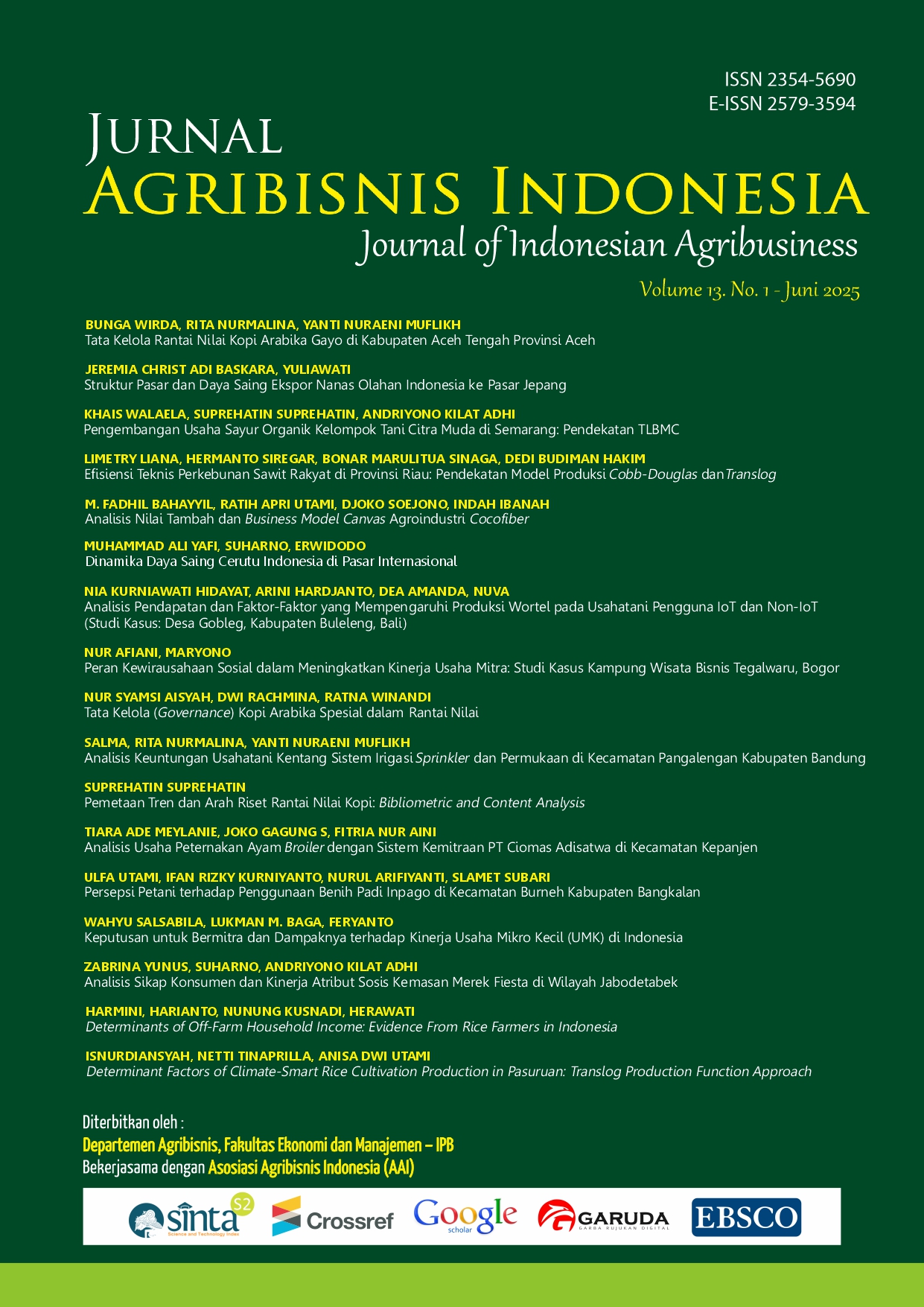
Determinants Of Off-Farm Household Income: Evidence From Rice Farmers In Indonesia
Article Sidebar
Main Article Content
Abstract
Most small-scale rice farming households in Indonesia face land ownership constraints that result in low on-farm income levels, often falling below the national poverty line. In such circumstances, off-farm income serves as a vital alternative source to meet household needs. This study aims to identify the key determinants of off-farm income among rice farming households in Indonesia using the two-step Heckman selection model to address potential sample selection bias. The analysis is based on household survey data collected in 2016 by the Ministry of Agriculture of the Republic of Indonesia, comprising 321 farming households across 14 major rice-producing districts. The estimation results indicate that off-farm income is significantly influenced by macro-level factors, such as the proportion of non-agricultural labor in the district and geographical proximity to economic centers. At the micro level, the number of working household members and the educational attainment of the household head are positively associated with off-farm income. Conversely, limited access to land and low levels of non-labor income serve as push factors driving participation in low-productivity off-farm activities. The findings suggest that policy interventions should focus on promoting the development of non-agricultural industries in rural areas and improving farmers' access to education and vocational training in order to enhance income diversification and strengthen the economic resilience of farming households.
Article Details
Section
Jurnal Agribisnis Indonesia (JAI) is an Open Access Journal. The authors who publish the manuscript in this journal agree to the following terms:
Creative Commons License
JAI is licensed under a Creative Commons Attribution 4.0 International License. This permits anyone to copy, redistribute, remix, transmit, and adapt the work provided the original work and source are appropriately cited.
This means:
(1) Under the CC-BY license, authors retain ownership of the copyright for their article, but authors grant others permission to use the content of publications in Jurnal Agribisnis Indonesia in whole or in part provided that the original work is properly cited. Users (redistributors) of JAI are required to cite the original source, including the author's name, JAI as the initial source of publication, year of publication, volume number, issue, and Digital Object Identifier (DOI); (2) Authors grant JAI the right of first publication. Although authors remain the copyright owner.
How to Cite
References
Aggarwal, S., Aker, J., Jeong, D., Kumar, N., & Spearot, A. (2024). The Dynamic Effects of Cash Transfers to Agricultural Households. Social Science Research Network. https://doi.org/10.2139/ssrn.4826038 DOI: https://doi.org/10.3386/w32431
Anang, B. T., & Yeboah, R. W. N. (2019). Determinants of Off-Farm Income among Smallholder Rice Farmers in Northern Ghana: Application of a Double-Hurdle Model. Advances in Agriculture, 2019. https://doi.org/10.1155/2019/7246176 DOI: https://doi.org/10.1155/2019/7246176
Beegle, K., Honorati, M., & Monsalve, E. (2018). Reaching the Poor and Vulnerable in Africa Through Social Safety Nets. Realizing the Full Potential of Social Safety Nets in Africa, 49–86. https://doi.org/10.1596/978-1-4648-1164-7_ch1 DOI: https://doi.org/10.1596/978-1-4648-1164-7_ch1
De Janvry, A., & Sadoulet, E. (2001). Income strategies among rural households in Mexico: The role of off-farm activities. World Development, 29(3), 467–480. https://doi.org/10.1016/S0305-750X(00)00113-3 DOI: https://doi.org/10.1016/S0305-750X(00)00113-3
Greene, B. E. B. W. (2012). Technical Efficiency Analysis Correcting for Biases from Observed and Unobserved Variables : An Application to a Natural Resource Management Project. (May 2014). https://doi.org/10.1007/s00181-011-0491-y DOI: https://doi.org/10.1007/s00181-011-0491-y
Greene, W. H. (2012). Seventh edition: Econometric analysis, International edition. Pearson Education Limited.
Grimm, Michael; Hartwig, Renate; Reitmann, Ann-Kristin; Bocoum, F. . (2020). Can informal redistribution withstand formal safety nets? Insights from urban-rural transfers in Burkina Faso. Retrieved from http://hdl.handle.net/10419/224947
Haile, D., Seyoum, A., & Azmeraw, A. (2021). Does building the resilience of rural households reduce multidimensional poverty? Analysis of panel data in Ethiopia. Scientific African, 12, e00788. https://doi.org/10.1016/j.sciaf.2021.e00788 DOI: https://doi.org/10.1016/j.sciaf.2021.e00788
Heckman, J. J. (1979). Sample Selection Bias as a Specification Error. Econometrica, 47(1). DOI: https://doi.org/10.2307/1912352
Huang, Q., Zheng, X., & Wang, R. (2022). The Impact of the Accessibility of Transportation Infrastructure on the Non-Farm Employment Choices of Rural Laborers: Empirical Analysis Based on China’s Micro Data. Land, 11(6). https://doi.org/10.3390/land11060896 DOI: https://doi.org/10.3390/land11060896
Imai, K. S., Gaiha, R., & Thapa, G. (2015). Does non-farm sector employment reduce rural poverty and vulnerability? Evidence from Vietnam and India. Journal of Asian Economics, 36, 47–61. https://doi.org/10.1016/j.asieco.2015.01.001 DOI: https://doi.org/10.1016/j.asieco.2015.01.001
Iqbal, M. A., Rizwan, M., Abbas, A., Makhdum, M. S. A., Kousar, R., Nazam, M., … Nadeem, N. (2021). A quest for livelihood sustainability? Patterns, motives and determinants of non-farm income diversification among agricultural households in punjab, pakistan. Sustainability (Switzerland), 13(16), 1–14. https://doi.org/10.3390/su13169084 DOI: https://doi.org/10.3390/su13169084
Kirui, O. K., & Kozicka, M. (2018). Vocational Education and Training for Farmers and Other Actors in the Agri-Food Value Chain in Africa. ZEP Working Paper Series, No. 164. Retrieved from http://hdl.handle.net/10419/187470 DOI: https://doi.org/10.2139/ssrn.3206514
Lewis, W. A. (1954). Economic Development with Unlimited Supplies of Labour. The Manchester School, 22(2), 139–191. https://doi.org/10.20430/ete.v91i364.2522 DOI: https://doi.org/10.1111/j.1467-9957.1954.tb00021.x
Mebrate, E., Reddy, O. C., Alemayehu, E., & Derbie, M. (2019). Bayesian Multilevel Model on determinants of off-Farm Income Diversification in Assosa Woreda, Benishangul Gumuz , Ethiopia. International Journal of Basic and Applied Sciences, 9(1), 7–13. Retrieved from www.crdeepjournal.org
Mishra, A. K., & Khanal, A. R. (2017). Assessing food security in rural Bangladesh: The role of a nonfarm economy. Frontiers of Economics and Globalization, 17, 241–257. https://doi.org/10.1108/S1574-871520170000017016 DOI: https://doi.org/10.1108/S1574-871520170000017016
Nengah, S. I., Ketut, S. I., Wayan, S. I., Utama, S., & Made, I. (2016). Effect of Social Capital, Community Participation, and Performance of Indigenous Community Financial Institutions for Rural Development in the Province of Bali.
Journal of Economics and Sustainable Development Www.Iiste.Org ISSN, 7(20), 22–30. Retrieved from www.iiste.org
Ngo, Q.-T. (2018). WIDER Working Paper 2018/154: Individual-level employment transitions in rural Viet Nam. (December). Retrieved from https://doi.org/10.35188/UNU-WIDER/2018/596-1 DOI: https://doi.org/10.35188/UNU-WIDER/2018/596-1
Peacock, E. A. (2012). The Authentic Village and the Modern City : The Space-Time of Class Identities in Urban Western Ukraine. 30(1), 213–236.
Rantšo, T. A. (2016). The role of the non-farm sector in rural development in Lesotho. Journal of Modern African Studies, 54(2), 317–338. https://doi.org/10.1017/S0022278X16000197 DOI: https://doi.org/10.1017/S0022278X16000197
Sauer, J., Gorton, M., & Davidova, S. (2015). Migration and farm technical efficiency: Evidence from Kosovo. Agricultural Economics (United Kingdom), 46(5), 629–641. https://doi.org/10.1111/agec.12159 DOI: https://doi.org/10.1111/agec.12159
Shavkat Hasanov, G. S. (2018). Non-farm employment trends and policy in rural areas of Samarkand region (Uzbekistan). (176). Retrieved from www.iamo.de/en
Sheng, Y., Zhao, Y., Zhang, Q., Dong, W., & Huang, J. (2022). Boosting rural labor off-farm employment through urban expansion in China. World Development, 151, 105727. https://doi.org/10.1016/j.worlddev.2021.105727 DOI: https://doi.org/10.1016/j.worlddev.2021.105727
Statistics Indonesia. (2018). The Result of Inter-Cencus Agricultural Survey 2018. Retrieved January 13, 2020, from Jakarta: BPS -Statistics Indonesia website: https://journals.sagepub.com/doi/10.1177/2233865913475434
Susilowati, S. H., & Maulana, M. (2012). Luas Lahan Usaha Tani dan Kesejateraan Petani: Eksistensi Petani Gurem dan Urgensi Kebijakan Reforma Agraria. Analisis Kebijakan Pertanian, 10(1), 17. https://doi.org/10.21082/akp.v10n1.2012.17-30 DOI: https://doi.org/10.21082/akp.v10n1.2012.17-30
Tadesse, S. (2022). Livelihood Diversification and Its Impact on Household Food Security among Farming Households in Kalu Wereda, South Wollo, Ethiopia. Journal of Economics and Sustainable Development, 13(5), 17–24. https://doi.org/10.7176/jesd/13-5-03 DOI: https://doi.org/10.7176/JESD/13-5-03
Wadley, D. (2021). Technology, capital substitution and labor dynamics: global workforce disruption in the 21st century? Futures, 132(November 2020), 102802. https://doi.org/10.1016/j.futures.2021.102802 DOI: https://doi.org/10.1016/j.futures.2021.102802
Yang, J., Wang, H., Jin, S., Chen, K., Riedinger, J., & Peng, C. (2016). Migration, local off-farm employment, and agricultural production efficiency: evidence from China. Journal of Productivity Analysis, 45(3), 247–259. https://doi.org/10.1007/s11123-015-0464-9 DOI: https://doi.org/10.1007/s11123-015-0464-9