
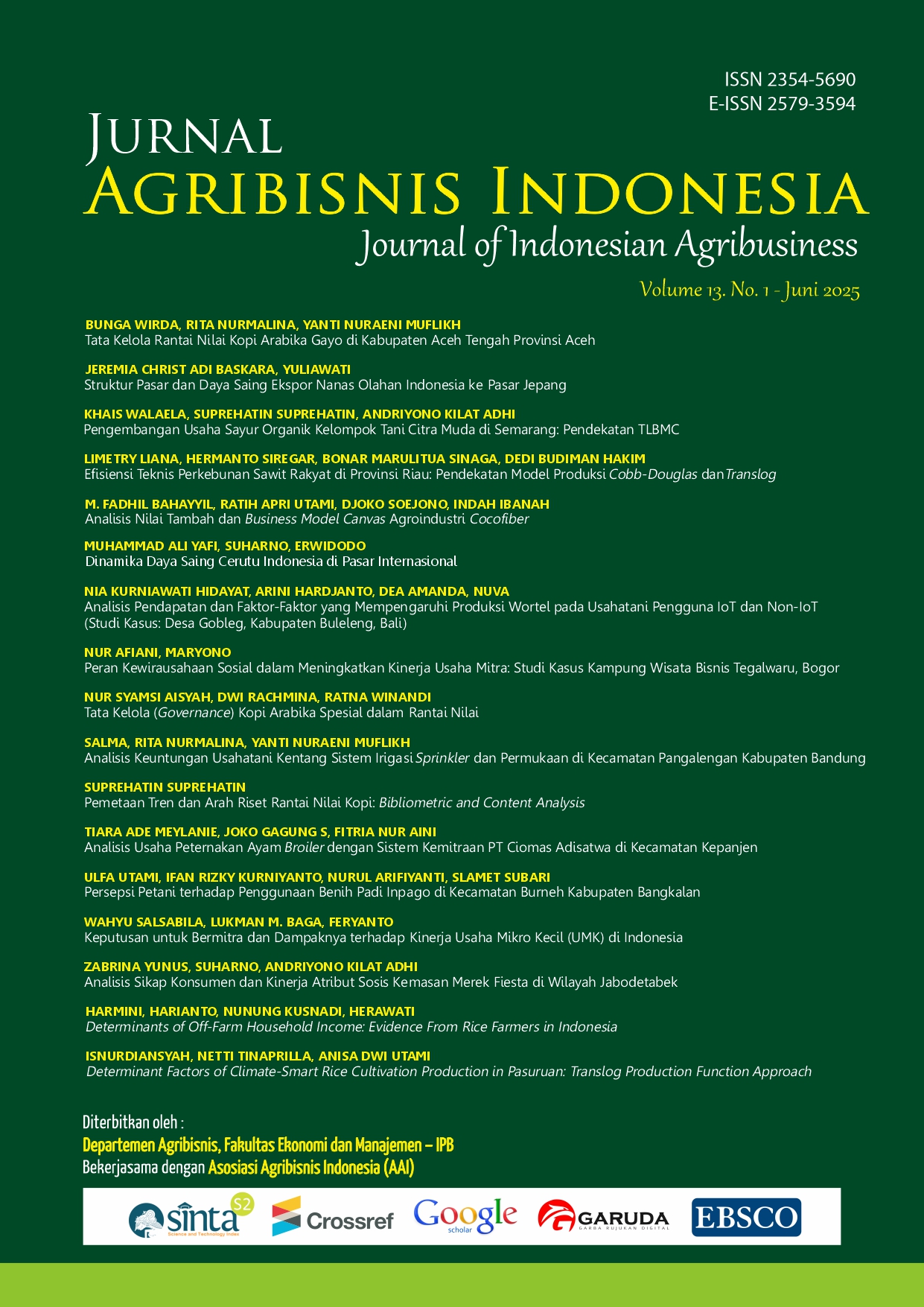
Struktur Pasar dan Daya Saing Ekspor Nanas Olahan Indonesia ke Pasar Jepang
Article Sidebar
Main Article Content
Abstract
Japan is an export destination for processed pineapple with great potential. This can be seen from the high demand for this tropical commodity in the Japanese market. Although the Indonesia-Japan Economic Partnership Agreement (IJEPA) should open up greater opportunities for processed pineapple exports, Indonesia has not optimally utilized it. This is reflected in the fluctuating trend of Indonesia's processed pineapple exports, which have tended to decline in recent years. In addition, the dominance of other countries such as the Philippines and Thailand has caused Indonesia to only act as a market follower. This study aims to identify the market structure and analyze the competitiveness of Indonesian processed pineapple exports in the Japanese market compared to the Philippines, Thailand, and Malaysia. Market structure analysis was conducted using Concentration Ratio (CR4) and Herfindahl-Hirschman Index (HHI). Meanwhile, competitiveness was analyzed by Revealed Comparative Advantage (RCA), Export Product Dynamic (EPD), and Index of Trade Specialization (ISP). The results showed that the market structure of processed pineapple in Japan is oligopolistic with high concentration. Indonesian processed pineapple has a comparative advantage in the Japanese market with an average RCA value of 6.43. On the other hand, there is a competitive advantage possessed by Indonesian processed pineapple, but less dynamic shown in the Falling Star category. In addition, the results of the ISP analysis show that Indonesia is a processed pineapple exporting country in the international market.
Article Details
Section
Jurnal Agribisnis Indonesia (JAI) is an Open Access Journal. The authors who publish the manuscript in this journal agree to the following terms:
Creative Commons License
JAI is licensed under a Creative Commons Attribution 4.0 International License. This permits anyone to copy, redistribute, remix, transmit, and adapt the work provided the original work and source are appropriately cited.
This means:
(1) Under the CC-BY license, authors retain ownership of the copyright for their article, but authors grant others permission to use the content of publications in Jurnal Agribisnis Indonesia in whole or in part provided that the original work is properly cited. Users (redistributors) of JAI are required to cite the original source, including the author's name, JAI as the initial source of publication, year of publication, volume number, issue, and Digital Object Identifier (DOI); (2) Authors grant JAI the right of first publication. Although authors remain the copyright owner.
How to Cite
References
Ahmadi, N. R., Mardiharini, M., & Indrawanto, C. (2021). Pineapple Farmer Corporation Development Strategy in Central Lampung District, Indonesia. E3S Web of Conferences (Vol 306, p. 02055). https://doi.org/10.1051/e3sconf/202130602055 DOI: https://doi.org/10.1051/e3sconf/202130602055
Ardiyanti, S. T. (2015). Dampak Perjanjian Perdagangan Indonesia-Jepang (IJEPA) Terhadap Kinerja Perdagangan Bilateral. Buletin Ilmiah Litbang Perdagangan, 9(2), 129–152. https://doi.org/https://doi.org/10.30908/bilp.v9i2.5 DOI: https://doi.org/10.30908/bilp.v9i2.5
Aurelia, R., Kurniati, D., & Hutajulu, P. J. (2022). Daya Saing Ekspor Pisang Indonesia di Negara Tujuan Ekspor Periode 2000-2019. Jurnal Agribisnis Indonesia (Journal of Indonesian Agribusiness), 10(2), 335–349. https://doi.org/https://doi.org/10.29244/jai.2022.10.2.335-349 DOI: https://doi.org/10.29244/jai.2022.10.2.335-349
Ballasa, B. (1965). Trade Liberalisation and Revealed Comparative Advantage. The Manchester School of Economic and Social Studies, 33(2), 99–123. https://doi.org/https://doi.org/10.1111/j.1467-9957.1965.tb00050.x DOI: https://doi.org/10.1111/j.1467-9957.1965.tb00050.x
Basri, F., & Munandar, H. (2010). Dasar-dasar Ekonomi Internasional: Pengenalan dan Aplikasi Metode Kuantitatif. Jakarta: Kencana.
BPS. (2024). Produksi Tanaman Buah-buahan. https://www.bps.go.id/id/statistics-table/2/NjIjMg==/produksi-tanaman-buah-buahan.html. [8 April 2024].
Esterhuizen, D. (2006). Measuring and Analysing Competitiveness in the Agribusiness Sector: Methodological and Analytical Framework. University of Pretoria.
ITC Mac Map. (2025). Market Access Conditions. https://www.macmap.org/. [22 Maret 2025].
ITPC Osaka. (2018). Laporan Informasi Intelijen Bisnis - Nanas HS 0804. Osaka: ITPC Osaka.
Japan Customs. (2025). Japan’s Tariff Schedule as of January 1 2025. https://www.customs.go.jp/english/tariff/2025_01_01/index.htm. [22 Maret 2025].
Kemendag. (2022). Ekspor Produk Pangan Olahan ke Jepang. Lamansitu. https://lamansitu.kemendag.go.id/content/persyaratan-mutu-makanan-olahan-jepang. [22 Maret 2025].
Kementan. (2022). Analisis PDB Sektor Pertanian Tahun 2022. Jakarta: Pusdatin Sekretariat Jenderal Kementerian Pertanian.
Kementan. (2023). Outlook Komoditas Pertanian Subsektor Hortikultura Nenas. Jakarta: Pusdatin Sekretariat Jenderal Kementerian Pertanian.
Kurniawati, A. W., Handayani, S. M., & Riptanti, E. W. (2024). Analisis Struktur Pasar dan Daya Saing Ekspor Kayu Manis (Cinnamomum burmannii) Indonesia dalam Perdagangan Internasional. Jurnal Agristan, 6(1), 179–200. https://doi.org/https://doi.org/10.37058/agristan.v6i1.10492 DOI: https://doi.org/10.37058/agristan.v6i1.10492
Laine, C. R. (1995). The Herfindahl Hirschman index: A concentration measure taking the consumer’s point of view. The Antitrust Bulletin, 40(2), 423–432. https://doi.org/https://doi.org/10.1177/0003603X9504000206 DOI: https://doi.org/10.1177/0003603X9504000206
Latifah, Z., & Kadir, K. (2021). Performa Komoditas Minyak Sawit Indonesia Di Tataran Global: Mampukah Kita Menjadi Pemain Kunci? Jurnal Sosial Ekonomi Pertanian, 14(3), 250–268. https://doi.org/10.19184/jsep.v14i3.26550 DOI: https://doi.org/10.19184/jsep.v14i3.26550
Miar, M., & Batubara, K. (2019). Analisis Konsentrasi Rasio Industri Besar Dan Sedang Di Indonesia (Studi Empiris Pada Perusahaan Manufaktur Subsektor Makanan Dan Minuman Yang Terdaftar Di Bursa Efek Indonesia Periode 2013 -2017). Jembatan : Jurnal Ilmiah Manajemen, 16(2), 121–132. https://doi.org/10.29259/jmbt.v16i2.10754 DOI: https://doi.org/10.29259/jmbt.v16i2.10754
Noviandini, D., Hasnah, H., & Hariance, R. (2023). Faktor yang Mempengaruhi Volume Ekspor Nanas Kaleng Indonesia Ke Amerika. JOSETA: Journal of Socio-Economics on Tropical Agriculture, 5(1), 27–35. https://doi.org/10.25077/joseta.v5i1.455 DOI: https://doi.org/10.25077/joseta.v5i1.455
Nugroho, P., Firdaus, M., & Asmara, A. (2017). Pengaruh Standar Keamanan Pangan Terhadap Ekspor Produk Biofarmaka Indonesia. Jurnal Ekonomi Dan Kebijakan Pembangunan, 6(1), 41–57. https://doi.org/https://doi.org/10.29244/jekp.6.1.2017.41-57 DOI: https://doi.org/10.29244/jekp.6.1.41-57
Ohta, S. (2021). Consumer and Market Trends for Tropical Fruits in Japan. Proceeding of the 2021 International Symposium on Tropical Fruits (ISTF2021), 112–130.
Putro, F. A. D., Putri, L. A., & Prawira, G. (2024). Daya Saing dan Determinan Ekspor Kopi Indonesia Di Jepang. Jurnal Agribisnis Indonesia (Journal of Indonesian Agribusiness), 12(1), 27–36. https://doi.org/10.29244/jai.2024.12.1.27-36 DOI: https://doi.org/10.29244/jai.2024.12.1.27-36
Putro, F., & Hidayat, N. (2023). Ekspor Teh Hitam Indonesia ke Jepang: Struktur Pasar dan Daya Saing. Buletin Ilmiah Litbang Perdagangan, 17(2), 177–202. https://doi.org/10.55981/bilp.2023.227 DOI: https://doi.org/10.55981/bilp.2023.227
Safitri, V., & Kartiasih, F. (2019). Daya Saing dan Faktor-Faktor yang Mempengaruhi Ekspor Nanas Indonesia. Jurnal Hortikultura Indonesia, 10(1), 63–73. https://doi.org/10.29244/jhi.10.1.63-73 DOI: https://doi.org/10.29244/jhi.10.1.63-73
Santosa, E. P., Firdaus, M., & Novianti, T. (2016). Daya Saing Komoditas Holtikultura Negara Berkembang dan Negara Maju di Pasar Internasional. Jurnal Ekonomi Dan Kebijakan Pembangunan, 5(2), 68–86. https://doi.org/https://doi.org/10.29244/jekp.5.2.2016.68-86 DOI: https://doi.org/10.29244/jekp.5.2.68-86
Soni, K. (2024). Canned Pineapple Market is projected to reach USD 2.68 Billion by 2031, with a CAGR of 5.80%. Linkedin. https://www.linkedin.com/pulse/canned-pineapple-market-projected-reach-usd-268-billion-kritika-soni-fsfaf. [22 Maret 2025].
Sugiyono. (2013). Statistika untuk Penelitian. Yogyakarta: Alfabeta.
Suwandari, N. K. R. R., & Widanta, A. A. B. P. (2024). Analisis Pengaruh Non-Tariff Measures (Sanitary and Phytosanitary) Terhadap Volume Ekspor Ikan Tuna Ke Negara Tujuan Ekspor. E-Jurnal Ekonomi Dan Bisnis Universitas Udayana, 13(5), 1057–1069. https://doi.org/https://doi.org/10.24843/EEB.2024.v13.i05.p20 DOI: https://doi.org/10.24843/EEB.2024.v13.i05.p20
Thuy, N. T., Thao, T. D., Thuong, T. T., Khue, D. C., & Nghia, D. G. (2023). Fruit and Vegetable Consumer Preferences of Japanese and Vietnam’s Export Potential. VMOST Journal of Social Sciences and Humanities, 65(3), 21–30. https://doi.org/10.31276/vmostjossh.65(3).21-30 DOI: https://doi.org/10.31276/VMOSTJOSSH.65(3).21-30
Uchiyama, T., Sruamsiri, P., & Jarupanthu, C. (2011). Feasibility Study for Marketing Thai Fresh Pineapple in Japan: Analysis of Consumer Taste and Market Structure. Bulletin of the Graduate School of Bioresources, Mie Univ, 37, 19–30.
UN Comtrade. (2024). United Nations Commodity Trade Statistics Database. https://comtradeplus.un.org/TradeFlow. [8 April 2024].
Untoro, A. W., Waluyati, L. R., & Darwanto, D. H. (2021). Export Competitiveness of Indonesia Canned Pineapple in European Union Market. 1st International Conference on Sustainable Agricultural Socio-Economics, Agribusiness, and Rural Development (ICSASARD 2021), 53–59. https://doi.org/https://doi.org/10.2991/aebmr.k.211214.008
Venda, B. N. (2020). Pengaruh Struktur Modal Terhadap Daya Saing Pasar Produk. Jurnal Ilmiah Bisnis Dan Ekonomi Asia, 14(1), 65–73. https://doi.org/10.32812/jibeka.v14i1.157 DOI: https://doi.org/10.32812/jibeka.v14i1.157
Wiranthi, P. E., & Mubarok, F. (2017). Competitiveness and the Factors Affecting Export of the Indonesia Canned Pineapple in the World and the Destination Countries. 2nd International Conference on Sustainable Agriculture and Food Security: A Comprehensive Approach, KnE Life Sciences, 339–352. https://doi.org/10.18502/kls.v2i6.1056 DOI: https://doi.org/10.18502/kls.v2i6.1056
Yudha, E. P., & Rachmadina, V. (2023). Daya Saing Ekspor Komoditas Nanas Indonesia, Thailand, dan Filipina di Negara Tujuan Ekspor Utama. Prospek Agribisnis, 2(2), 414–433. DOI: https://doi.org/10.31959/jm.v12i2.1450
Zainal, S. M., Tarumun, S., & Tety, E. (2021). Analisis Daya Saing dan Faktor yang Mempengaruhi Ekspor Nenas Indonesia. Journal of Agribusiness and Community Empowerment (JACE), 4(2), 134–145. https://doi.org/10.32530/jace.v4i2.289 DOI: https://doi.org/10.32530/jace.v4i2.289
Zakariyah, M., Anindita, R., & Baladina, N. (2014). Analisis Daya Saing Teh Indonesia di Pasar Internasional. AGRIMETA: Jurnal Pertanian Berbasis Keseimbangan Ekosistem, 4(8), 29–37.