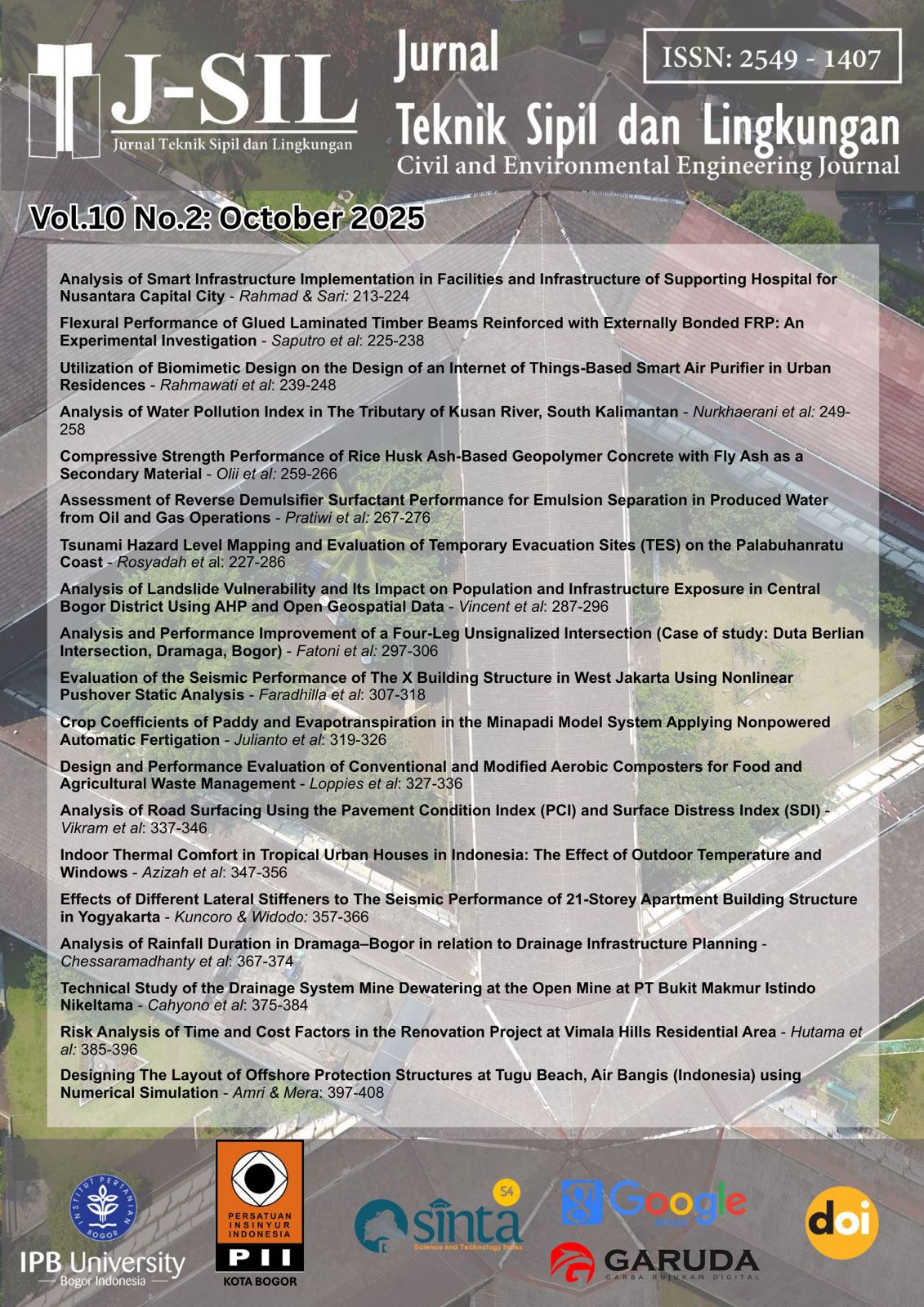
Tsunami Hazard Level Mapping and Evaluation of Temporary Evacuation Sites (TES) on the Palabuhanratu Coast
DOI:
https://doi.org/10.29244/jsil.10.2.227-286Kata Kunci:
evacuation route, hazard zone, TES, tsunamiAbstrak
Indonesia is highly prone to disasters due to its location at the convergence of three active tectonic plates: the Eurasian, Pacific, and Indo-Australian plates. Sukabumi Regency ranks as the second-highest risk area in the country. In the coastal region, Palabuhanratu Urban Village has the highest population density in Palabuhanratu District, reaching 6,042 people/km². The high population density in coastal areas increases the potential for casualties in the event of a tsunami. Therefore, mitigation efforts in the form of Temporary Evacuation Sites (TES) are essential across the coastal areas of Palabuhanratu District. A reassessment of the existing TES locations is necessary to evaluate their effectiveness. This study aims to identify the affected area and population under tsunami scenarios with run-up heights of 10 m, 15 m, and 20 m. Additionally, it analyzes the coverage of TES locations and the effectiveness of evacuation routes in Palabuhanratu District. The analysis is conducted using ArcGIS and QGIS software through several stages, including tsunami hazard zoning, tsunami inundation modeling, TES coverage analysis, and evacuation route optimization using network analyst tools. The results indicate that 90.6% of the coastal area in Palabuhanratu District falls into the safe category. The tsunami inundation modeling shows an affected area of 3.32 km² (run-up 10 m), 4.9 km² (run-up 15 m), and 6.1 km² (run-up 20 m). The estimated affected population for these run-up heights is 6,123, 9,348, and 12,849 people, respectively. On average, 68% of the affected population can reach a TES. A total of 68 evacuation routes were generated, with 30 routes classified as highly safe, safe, or moderate, requiring 0–20 minutes of travel time. The findings suggest that additional TES locations should be strategically placed along the coastal areas, particularly near residential zones, to improve evacuation efficiency.
Referensi
[1] Windupranata W, Hanifa NR, Nusantara CADS, Aristawati G, Arifianto MR. Analysis of tsunami hazard in the Southern Coast of West Java Province - Indonesia. IOP Conference Series: Earth and Environmental Science 2020; 618:012026. https://doi.org/10.1088/1755-1315/618/1/012026.
[2] BNPB. Indeks Risiko Bencana Indonesia Tahun 2023. vol. 02. 2024.
[3] BPS. Kecamatan Palabuhanratu Dalam Angka 2024 2024. https://sukabumikab.bps.go.id/id/publication/2024/09/26/a95c95d385a0825605e239d2/palabuhanratu-subdistrict-in-figures-2024.html (accessed March 25, 2025).
[4] Nugraha K, Somantri. Potential Tsunami Inundation Model Using UAV at Palangpang Beach, Ciletuh-Palabuhanratu Geopark, Sukabumi, Indonesia. International Journal of Geotourism Science and Development 2023;3:1–7. https://doi.org/10.58856/ijgsd.v3i1.24.
[5] Habibie MF. ANALISIS LOKASI SHELTER EVAKUASI TSUNAMI DI PELABUHAN RATU. 2022.
[6] Hamidah R, Mahlil T, Putriansyah C, Putri M, Prawiranegara M, Aufasani N, et al. Tsunami Evacuation Route Planning Research in Pelabuhan Ratu Village, Sukabumi Regency, EAI; 2023. https://doi.org/10.4108/eai.23-11-2022.2341572.
[7] BMKG. Pedoman Pelayanan Peringatan Dini Tsunami. Jakarta: 2013.
[8] Berryman K. Review of Tsunami Hazard and Risk in New Zealand. Lower Hutt: Institute of Geological & Nuclear Sciences; 2006.
[9] Ashar F, Amaratunga D, Haigh R. The Analysis of Tsunami Vertical Shelter in Padang City. Procedia Economics and Finance 2014;18:916–23. https://doi.org/10.1016/s2212-5671(14)01018-1.
[10] Hoppe MW, Spahn H. Panduan Pemetaan Bahaya Tsunami untuk Tingkat Kabupaten. Jakarta: GTZ International Service; 2009.
[11] Post J, Wegscheider S, Mück M, Zosseder K, Kiefl R, Steinmetz T, et al. Assessment of human immediate response capability related to tsunami threats in Indonesia at a sub-national scale. Natural Hazards and Earth System Sciences 2009;9:1075–86. https://doi.org/10.5194/nhess-9-1075-2009.
[12] Shabrina N, Ahmad D. Analisis Jalur Terdekat Menuju Bangunan Shelter Evakuasi Tsunami di Kota Padang Menggunakan Network Analyst. Jurnal Pendidikan Matematika 2023;1:13. https://doi.org/10.47134/ppm.v1i2.202.
[13] Isdianto A, Kurniasari D, Subagiyo A, Haykal MF, Supriyadi S. Pemetaan Kerentanan Tsunami untuk Mendukung Ketahanan Wilayah Pesisir. Jurnal Permukiman 2021;16:90. https://doi.org/10.31815/jp.2021.16.90-100.
[14] Zahro Q. KAJIAN SPASIAL RISIKO BENCANA TSUNAMI KABUPATEN SERANG, BANTEN. Jurnal Sains Dan Teknologi Mitigasi Bencana 2019;12:44–52. https://doi.org/10.29122/jstmb.v12i1.3699.
[15] Widiyantoro S, Gunawan E, Muhari A, Rawlinson N, Mori J, Hanifa NR, et al. Implications for megathrust earthquakes and tsunamis from seismic gaps south of Java Indonesia. Sci Rep 2020;10:15274–15274. https://doi.org/10.1038/s41598-020-72142-z.
[16] DISDUKCAPIL. Buku Profil Perkembangan Kependudukan Provinsi Jawa Barat. Jawa Barat: Dinas Kependudukan dan Pencatatan Sipil Provinsi Jawa Barat; 2023.
Unduhan
Diterbitkan
Terbitan
Bagian
Lisensi
Hak Cipta (c) 2025 Jurnal Teknik Sipil dan Lingkungan

Artikel ini berlisensi Creative Commons Attribution-NonCommercial-NoDerivatives 4.0 International License.
Authors who publish with Jurnal Teknik Sipil dan Lingkungan, JSIL agree to the following terms:
a. Authors retain copyright and grant the journal right of first publication with the work simultaneously licensed under a Creative Commons Attribution License that allows others to share the work with an acknowledgment of the work's authorship and initial publication in this journal.
b. Authors are able to enter into separate, additional contractual arrangements for the non-exclusive distribution of the journal's published version of the work (e.g., post it to an institutional repository or publish it in a book), with an acknowledgment of its initial publication in this journal.
c. Authors are permitted and encouraged to post their work online (e.g., in institutional repositories or on their website) prior to and during the submission process, as it can lead to productive exchanges, as well as earlier and greater citation of published work (See The Effect of Open Access).